In This Article
Here’s a strange fact: most of us childproof the stairs, fit a smoke alarm in the hallway, and fuss over kitchen worktop edges — then step onto a glass-smooth shower tray every single morning without a second thought. An anti-slip shower tray is a shower base manufactured or treated with a textured, high-friction surface designed to reduce the chance of slipping when the floor is wet and soapy; it’s tested against recognised standards rather than simply labelled “safe” by a marketing team. That distinction matters more than most bathroom buyers realise, because a smooth acrylic tray covered in a thin film of shampoo is one of the most reliably slippery surfaces in an average British home — and, according to RoSPA’s Falls Prevention Hub, falls of exactly this kind remain the leading cause of accidental injury inside UK homes.
I’ve spent the last few weeks pulling apart the specs, warranty documents, and aggregated customer sentiment behind the anti-slip shower tray options genuinely available to UK households in 2026 — not just the ones with the flashiest product photography. What follows is a properly researched, properly referenced look at seven real trays worth considering, how they stack up against each other, and the practical stuff — cleaning, installation snags, and who actually needs which type — that the average Amazon listing conveniently skips over.
Quick Comparison Table: Anti-Slip Shower Tray Types at a Glance
Not every anti-slip shower tray is built the same way, and the construction method has a real effect on how it feels underfoot, how easy it is to clean, and how long the anti-slip properties last. Before we get into individual products, here’s how the main categories compare.
| Tray Type | Typical Slip Rating | Feel Underfoot | Cleaning Difficulty | Best For |
|---|---|---|---|---|
| Stone resin (integrated texture) | DIN 51097 Class C | Slightly gritty, secure | Low-medium | Mira Flight Safe, Kudos Kstone, family bathrooms |
| Acrylic-capped ABS (moulded texture) | DIN 51097 Class C | Firm, consistent grip | Low | Aquadart, Merlyn Touchstone, budget-conscious buyers |
| Mineral casting / stone-feel | DIN 51097 Class C | Warm, natural texture | Low | Ideal Standard i.life Ultraflat S, barrier-free access |
| Steel enamel with anti-slip coating | DIN 51097 Class B–C | Smooth-looking, textured on contact | Very low | Bette BetteFlat, premium/luxury installs |
| Standard smooth tray + stick-on strips | Untested/variable | Rubbery ridges | High (mould traps) | Renters, temporary fixes only |
Looking at the table, the biggest practical takeaway is that permanently textured stone resin and mineral-casting trays currently dominate the genuinely tested end of the market, while stick-on strips and rubber mats — despite being the cheapest fix — sit in a different, largely unverified category entirely. If durability and certified performance matter more to you than upfront cost, an integrated anti-slip tray is worth the extra outlay over an add-on mat.
💬 Comparing options already? One click helps you check today’s prices on the trays below before they change!😊
Top 7 Anti-Slip Shower Trays: Expert Analysis
I’ve grouped these across budget, mid-range and premium price points, covering stone resin, acrylic-capped ABS, mineral casting and steel enamel construction, so there should be a sensible match here whether you’re renovating a tight en-suite or fitting out a family bathroom that three different generations will use.
1. Mira Flight Safe — best all-round choice for busy family bathrooms
The Flight Safe range is Mira’s dedicated anti-slip line, and it’s built specifically to answer the “will my kids and my parents both be safe in here” question. It’s manufactured from acrylic-capped resin stone with BioCote antimicrobial technology built into the surface, which Mira says has been shown to cut bacteria and mould growth on the tray by close to 99.9% — a genuinely useful spec for a surface that stays damp most of the day. Sizes run from compact 800 x 800mm trays up to expansive 1700 x 900mm formats, so it scales from an en-suite to a full family bathroom without switching brands.
Based on the spec comparison, what stands out here is that Mira didn’t bolt anti-slip texture onto an existing tray as an afterthought — the surface is independently tested and exceeds industry standards for slip resistance, putting it at DIN 51097 Class C, the highest classification available. This is the tray I’d point a parent of young children toward first, simply because it balances proven grip with a fairly gentle-looking texture rather than an aggressively rough finish. Reviewers on retailer sites consistently mention that the non-slip surface feels reassuring underfoot without feeling harsh on bare skin, and buyers frequently cite it as an upgrade from a previous glossy tray that felt genuinely risky when wet.
Pros:
- ✅ DIN 51097 Class C rating — highest available slip resistance
- ✅ BioCote antimicrobial surface fights mould and bacteria
- ✅ Wide size range covers en-suites through to large family bathrooms
Cons:
- ❌ Textured surfaces generally need slightly more scrubbing than gloss
- ❌ Premium sizes sit toward the higher end of the mid-range price band
At the time of research, prices for Mira Flight Safe sit broadly in the low-to-mid £300s for compact sizes, climbing toward £500-£600 for the largest rectangular formats — check current price before buying, since size and retailer both move the number significantly. Given the antimicrobial coating and Mira’s ten-year guarantee, it represents strong value for a family bathroom that gets daily heavy use.
2. AKW Contour Falcon 30 Slim — best for low-level, wheelchair-friendly access
AKW built its reputation on accessible bathroom design rather than shower trays in general, and the Contour Falcon 30 Slim reflects that heritage. Its anti-slip surface has been independently tested and rated “best in class” to DIN 51097:1992 Class C, the highest achievable classification for slip resistance, and at just 30mm high, it’s shallow enough for genuinely low-threshold, wheelchair-accessible installations. It can also be cut down by up to 300mm in length, which is a rare and genuinely handy feature if you’re retrofitting an awkward wet room rather than working with standard dimensions.
Here’s what most buyers overlook about this model: it isn’t just slip-tested, it’s also hygiene-tested, complying with ISO 22196:2011, the international standard for measuring antibacterial activity against MRSA on non-porous surfaces. That’s a fairly unusual level of certification for a shower tray, and it signals this range was engineered with care homes, assisted-living bathrooms, and multi-generational households specifically in mind, rather than purely for looks. If you’re specifying a wet room for an elderly relative or planning ahead for reduced mobility, this is the tray worth putting at the top of your shortlist.
Pros:
- ✅ Best-in-class DIN 51097 Class C slip rating, independently verified
- ✅ Cuttable to size for awkward or non-standard wet room layouts
- ✅ Additional ISO 22196 antibacterial certification
Cons:
- ❌ Accessible/wet-room specialist pricing sits above general DIY-market trays
- ❌ Ultra-low 30mm profile needs careful sub-floor preparation to install correctly
AKW’s accessible-market positioning generally puts the Falcon 30 Slim in the £300-£550 range depending on dimensions, and it’s worth noting this sits in the mid-to-premium segment because of the specialist testing rather than pure branding — check current price for your specific size before committing.
3. Kudos Kstone — best value British-made stone resin tray
Kudos Kstone trays are manufactured in the UK from ABS-capped stone resin, and the anti-slip variant swaps the standard high-gloss finish for a textured surface without changing the underlying construction. What most people miss when comparing shower trays on spec sheets alone is that the “capping” material matters as much as the anti-slip texture itself — Kudos uses a high-quality acrylic-capped ABS surface material for increased durability and longevity, supported by a resin-bonded stone filler for extra stability, which is why these trays tend to resist the yellowing and hairline cracking that cheaper pure-acrylic trays sometimes develop after a few years.
On paper, this puts Kudos Kstone in direct competition with Mira and Merlyn on construction quality, but at a noticeably friendlier price point — and it comes backed by a lifetime guarantee, which is a confident claim for a manufacturer to make on a bathroom fixture. Reviewers across UK bathroom retailers tend to flag the finish quality and rigidity as standout points, with the ABS-capped surface staying genuinely glossy (on the standard range) or reliably gritty (on the anti-slip range) rather than degrading with repeated cleaning.
Pros:
- ✅ UK-manufactured with a lifetime guarantee as standard
- ✅ Acrylic-capped ABS resists scratching, staining and yellowing
- ✅ Competitive pricing relative to comparable stone resin trays
Cons:
- ❌ Fewer ultra-large size options than Mira’s widest range
- ❌ Anti-slip texture variant not available across every single shape
Given the lifetime guarantee and UK manufacturing, Kudos Kstone trays typically land in the £180-£350 range across common rectangular and quadrant sizes at the time of research, making this one of the strongest value-for-money picks in this list — always confirm the current price for your exact dimensions.
4. Ideal Standard i.life Ultraflat S — best ultra-flat profile for barrier-free showers
Ideal Standard’s i.life Ultraflat S is built from mineral casting — a blend of natural dolomite and resins — rather than the acrylic-capped resin used by most competitors on this list, and it shows in the finish. The tray carries a Class C anti-slip rating, the top tier for this kind of surface, while sitting at a genuinely slim 30-35mm profile that Ideal Standard positions as accessible and family-friendly for households with reduced mobility. It can also be trimmed down on all four sides, so awkward reveals and non-standard enclosures aren’t automatically a dealbreaker.
What the spec sheet won’t necessarily tell you, but the material itself does, is that mineral casting has a naturally warmer, less clinical feel underfoot than moulded acrylic — reviewers consistently describe the matt sand texture surface as offering enhanced grip and comfort with a warm touch rather than the colder sensation typical of gloss acrylic. If you’re designing a genuinely barrier-free wet room — flush to the floor, no lip to trip over — this is one of the few trays on the market engineered specifically for that use case while still carrying full anti-slip certification.
Pros:
- ✅ DIN Class C anti-slip rating with a natural stone-feel texture
- ✅ Ultra-flat 30-35mm profile suited to flush, barrier-free installs
- ✅ Trimmable on all four sides for non-standard enclosures
Cons:
- ❌ Mineral casting trays are heavier than acrylic, complicating solo installs
- ❌ Antibacterial surface still needs regular cleaning, not a substitute for it
At the time of research, an 800 x 800mm Ideal Standard i.life Ultraflat S sits around the £260 mark at major UK retailers, with larger rectangular sizes moving into the £350-£450 bracket — prices may vary, so check current pricing on your chosen dimensions.
5. Merlyn Touchstone Slip Resistant — best natural-feel texture without harsh grip
Merlyn took a different design approach with Touchstone: rather than a visibly rough, obviously “safety” texture, the anti-slip properties are part of the acrylic-capped ABS surface itself rather than added as a separate coating, giving a matt white finish that the manufacturer describes as avoiding the harsh surface texture sometimes experienced in a slip-resistant finish. In independent testing it achieved Slip Resistance Values in wet conditions greater than the required 36 mark, and Class C for DIN 51097 in the barefoot ramp test — so despite the gentler feel, the certified performance is right up there with the grittier competition.
Here’s what I’d flag for anyone torn between “safe” and “comfortable”: this is precisely the trade-off Touchstone is trying to solve. Based on the spec comparison, it ranks in the premium performance bracket rather than settling for a token pass, while remaining genuinely pleasant to stand on barefoot — reviewers frequently note the surface feels warm and natural rather than abrasive, which matters if anyone in the household has sensitive skin or arthritis in their feet.
Pros:
- ✅ DIN Class C with an SRV above the 36 safety threshold
- ✅ Textured finish designed to feel gentle rather than gritty
- ✅ Anti-slip built into the surface, so it can’t wear away or peel off
Cons:
- ❌ Matt white is currently the main finish, limiting colour choice
- ❌ Sits toward the premium end for an acrylic-capped ABS tray
Depending on size, Merlyn Touchstone Slip Resistant trays generally run from around £280 for compact squares to £500-£650 for the largest 1700-1800mm rectangles, according to current UK retailer listings — as always, treat this as an indicative range rather than a fixed price.
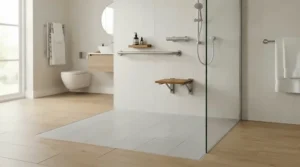
6. Aquadart Anti-Slip Stone Resin Tray — best budget-friendly lifetime-guarantee pick
Aquadart’s anti-slip stone resin range is aimed squarely at buyers who want certified performance without paying a premium-brand markup. The anti-slip surface is formed directly into the shower tray at the time of manufacture, ensuring it never wears away and will last as long as the tray itself, and the company states it’s been independently tested to Class C, the highest industry standard, offering twice the bathroom industry standard of slip resistance. That “formed in, not applied on top” construction detail is worth paying attention to, because coatings that sit on top of a surface are the ones most likely to wear thin over years of scrubbing.
What most buyers overlook about budget-positioned trays like this one is that “budget” doesn’t automatically mean “compromised” — Aquadart backs the range with a lifetime guarantee, matching the confidence shown by considerably pricier competitors. The trade-off tends to be a slightly more limited shape and finish selection compared with Mira or Merlyn, but for a straightforward rectangular or square family bathroom tray, it’s hard to fault the value proposition here.
Pros:
- ✅ Anti-slip texture is moulded in, so it can’t peel or wear off
- ✅ Certified Class C — twice the standard bathroom industry benchmark
- ✅ Backed by a lifetime guarantee at a genuinely budget price point
Cons:
- ❌ Narrower range of shapes and colour finishes than premium brands
- ❌ Fewer accessibility-specific low-profile variants available
Expect Aquadart Anti-Slip Stone Resin Tray pricing to sit broadly in the £130-£300 range for the most common sizes at the time of research, making it one of the most accessible entry points into certified Class C slip resistance — check current price for exact dimensions.
7. Bette BetteFlat Anti-Slip Sense — best premium steel-enamel finish
Bette’s approach is entirely different from the stone resin and acrylic-capped trays above: BetteFlat is made from titanium-steel with a glazed enamel finish, and the anti-slip treatment — BetteAntirutsch Sense — is engineered to be almost invisible. Bette’s own explanation is that the grip lives at a microscopic level within the enamel, staying dormant until body weight and water combine underfoot — so a dry BetteFlat tray looks and feels exactly like a standard glossy model, and the safety only becomes apparent in use. It’s been independently assessed by TÜV Rheinland to the top DIN 51097 rating group C, and the enamel finish carries a 30-year warranty.
What the spec sheet won’t tell you outright is why this matters for design-led bathrooms: most anti-slip trays announce themselves visually, with a speckled or matt texture that’s obviously “the safety one.” BetteFlat doesn’t — it looks like any other glossy steel-enamel tray until you’re actually standing on it wet, which is precisely why it turns up so often in architect-specified and high-end hotel bathrooms where slip resistance can’t be allowed to compromise the aesthetic. That invisibility is the whole point, and it comes at a genuinely premium price to match the premium materials.
Pros:
- ✅ Anti-slip texture is invisible when dry — no compromise on looks
- ✅ Top DIN 51097 Class C rating, independently TÜV-tested
- ✅ Titanium-steel enamel backed by a 30-year warranty
Cons:
- ❌ Considerably more expensive than stone resin or acrylic-capped trays
- ❌ Steel enamel trays are heavier and typically need professional fitting
At the time of research, Bette BetteFlat Anti-Slip Sense pricing generally starts around £600-£700 for compact sizes and climbs well past £1,000 for larger formats — this sits firmly in premium territory, so weigh the invisible-safety design against your actual budget before committing, and always check the current price.
Practical Usage Guide: Setting Up and Cleaning Anti-Slip Surfaces
Buying the right tray solves half the problem; installing and maintaining it correctly solves the rest. A textured anti-slip surface behaves differently from glossy acrylic in ways that catch a lot of first-time buyers out during the first month of use.
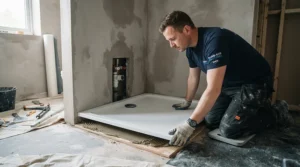
On installation, the single most common mistake is skipping a proper sub-floor level check, particularly with ultra-low-profile trays like the AKW Falcon 30 Slim or Ideal Standard Ultraflat S — even a few millimetres of unevenness can create a “wobble point” that stresses the sealant and eventually lets water track underneath. Give the tray 24-48 hours to fully bed into adhesive before resealing the edges, and always use a flexible sanitary sealant rather than rigid grout at the tray-to-wall junction, since trays flex fractionally under weight.
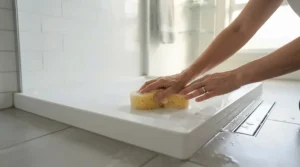
For cleaning anti-slip surfaces specifically, avoid abrasive scourers and harsh descaling chemicals, which can gradually wear down a textured or micro-etched finish faster than a smooth one — most manufacturer guidance, including Merlyn’s own care instructions, recommends hot soapy water and a soft cloth or soft brush, with scourers, abrasives and hydrochloric-acid-based cleaners specifically avoided because they can discolour or degrade the surface. A weekly wipe-down with a soft-bristled brush gets into the texture grooves far more effectively than a flat cloth, and it’s worth doing this before limescale has a chance to bond to the surface rather than after.
Real-World Scenarios: Matching a Tray to Your Household
Specs only tell half the story — how a tray performs depends heavily on who’s actually using it. Here are three genuinely common household profiles and the reasoning behind matching them to a tray type.
The family with young children and one on the way. If you’re renovating a family bathroom that toddlers will be standing (and inevitably jumping) in for the next decade, prioritise a mid-profile stone resin tray with Class C certification and a gentle rather than aggressive texture — the Mira Flight Safe or Merlyn Touchstone both fit this brief well, since neither feels harsh on small bare feet while both deliver top-tier certified grip.
The household planning ahead for an ageing parent moving in. Where mobility, a wheelchair, or a wet-room conversion is on the horizon, the ultra-low-profile, cuttable-to-size options matter more than aesthetics — the AKW Contour Falcon 30 Slim and Ideal Standard i.life Ultraflat S were both specifically engineered around accessible, barrier-free installation, and their additional hygiene certifications are a genuine bonus in a bathroom that may see more frequent use by a vulnerable user.
The renovator working to a tight budget on a rental or first home. If certified slip resistance matters but the budget is genuinely constrained, the Aquadart Anti-Slip Stone Resin Tray or Kudos Kstone deliver the same Class C rating as far pricier trays, just with a narrower range of shapes and finishes — a sensible trade-off if the tray itself, not the aesthetic variety, is the priority.
Problem → Solution: Common Anti-Slip Shower Tray Issues
Even a well-chosen anti-slip tray can throw up a few predictable snags. Here’s how to deal with the ones that come up most often.
Problem: Limescale building up faster in the texture grooves than it did on a smooth tray. Textured surfaces have more surface area for mineral deposits to cling to, especially in hard-water areas. Solution: a weekly soft-brush clean rather than an occasional deep clean prevents the build-up from ever becoming stubborn, and a squeegee pass after each shower dramatically slows limescale formation.
Problem: The anti-slip texture feels less effective after a year or two of heavy use. This is more common with add-on coatings than with trays like Mira Flight Safe or Aquadart, where the texture is moulded into the material itself rather than applied as a surface layer. Solution: if you’ve opted for an aftermarket anti-slip coating rather than an integrated tray, expect to reapply it periodically, and check the manufacturer’s recommended reapplication interval before you buy.
Problem: A textured surface is genuinely harder to clean than a smooth gloss tray. This trade-off is real, not imaginary — but it’s manageable. Solution: choosing a tray like Merlyn Touchstone, engineered specifically for a gentler, less aggressive texture, narrows the gap considerably without sacrificing the DIN Class C rating.
Problem: A retrofitted stick-on anti-slip strip or coating has started peeling at the edges. Adhesive-based fixes are the most vulnerable to constant water exposure and foot traffic. Solution: this is usually the point at which replacing the tray with a genuinely integrated anti-slip model becomes more cost-effective than repeatedly reapplying a temporary fix.
How to Choose an Anti-Slip Shower Tray
Picking the right anti-slip shower tray comes down to a handful of decisions that genuinely affect day-to-day safety and satisfaction, not just aesthetics. Here’s the order I’d work through them in.
- Check the slip rating first, not last. Look specifically for a DIN 51097 Class C rating — this is the barefoot wet-area standard, and it’s the single most meaningful safety spec on any tray’s data sheet.
- Match the profile height to your installation type. Ultra-low 30-35mm profiles like the AKW Falcon 30 Slim suit flush, barrier-free wet rooms; standard 40-50mm trays suit conventional raised installations.
- Decide between integrated texture and applied coating. A texture moulded into the material during manufacture, as with Aquadart or Mira, won’t wear away; an applied coating may need periodic reapplication.
- Think about who’s actually using the bathroom. Young children and older or less mobile household members benefit most from a gentler, non-abrasive texture alongside the certified grip.
- Factor in cleaning realities, not just install-day looks. A textured surface needs a soft brush and weekly attention rather than an occasional wipe — budget the extra five minutes into your routine.
- Compare the guarantee length, not just the headline price. Lifetime and ten-year guarantees, common on stone resin trays, are a reasonable proxy for how confident the manufacturer is in long-term surface durability.
- Confirm the waste and shape compatibility with your existing enclosure. Anti-slip trays are available in the same shapes and waste configurations as standard trays, so this shouldn’t force a compromise on style.
Anti-Slip Shower Tray vs Standard Shower Tray
The core difference is straightforward: an anti-slip tray is built with a specific texture, coating or moulded finish whose job is to boost underfoot grip, while a standard tray’s surface — smooth or otherwise — was never engineered with that goal in mind. Beyond that headline distinction, though, the practical differences ripple through the whole ownership experience.
A standard gloss tray typically looks sleeker on install day and is marginally easier to wipe clean of soap scum, since there’s no texture for residue to catch in. But that same smoothness is precisely what makes it risky the moment shampoo, conditioner or plain soap hits the surface — friction drops sharply, and it drops fastest for bare feet, which is exactly the scenario a shower creates every single day. An anti-slip tray trades a small amount of that gloss-day sheen and a few extra minutes of weekly cleaning for a measurably lower chance of a slip, particularly for children, older users, or anyone showering half-asleep before work. NHS guidance on preventing falls specifically lists simple home changes like this as one of the most effective, low-effort ways to cut everyday risk.
Cost-wise, the gap has narrowed considerably in recent years; most major manufacturers now sell an anti-slip version alongside the standard version of practically every shape, size and profile they make, so you’re rarely choosing between “the nice one” and “the safe one” anymore — the anti-slip premium is usually a modest add-on rather than a different product tier entirely.
Tray Surface Texture Explained: Which Anti-Slip Finish Feels Right
Not all anti-slip textures feel the same underfoot, and this is genuinely worth testing (or at least researching carefully) before you commit, since you’ll be standing on this surface barefoot every day. Broadly, three texture styles dominate the current UK market.
Micro-etched textures, used on trays like Bette’s BetteAntirutsch Sense, are designed to be invisible and smooth-feeling when dry, with the friction effect only activating under wet, weight-bearing contact. These suit design-conscious bathrooms where a visibly “safety” texture would clash with a minimalist aesthetic.
Moulded fine-grain textures, seen on Merlyn Touchstone and Ideal Standard’s mineral-casting range, sit between invisible and obviously gritty — noticeable to the touch but not abrasive, and generally the most comfortable option for households with sensitive feet, arthritis, or young children who dislike rough sensations.
Pronounced stone-resin textures, typical of Mira Flight Safe, Kudos Kstone and Aquadart, offer the most immediately obvious grip and tend to be the most forgiving in terms of certified performance-to-price ratio, at the cost of needing slightly more attention when cleaning. If you’ve ever stood on wet pool-surround tiles and noticed the grainy, secure feeling underfoot, this is the closest domestic equivalent.

Anti-Slip Tray Coatings vs Integrated Anti-Slip Trays
If you already have a shower tray you like and simply want to improve its grip, an aftermarket anti-slip coating is the cheaper route — but it’s worth understanding exactly what you’re trading off against buying an integrated anti-slip tray outright.
A coating, brushed or rolled onto an existing acrylic or fibreglass surface, sits on top of the material rather than being formed into it. It can meaningfully improve grip in the short-to-medium term, but because it’s a surface layer subjected to daily foot traffic, cleaning chemicals and standing water, it’s inherently more prone to gradual wear than texture that’s moulded into the tray itself during manufacture — the kind used by Aquadart and Mira Flight Safe. Coatings also generally lack the independent DIN 51097 certification that integrated trays carry, so you’re relying on manufacturer claims rather than third-party lab testing.
| Approach | Upfront Cost | Certified Testing | Expected Lifespan | Best For |
|---|---|---|---|---|
| Aftermarket coating | Low | Rarely independently certified | 1-3 years before reapplication | Renters, quick fixes, tight budgets |
| Stick-on anti-slip strips | Very low | Untested/variable | Months, replaced regularly | Temporary or short-term use |
| Integrated anti-slip tray | Medium-high | DIN 51097 Class C (most brands) | Lifetime of the tray | Anyone doing a proper bathroom renovation |
Looking at the table, the honest takeaway is that a coating or stick-on strip genuinely earns its place for renters or anyone needing a fast, low-cost fix before a bigger renovation — but for a permanent family bathroom, an integrated anti-slip tray like Kudos Kstone or Ideal Standard i.life Ultraflat S delivers certified, long-term performance that a surface-level add-on simply can’t match over a ten-year ownership window.
Anti-Slip Shower Trays for Family Bathrooms: Safety for Every Age
This is where the case for an anti-slip shower tray stops being theoretical and starts being genuinely urgent. In 2023 alone, falls of all kinds sent close to 450,000 people in England to A&E, and bathrooms are consistently flagged by occupational therapists as one of the highest-risk rooms in the house, precisely because they combine hard surfaces, standing water, and the specific vulnerability of being barefoot.
The good news is that a family bathroom is exactly the environment where an anti-slip shower tray earns its keep fastest. Toddlers learning to stand and wash themselves, teenagers rushing through a shower before school, and older relatives visiting or living with the family all share one thing in common: none of them are paying attention to foot placement the way an adult carefully stepping onto a known-slippery surface would. A certified anti-slip tray works passively, every single day, without anyone needing to remember to be careful — which matters, because relying on memory and caution alone is a fragile safety strategy in a busy household.
For multi-generational households in particular, a tray like the Mira Flight Safe or AKW Contour Falcon 30 Slim offers something a stick-on mat never can: consistent, tested performance regardless of who’s using the bathroom or how carefully they’re paying attention that morning.
Common Mistakes When Buying an Anti-Slip Shower Tray
Even careful buyers trip up on a handful of predictable errors when choosing an anti-slip shower tray — here’s what to watch for.
Assuming “textured” automatically means “certified.” Plenty of budget trays describe themselves as anti-slip or textured without citing any independent test standard. Always look specifically for a DIN 51097 rating (or equivalent) rather than taking marketing language at face value.
Choosing purely on price without checking the profile height. A cheap tray that’s too deep for a planned flush installation, or too shallow for your existing waste plumbing, becomes an expensive mistake once fitting costs are added. Confirm compatibility with your existing shower enclosure and waste position before ordering.
Overlooking the practical cleaning commitment. A textured surface genuinely needs more regular attention than a smooth one — buyers who skip this consideration sometimes end up disappointed by limescale build-up that a quick wipe won’t shift.
Forgetting to check the guarantee terms. Guarantee length varies enormously across this market, from a handful of years to a genuine lifetime promise. A longer guarantee is a reasonable proxy for manufacturer confidence in the anti-slip surface’s durability, so it’s worth weighing alongside the sticker price.
Features That Actually Matter (And Those That Don’t)
With every manufacturer claiming their tray is “the safest,” it helps to separate genuinely meaningful specs from marketing padding.
What actually matters: an independently verified DIN 51097 Class C rating; whether the anti-slip texture is moulded into the material or applied as a surface coating; the length and terms of the manufacturer’s guarantee; and waste flow rate, since a slow-draining tray leaves standing water sitting on the anti-slip surface for longer, which is its own minor hazard.
What matters less than the marketing suggests: the exact colour or finish name (matt white performs the same whether it’s called “Arctic White” or “Pure White”); claimed weight capacity figures, since virtually every domestic tray on this list comfortably exceeds normal household use; and vague, uncertified phrases like “enhanced grip technology” that aren’t backed by a named testing standard — these should prompt a follow-up question to the retailer, not automatic trust.
Safety, Regulations and Compliance Guide
UK shower tray slip resistance is measured against the DIN 51097 standard, which specifically covers barefoot wet areas such as showers, swimming pool surrounds and changing rooms. Ratings run from Class A (lowest resistance) through to Class C (highest), and without a DIN rating, there’s genuinely no reliable way to verify the safety standard of a shower tray you’re specifying — a phrase like “non-slip” with no accompanying certification carries no real weight.
If you’re planning an accessible or barrier-free wet room, it’s also worth reviewing gov.uk’s Approved Document M guidance on access to and use of buildings, which covers level-access shower provisions and broader accessibility requirements relevant to bathroom design in England. This is particularly relevant if you’re planning ahead for a household member with reduced mobility, since it shapes recommended thresholds, clearances and fitting approaches around accessible shower installations.
For anyone specifically weighing up the health case for investment in home safety measures, it’s worth noting that falls prevention has become a recognised NHS and public health priority, with clinical guidance increasingly treating home modifications — including bathroom safety improvements — as a legitimate, cost-effective preventative measure rather than a lifestyle upgrade.
Frequently Asked Questions
❓ What is the best anti-slip shower tray for a family bathroom?
❓ Do anti-slip shower trays really work?
❓ Can you retrofit an anti-slip coating onto an existing shower tray?
❓ How do you clean a textured anti-slip shower tray?
❓ What DIN rating should I look for in an anti-slip shower tray?
Conclusion
If there’s one thing this comparison makes clear, it’s that “anti-slip shower tray” isn’t a single product category so much as a spectrum — from invisible micro-etched steel enamel at the premium end, through moulded stone resin in the mid-range, down to budget-friendly acrylic-capped trays that still carry the same top-tier DIN Class C certification as their pricier siblings. The right choice genuinely depends on who’s stepping into that shower every morning, not just on the headline price tag.
For most UK family bathrooms, I’d point people first toward Mira Flight Safe or Kudos Kstone — both deliver certified, moulded-in slip resistance without demanding a premium budget. If accessibility or ageing-in-place planning is part of the brief, the AKW Contour Falcon 30 Slim and Ideal Standard i.life Ultraflat S are purpose-built for exactly that. And if a design-led, invisible-safety finish matters more than price, Bette BetteFlat Anti-Slip Sense remains the standout premium option. Whichever you choose, prioritising a genuinely certified Class C rating over vague marketing language is the single decision most likely to actually keep your household safer, one ordinary Tuesday morning shower at a time.
Recommended for You
- Anti-Slip Shower Tray for Elderly: 7 Safest Picks (2026)
- Stone Resin Shower Tray Review: 7 Best UK Picks 2026
- Slimline vs Stone Resin Shower Tray: 7 Best UK Picks (2026)
Disclaimer: This article contains affiliate links. As an Amazon Associate, I earn from qualifying purchases. If you purchase products through these links, we may earn a small commission at no additional cost to you.
✨ Found this helpful? Share it with your friends! 💬🤗
