In This Article
Picture the scene. You’ve fitted a lovely rainfall head, picked a smart thermostatic valve, and turned the tap with the smugness of someone who watches a lot of DIY telly. Out comes a stream with all the vigour of a sleepy garden hose. If your home still has a loft tank and an airing-cupboard cylinder, the shower isn’t to blame. Gravity is: wonderful for apples, rubbish for water pressure. For most British homes with that set-up, the fix is a shower pump for low pressure.
Gravity-fed water systems are the most likely to suffer weak flow, as Mira’s guide to water pressure explains, and a pump is the usual remedy. But buying one isn’t a matter of grabbing the biggest number on the box. The right shower pump for gravity fed system installations depends on whether the pump is fed by gravity (positive head) or not (negative head), how generous your cold water tank is, and how much pressure and flow rate your shower really needs. A 3 bar shower pump sounds like the obvious winner until your mixer valve, pipework or loft tank starts having opinions.
This guide cuts through the noise. You’ll find seven real pumps from Salamander and Stuart Turner, analysed from published specifications and aggregated retailer review sentiment. There’s no pretend hands-on testing here, just spec sheets, review patterns and plumbing logic. After the products come practical guides, buying advice and a safety section. Prices are ranges only, so check current prices and confirm that any listing, including on amazon.co.uk, states compatibility with gravity-fed systems before you buy.
Quick Comparison Table: The Best Shower Pump for Low Pressure at a Glance
| Product | Closed-Head Pressure | Head Type | Price Range | Best For |
|---|---|---|---|---|
| Salamander CT50 Xtra | 1.5 bar | Positive | Entry level (check current price) | Older pipework, small tanks |
| Stuart Turner Showermate Standard S2.0 | 2.0 bar | Positive | Around £175-£250 | Compact single-shower boost |
| Salamander CT75 Xtra | 2.0 bar | Positive | Around £175-£250 | Best all-round value |
| Salamander CT Force 30 PT | 3.0 bar | Positive | Roughly £300-£600 | Rainfall heads, brass build |
| Stuart Turner Monsoon Standard S3.0 | 3.0 bar | Positive | Around £600-£700 | Quiet, premium bathrooms |
| Salamander CT Force 30 TU | 3.0 bar | Positive and negative | Roughly £430-£500 | Negative-head layouts |
| Salamander RP100TU | 3.0 bar | Positive and negative | Around £500-£550 | Multiple outlets, whole house |
Looking at the table, the CT75 Xtra and Showermate Standard S2.0 share a price bracket and a 2.0 bar rating, so the decision comes down to noise, hoses and warranty. The CT Force 30 PT is the cheapest way into brass-bodied 3 bar territory, but only if you have positive head. Anything involving negative head pushes you towards the CT Force 30 TU or RP100TU, and your budget upwards.
💬 Just one click — help others make better buying decisions too!😊
Top 7 Shower Pump for Low Pressure Picks: Expert Analysis
Every pump below is a real, currently listed model. The commentary is analysis of the specs and the review patterns, not borrowed experience.
1. Salamander CT50 Xtra — gentlest boost for modest loft tanks
Sometimes the smartest upgrade is the polite one. The Salamander CT50 Xtra is a compact, positive-head twin pump that nudges a weak shower upwards instead of hurling it across the bathroom.
It’s rated at 1.5 bar closed head, with a listed 1.4 bar at 8 litres a minute. That sounds modest, and it is, but retailer guidance notes that a 1.5 bar pump puts less strain on ageing pipework and smaller loft tanks. If your 15 mm pipes date from the Callaghan era, gentle is a feature. Like all CT Xtra pumps, it suits positive-head gravity-fed systems only, and the manufacturer warns it may not work in a negative-head set-up.
Based on the spec comparison, this is a one-shower, one-thermostatic-mixer pump for a standard handset. Expect a clear improvement over raw gravity, not a hotel monsoon. If a rainfall head is in your plans, step up a rung.
On reviews, I couldn’t verify a meaningful pool of independent feedback for this specific model, so treat it as a spec-led choice. Its bigger sibling, the CT75 Xtra, has a far better-documented track record.
Pros:
- ✅ Kind to older pipework and small tanks
- ✅ Twin impeller balances hot and cold feeds
- ✅ Compact enough for cramped airing cupboards
Cons:
- ❌ Positive head only, no negative-head fitting
- ❌ Too gentle for rainfall heads
Sitting at the entry end of Salamander’s range, it’s good value if your needs are modest. Check current price.
2. Stuart Turner Showermate Standard S2.0 — compact twin with four flexible hoses included
Stuart Turner’s Showermate Standard S2.0 is the sort of pump that arrives ready to work. Four 15 mm anti-vibration flexible hoses with isolation valves come in the box, which saves a trip to the plumbers’ merchant.
It delivers 2.0 bar closed head and 1.5 bar at 9 litres a minute, falling to 0.9 bar at 18 litres a minute. That drop-off is the real-world story: it’s happiest feeding one shower, not two outlets at once. Maximum flow is listed at 37 litres a minute, with a flow-switch sensitivity of 0.8 litres a minute, dry-run protection and a three-year warranty. It’s positive head only.
Here’s what the spec sheet won’t tell you, but reviewers hint at: noise. Listings quote roughly 53-57 dB(A) depending on variant, which is fine in an airing cupboard and less fine on a bedroom wall.
Review sentiment is mixed. Some buyers describe near-silent running, while one reviewer reported a loud pump a few months after the warranty ended. Sample sizes on retailer pages are modest, so weigh that lightly.
Pros:
- ✅ Four 15 mm hoses with isolation valves supplied
- ✅ Three-year warranty and WRAS approval
- ✅ Dry-run protection built in
Cons:
- ❌ Pressure drops noticeably at higher flows
- ❌ Some buyers report noise over time
At around £175-£250, it’s solid value for a single-shower boost.
3. Salamander CT75 Xtra — the sensible middle of the range
If shower pumps were biscuits, the Salamander CT75 Xtra would be the digestive: unglamorous, dependable, and the one that gets recommended most often. It replaced the long-running CT75 with a quieter motor.
Its pressure figures are the most useful published for any pump here: 2.0 bar closed head, 1.7 bar at 8 litres a minute and 1.3 bar at 16 litres a minute. That gentle slope means a single shower stays strong when someone flushes the loo next door. It runs at about 53.5 dB(A), has a continuously rated motor and a three-year guarantee, and comes in a compact plastic body. Some bundles add hoses and an anti-vibration mat.
Retailer buying guides call 2 bar a sensible middle ground for low-pressure gravity-fed showers. That’s the sweet spot: enough oomph for a thermostatic mixer and a decent head, without stressing a modest cold water tank.
Reviews are the best-documented here, with dozens of ratings across major retailers and a generally positive tone on fitting and performance. The recurring caveat, carried over from the older CT75, is that it can be louder than some owners expected.
Pros:
- ✅ Well-documented pressure at real flow rates
- ✅ Compact, quieter motor than the old CT75
- ✅ Three-year guarantee and WRAS approval
Cons:
- ❌ Positive head only
- ❌ Plastic body, not brass
At around £175-£250, it’s the value verdict winner for most households.
4. Salamander CT Force 30 PT — brass-bodied 3 bar shower pump for positive head
The Salamander CT Force 30 PT is where things get properly lively. It’s a regenerative twin pump with brass ends and impellers in a compact 120 x 165 x 220 mm case, built for a positive-head shower pump for gravity fed system installations.
A 3 bar shower pump figure is a ceiling, not a promise. The useful number is the listed 2.5 bar at 8 litres a minute, roughly 0.8 bar more than the CT75 Xtra at similar flow. Retailer listings put noise at about 52.5 dBA, maximum flow at 40 litres a minute, and connectable showers at up to three. Isolating valves and anti-vibration couplers come in the box, and listings quote guarantees of up to five years, so check the one on your listing.
Who benefits? Anyone running a larger head, a handset plus a rainfall head, or long pipe runs where pressure bleeds away. For a single basic shower, it’s more pump than the job needs.
Review detail is thin. One retailer shows a small set of reviews without much useful text, so I can’t responsibly summarise sentiment. The brass build and warranty are the stronger evidence.
Pros:
- ✅ About 2.5 bar at 8 litres a minute
- ✅ Brass ends and impellers
- ✅ Compact with isolating valves included
Cons:
- ❌ Positive head only
- ❌ Retailer prices vary widely
Expect roughly £300-£600 depending on where you shop, so compare carefully.
5. Stuart Turner Monsoon Standard S3.0 — whisper-quiet brass for the whole bathroom
The Stuart Turner Monsoon Standard S3.0 is the pump for people who’d rather not hear their shower being made. Listings quote noise as low as 48 dB(A), among the quietest figures here.
It’s a brass twin pump with 3.0 bar closed head, IPX4 rating, G 3/4 pump connections stepping to 22 mm pipework and a pre-wired 1.5 m cable. Listed maximum flow is up to 60 litres a minute, and it can feed up to three showers. Positive head only, so it needs a cold water tank sitting well above it.
Analytically, you’re paying for three things: low noise, brass durability and flow headroom. That headroom matters if you want a bath tap, basin and shower boosted together, because the pump isn’t gasping at higher demand. Warranty details vary by listing, from two years to five, so verify before ordering.
Review sentiment is encouraging. One major retailer listing showed 4.5 stars out of 5 at the time of research. That’s a retailer rating, not a test result, but it suggests satisfied buyers.
Pros:
- ✅ Noise as low as 48 dB(A)
- ✅ Brass build with high flow headroom
- ✅ Feeds up to three showers
Cons:
- ❌ Positive head only at this price
- ❌ Clearly the premium end of the range
Expect around £600-£700. It’s a luxury, not a necessity, but a justified one for bedroom-adjacent bathrooms.
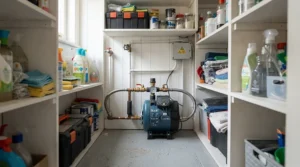
6. Salamander CT Force 30 TU — universal 3 bar for negative-head layouts
The Salamander CT Force 30 TU exists for one awkward situation: when the cold water tank isn’t comfortably above the pump. That’s a negative-head set-up, common in bungalows, loft conversions and some extensions.
It’s a 3.0 bar twin pump suitable for both positive and negative head, with brass ends and impellers and a 3/4″ BSP connection. Listings describe it boosting hot and cold supplies independently to showers, basins, toilets and even appliances. With negative head, the pump has to pull water rather than being fed, so the extra pumping muscle isn’t just luxury, it’s the point.
Based on the specs, it’s the sensible choice when you’re unsure which head type you have, or expect your bathroom layout to change. The trade-off is cost, since universal pumps price above positive-only equivalents.
Review sentiment is more mixed than for the Monsoon. One major retailer listing showed a 3.5-star average at the time of research, with a handful of ratings elsewhere. That’s a small, uneven sample, so verify against current listings.
Pros:
- ✅ Works in positive and negative head
- ✅ Brass ends and impellers
- ✅ Can boost basins, toilets and appliances
Cons:
- ❌ Costs more than positive-only pumps
- ❌ Retailer ratings look mixed
Around £430-£500 is the range to expect. Check current price.
7. Salamander RP100TU — centrifugal whole-house workhorse
Most pumps here are regenerative. The Salamander RP100TU takes the centrifugal route, which listings say boosts pressure and flow quietly and holds pressure at higher flow rates.
It’s a 3.0 bar twin pump for positive and negative head, with 22 mm push-fit anti-vibration couplers and a built-in 22 mm isolating valve. Listed maximum flow is 48 litres a minute, minimum flow 2 litres a minute, IPX3 rating and a three-year guarantee, and it can feed up to three showers. That 22 mm plumbing is the clue: this pump is designed for homes with generous pipework and several outlets to serve.
Honestly assessed, it’s overkill for one standard shower and ideal for a household where the shower, bath and basin all want attention at once. The higher minimum flow also means it needs a decent supply feeding it, which is another reason to check your cold water tank first.
On reviews, only a few ratings appear on retailer pages, so I can’t summarise sentiment with any confidence. The specification is the main evidence.
Pros:
- ✅ Centrifugal design for steadier pressure
- ✅ Handles positive and negative head
- ✅ 22 mm couplers suit whole-house use
Cons:
- ❌ Overkill for a single basic shower
- ❌ Few reviews to lean on
Around £500-£550 puts it mid-premium, good value only if you’ll use the capacity.
Installing and Running Your Shower Pump for Low Pressure: A First-30-Days Guide
A pump is only as good as its installation. These steps turn a decent purchase into a quiet, reliable one.
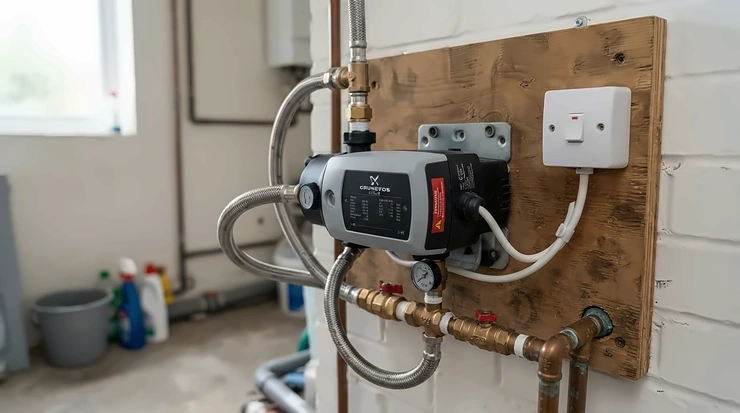
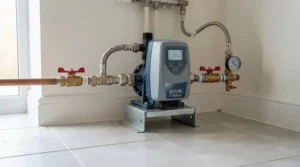
Choose the spot. Fit it in the airing cupboard or loft-adjacent space, on a solid surface, with the supplied anti-vibration mat or feet. For positive-head pumps, retailer guidance says there should be roughly a metre between the bottom of the cold water tank and the pump.
Plumb it properly. Use the flexible hoses and isolating valves supplied so you can service the pump without draining the house. Flush the pipework before connecting, and open the valves slowly to purge air.
Keep it off the mains. Retail listings repeat the warning that these pumps must not be connected directly to a mains supply. Under the Water Supply (Water Fittings) Regulations 1999, a pump or booster drawing more than 12 litres a minute connected to a supply pipe falls under notification rules. Gravity set-ups are fed from storage, but ask your installer to confirm.
First 30 days checklist:
- Week one: listen for pulsing, rattling or a pump running after the shower stops.
- Week two: confirm the hot and cold tap temperatures stay balanced.
- Week four: check the cold water tank refills between showers, then give the isolating valves a gentle open-close.
Most early problems are air, mounting or tank supply, not a faulty pump.
Shower Pump for Low Pressure Problems and Fixes
Even good pumps misbehave when the system around them is wrong. Here are the five most common complaints.
1. Pulsing or surging water. Usually air in the pipes or a tank running low. Re-bleed the system and check the cold water tank’s float valve.
2. Noise. Hard-mounting is the usual culprit. Fit the anti-vibration mat, use flexible hoses and keep the pump off thin partition walls. Entry-level pumps like the Showermate Standard S2.0 and CT75 Xtra sit around 53-57 dB(A), so placement matters more than the badge.
3. Temperature swings. If mains-pressure cold meets gravity-fed hot at the same valve, the cold overpowers the hot. A twin impeller pump, such as the CT75 Xtra or Monsoon Standard S3.0, boosts both feeds equally.
4. Pump won’t start. Flow switches need a minimum flow, listed at 0.6-0.8 litres a minute on several models. Check isolating valves and tank level.
5. Still weak after fitting. Look at the shower head, 15 mm pipe restrictions and valve filters before blaming the pump. If a CT50 Xtra isn’t enough, stepping up to a CT75 Xtra or CT Force 30 PT is usually the right fix.
Which Shower Pump for Low Pressure Suits You? Three Real-World Scenarios
The terraced-house commuter. A 1930s house, small loft tank, one shower, 15 mm pipes, and a budget of about £250. The CT75 Xtra is the sensible fit, with the CT50 Xtra as the gentler option if the pipework is ancient. The shower runs twice a day for ten minutes.
The busy family of four. Rainfall head plus handset, 22 mm pipework, a bathroom more than a metre below a generous tank, and showers back-to-back every morning. The CT Force 30 PT gives the 2.5-bar-at-flow punch, while the Monsoon Standard S3.0 adds quiet and flow headroom if the bathroom shares a wall with a bedroom.
The bungalow en suite. The tank sits at or below pump level, so positive-head pumps are out. The CT Force 30 TU suits a single shower, and the RP100TU makes sense if the bath and basin need boosting too.
Match the pump to the layout first and the budget second, and you’ll rarely go wrong.
✨ Ready to Fix That Feeble Shower?
🔍 Take your shower pump for low pressure search to the next level with these carefully selected pumps. Click any highlighted product name to check current pricing and availability. These pumps will help you create the invigorating shower your household deserves!
What Is a Shower Pump for Low Pressure?
A shower pump for low pressure is an electric booster fitted to a gravity-fed hot and cold supply, typically in the airing cupboard, that mechanically raises the pressure and flow rate reaching your shower. It draws water from the cold water tank and hot cylinder, then pushes it to the outlet, turning a trickle into a proper spray.
How does it know when to work? A flow switch detects water movement when you open the shower and starts the motor. Twin impeller models boost hot and cold together, while single models boost one feed or a blended supply.
Compatibility matters. Buying guides agree that pumps suit gravity-fed water systems with a hot water cylinder and cold water tank, and they don’t suit mains-pressure systems. Electric showers, meanwhile, don’t need a separate pump at all. The short version: if your home has a loft tank and a cylinder, you’re the target audience.
How to Choose a Shower Pump for Low Pressure
Follow these six steps in order, because each one narrows the next.
- Confirm you have gravity-fed water systems. A loft tank and airing-cupboard cylinder means yes. A combi boiler means a different solution.
- Identify positive or negative head. If the cold water tank sits about a metre or more above the pump, positive head pumps will work. If not, you need a universal model.
- Pick single or twin impeller. Thermostatic mixer showers work best with twin impeller pumps, as Mira’s shower pump buying and fitting guide notes, because both feeds are balanced.
- Match the bar rating. Retailer guidance suggests 1.5 bar for older pipework and small tanks, 2 bar for typical low-pressure showers, and 2.5-3 bar for large heads and multiple outlets.
- Check flow demand against supply. A pump can’t create water, only move it, so a rainfall head plus a small tank is a mismatch.
- Verify the small print. Look for WRAS approval, the warranty length, the quoted noise level and your mixer valve’s maximum inlet pressure.
Shower Pump for Gravity Fed System: Positive Head vs Negative Head
Choosing a shower pump for gravity fed system homes begins with one question: is your pump fed by gravity, or does it have to pull?
Positive head
With positive head, the cold water tank sits above the pump. Retailer guides say you want roughly a metre of drop between the bottom of the tank and the pump. Gravity feeds the pump, which then boosts the pressure. The CT50 Xtra, Showermate Standard S2.0, CT75 Xtra, CT Force 30 PT and Monsoon Standard S3.0 are positive-head only.
Negative head
With negative head, the tank is level with or below the pump, so the pump must draw water in. That needs a universal design, like the CT Force 30 TU or RP100TU. Manufacturer notes warn that installing a positive-head pump here may mean it simply won’t work.
What to do if you’re unsure
Measure it. Check the vertical gap between the tank outlet and your intended pump position. If it’s borderline, spending more on a universal pump is cheaper than buying twice.
3 Bar Shower Pump: Brilliant Tool or Expensive Overkill?
The 3 bar shower pump has a marketing glow. Bigger number, better shower, right? Not quite.
Closed-head versus working pressure. The 3 bar figure is the maximum with the valve closed. Under flow it drops. The CT Force 30 PT lists roughly 2.5 bar at 8 litres a minute, while the CT75 Xtra lists 1.7 bar at the same flow. That’s a real gain, but not a 50% leap in your shower.
When it earns its keep. Retailer advice puts 2.5 bar and above with power showers and large heads, where bigger flow at high pressure is needed. If you have a rainfall head, body jets or two outlets running together, a 3 bar shower pump gives you headroom.
When it doesn’t. For a single standard handset, 2 bar is widely described as the reliable middle ground. Pushing 3 bar through ageing 15 mm pipes or a small tank can strain both. It also drains the tank faster, and your mixer valve has a maximum inlet pressure to respect.
Choose 3 bar for demanding fittings and generous plumbing, not just because the number is bigger.

Pressure and Flow Rate: Why Both Numbers Matter
Pressure is the push, and flow is the volume. A shower needs both, and a pump boosts both, but not equally at all times.
Pump curves show the trade-off. The Showermate Standard S2.0 lists 1.5 bar at 9 litres a minute and 0.9 bar at 18 litres a minute. As you demand more flow, pressure falls. A pump that looks mighty at closed head may feel ordinary at working flow.
So read the working-flow figure, not just the headline. Aim for the pump whose pressure at your expected flow meets your shower’s needs. A thermostatic valve with a standard head may be content with 1.5 bar. A rainfall head may demand double the water of a handset, so it needs a pump that holds pressure at higher flow, such as the CT Force 30 PT, Monsoon Standard S3.0 or RP100TU.
One final point on pressure and flow rate: the outlet must already deliver a minimum trickle for the pump to trigger. Several makers list about 0.6-1 litre a minute at the outlet. No trickle, no boost.
Gravity-Fed Water Systems and Your Cold Water Tank
Gravity-fed water systems are charmingly simple: a cold water tank in the loft feeds a hot cylinder and your cold taps. Typical gravity pressure is tiny, often quoted around 0.1-0.3 bar, which is why showers dribble.
The cold water tank is the overlooked half of any pump decision. A pump moves water faster than a float valve refills a tank, so a small tank with a hungry pump can run low mid-shower. Heat and Plumb’s advice is to make sure the tank can supply the pump without running short.
Here’s a quick audit:
- Capacity: Is the tank large enough for your household’s back-to-back showers?
- Pipework: Does the feed to the pump use sufficiently wide pipe, ideally 22 mm for higher-flow pumps?
- Condition: Is it lidded, clean and insulated?
- Hot side: Stuart Turner’s data sheet notes 60°C stored hot water is sufficient for normal needs and limits scale in hard-water areas.
A modest pump like the CT75 Xtra is kinder to a modest tank than a RP100TU.
Shower Pump vs Alternatives
A shower pump for low pressure isn’t the only answer. Here’s how it compares with the main alternatives.
| Option | Works with Gravity-Fed? | Effect on Pressure and Flow | Best For |
|---|---|---|---|
| Twin shower pump, such as the CT75 Xtra | Yes | Boosts hot and cold together | Existing mixer showers |
| Power shower | Yes, built-in pump | Strong boost, needs adequate head | Replacing the whole shower |
| Electric shower | Yes, no pump needed | Heats water on demand | Simple, cold-water-only supply |
| Shower head swap | Yes | Small gain from fewer, smaller holes | Mild pressure problems |
A pump suits you if you love your current mixer and just want it to perform. A power shower replaces the whole unit, which makes sense if the shower is already tired. An electric shower avoids the hot-water cylinder altogether, and a new head is the cheapest first experiment before spending on a Showermate Standard S2.0.
Long-Term Cost & Maintenance
Running costs are trivial. A 300 W pump running ten minutes uses about 0.05 kWh, so a few pence per shower. The real cost is purchase price plus longevity.
| Tier | Pumps | Price Range | Value Verdict |
|---|---|---|---|
| Budget | CT50 Xtra, Showermate Standard S2.0, CT75 Xtra | Entry level to around £250 | Best for single showers |
| Mid-range | CT Force 30 PT, CT Force 30 TU | Roughly £300-£600 | Brass build, more outlets |
| Premium | Monsoon Standard S3.0, RP100TU | Around £500-£700 | Quiet, whole-house capacity |
Value-wise, the budget tier covers most households, and the mid-range suits big heads or tricky layouts. Premium makes sense only when noise or multiple outlets are priorities. Longer warranties, from three years on the CT75 Xtra up to the five years listed on brass models, also change the maths.
Maintenance is light: annual check of isolating valves, hose condition and mounting, plus descaling in hard-water areas. Replace a noisy or vibrating pump early before it stresses the pipework.
Safety, Regulations and Compliance
Pumps sit in your water system and your electrics, so a few rules matter.
Water regulations. The Water Supply (Water Fittings) Regulations exist to prevent waste, misuse and contamination of water. The Water Regulations UK guidance for England and Wales sets out the requirements and the role of approved contractors. Listings highlight WRAS approval on many pumps here, which is the reassuring badge to look for.
Mains warning. Retail specifications state these pumps must not connect directly to the mains supply. Keep them on the gravity side.
Electrics and ratings. Models quote IPX3 or IPX4 ratings and fuse requirements, such as 5 A on some Showermate models. Wiring should be done by a competent person, and the pump should sit away from direct splashing.
Product markings. Look for CE or UKCA marking on the documentation, and follow the installation manual. If anything about your system is unusual, a qualified plumber is cheaper than a flooded airing cupboard.

FAQ
❓ Can a shower pump for low pressure work with a combi boiler?
❓ How much does a 3 bar shower pump cost?
❓ Will a 3 bar shower pump damage my shower valve?
❓ How high must my cold water tank be above the pump?
❓ Do I need a shower pump for gravity fed system homes with an electric shower?
Conclusion
A weak shower in a gravity-fed home is a solvable problem, and a well-chosen shower pump for low pressure is usually the cheapest, tidiest cure. The trick is matching the pump to the plumbing. Check your head type first, then your cold water tank, then the working pressure and flow rate your fittings demand.
For most households, the CT75 Xtra is the sensible centre of gravity: well documented, fairly priced, and gentle enough for ordinary tanks. The Showermate Standard S2.0 is a strong alternative if included hoses appeal, and the CT50 Xtra suits older pipework. If you’re chasing rainfall-head drama, the CT Force 30 PT is the brass 3 bar shower pump to shortlist. The Monsoon Standard S3.0 is the one for quiet, the CT Force 30 TU and RP100TU are the answer when negative head or multiple outlets complicate things.
Whatever you pick, confirm compatibility on the listing, check current prices and let a competent installer do the wiring. Then enjoy a shower that finally behaves like it was worth the tiling.
Recommended for You
- Extra Long Shower Hose 2m: 7 Best Picks For UK Homes (2026)
- Anti-Kink Shower Hose: 7 Best Tangle-Free Picks For UK Homes (2026)
- Shower Hose Replacement: 7 Best Leak-Free Picks For UK (2026)
Disclaimer: This article contains affiliate links. As an Amazon Associate, I earn from qualifying purchases. If you purchase products through these links, we may earn a small commission at no additional cost to you.
✨ Found this helpful? Share it with your friends! 💬🤗
