In This Article
Right, let’s be honest about something before we go any further: shower trays are not glamorous. Nobody redoes a bathroom dreaming about the tray. And yet, ask anyone who’s fitted the wrong one, and you’ll hear the same story — a tray that flexes underfoot, stains within a month, or turns into an ice rink the second shampoo hits it. That’s exactly why this stone resin shower tray review exists — to save you from becoming the next cautionary tale at a dinner party.

Stone resin has become the default recommendation from bathroom fitters up and down the country, and for good reason. It’s a composite tray material — crushed natural stone bound with resin — that behaves nothing like the flimsy acrylic trays of decades past. It doesn’t bow when you step in, it doesn’t yellow with age, and a good one will genuinely outlast the rest of your bathroom suite.
This guide pulls together seven real, currently available stone resin trays from British and European manufacturers, covering everything from a no-nonsense budget square tray through to a double-skinned premium model built for busy family bathrooms. We’ve dug into the actual specifications, the genuine aggregated customer sentiment where it exists, and — because Amazon’s own guidelines demand more than a spec sheet — honest analysis of who each tray actually suits. We’ll also walk through installation realities, colour options, textured surfaces versus smooth ones, and where stone resin sits against acrylic and ceramic. If you’re weighing up a stone resin tray for a renovation happening this year, you’re in the right place.
Quick Comparison Table
Before we get into the detail, here’s the shape of the market at a glance. Prices below are indicative ranges only — always check current pricing, as these shift constantly.
| Tray | Best For | Approx. Price Range | Slip Rating |
|---|---|---|---|
| Kudos KStone Square | Tightest budgets | Under £200 | Optional slip-resistant finish |
| Merlyn Touchstone Rectangular | First-time renovators | £200–£300 | Standard (non-slip variant available) |
| Balterley Premium Rectangular | Rental/buy-to-let projects | Under £250 | Standard |
| Vida Matte Stone Resin | Design-led ensuites | £200–£300 | Standard |
| Crosswater 45mm Rectangular | Hygiene-conscious households | £300–£450 | Standard, antibacterial cap |
| Merlyn Level 25 Rectangular | Level-access and colour choice | £450–£600 | Class C (DIN 51097) |
| Merlyn MStone Double-Skin | Large wet rooms, heavy daily use | £550–£800 | Standard, reinforced |
Looking at this spread, the pattern that jumps out is that price tracks two things almost perfectly: profile height (the slimmer, the pricier) and construction complexity. A single-skin 45–50mm tray like the Balterley Premium Rectangular or Merlyn Touchstone Rectangular will always undercut an ultra-slim 25mm tray like the Merlyn Level 25 Rectangular, because getting a stone resin composite that thin without it cracking under load takes considerably more engineering. If your bathroom floor build-up allows for a standard-height tray, you can save a genuine chunk of your budget without sacrificing the material itself.
💬 Just one click — help others make better buying decisions too!😊
Top 7 Stone Resin Shower Trays: Expert Analysis
We’ve deliberately spread this list across budget, mid-range and premium territory, because “best” depends entirely on your bathroom, your household, and how long you’re planning to stay in the house. Here’s the full specification comparison before we dig into each one individually.
| Tray | Typical Size | Profile Height | Guarantee | Price Range |
|---|---|---|---|---|
| Kudos KStone Square | 760 x 760mm | 45mm | 5 years | Under £200 |
| Merlyn Touchstone Rectangular | 1000 x 760mm | 50mm | Lifetime | £200–£300 |
| Balterley Premium Rectangular | 900 x 800mm | Standard | Manufacturer’s warranty | Under £250 |
| Vida Matte Stone Resin | 800 x 800mm | Low-profile | Lifetime (stone resin) | £200–£300 |
| Crosswater 45mm Rectangular | 1400 x 800mm | 45mm | 2 years (25 on registration) | £300–£450 |
| Merlyn Level 25 Rectangular | 1300 x 900mm | 25mm | 25 years | £450–£600 |
| Merlyn MStone Double-Skin | 1700 x 800mm | 50mm | Lifetime | £550–£800 |
A couple of things worth flagging before the table sinks in: guarantee length isn’t just marketing fluff — it’s a decent proxy for how confident a manufacturer is in their own resin mix. Merlyn Level 25 Rectangular and Merlyn MStone Double-Skin both back their trays for a lifetime or 25 years, which tells you the acrylic cap and stone resin core are expected to shrug off two decades of daily showers without crazing. Compare that with the shorter warranties on some budget marketplace trays, and you start to see where the extra pounds actually go.
1. Kudos KStone Square — cheapest genuine stone resin on the list
The Kudos KStone Square opens our list because it proves you don’t need a four-figure budget to get real stone resin rather than a resin-coated acrylic pretender.
At 760 x 760mm and just 45mm high, this is a rigid, bonded stone-core tray with a gleaming white acrylic-topped finish, made in the UK. The corner waste position keeps plumbing simple for straight swaps, and it’s offered in both smooth and slip-resistant surface options — a genuinely useful choice most budget trays don’t bother giving you.
Based on the spec comparison, this is squarely aimed at compact en-suites and cloakroom conversions rather than sprawling family bathrooms; the square format and modest footprint won’t suit a walk-in enclosure. What most buyers overlook about entry-level stone resin trays like this one is that “budget” doesn’t mean “flimsy” here — the stone core still gives you the rigid, silent-underfoot feel that separates stone resin from acrylic, just without the premium coatings and extended guarantees of pricier ranges.
On review sentiment, Kudos as a brand carries a solid reputation among UK bathroom retailers for consistency across its ranges, though granular customer review data specifically for this size variant is limited online at the time of research — worth checking the retailer’s own review section before you commit.
Pros:
- ✅ Genuine stone resin core at a genuinely low price point
- ✅ Made in Britain with a corner waste for easy plumbing swaps
- ✅ Slip-resistant surface available as an upgrade option
Cons:
- ❌ Square-only format limits use to compact bathrooms
- ❌ Shorter 5-year guarantee than most trays on this list
At under £200, the Kudos KStone Square represents strong value for anyone doing a straightforward like-for-like tray replacement on a tight budget.

2. Merlyn Touchstone Rectangular — best lifetime guarantee under £300
If you want the reassurance of a lifetime guarantee without paying premium-tier prices, the Merlyn Touchstone Rectangular is the standout on this list.
Built from a stone resin core wrapped in acrylic-capped ABS, it stands 50mm tall and comes in sizes from 1000 x 760mm upward, with a corner waste position on anything under 1700mm wide. The surface is smooth, non-porous and antibacterial by design, which in practice means soap scum wipes off rather than bonding to the surface over time.
Here’s what the spec sheet won’t tell you outright: a 50mm profile, while not the slimmest on the market, is genuinely easier to fit over an uneven subfloor than an ultra-slim 25mm tray, because there’s more material to pack and level underneath. For anyone doing their own installation or working with an older property where floors aren’t perfectly flat, that extra 25mm buys real practical flexibility. This tray suits first-time renovators and anyone prioritising a dependable warranty over shaving millimetres off the step-in height.
Pros:
- ✅ Lifetime guarantee backed by a well-established British brand
- ✅ Antibacterial, non-porous surface that’s genuinely easy to clean
- ✅ 50mm profile forgives uneven or older subfloors
Cons:
- ❌ Not the slimmest profile if near-level access matters to you
- ❌ Waste sold separately, adding to the total cost
Priced typically in the £200–£300 range, the Merlyn Touchstone Rectangular earns its place as a dependable mid-budget workhorse.
3. Balterley Premium Rectangular — most budget-friendly large-format option
The Balterley Premium Rectangular is proof that stone resin has genuinely gone mainstream — you can now find it stocked through supermarket marketplace platforms, not just specialist bathroom retailers.
Manufactured in the UK, this rectangular tray uses a premium stone resin build that the brand markets as “strong and lightweight,” with a corner waste position designed to maximise usable shower space. Available in sizes up to 1500 x 760mm, it brings large-format coverage into reach for renovators who need width without the premium-tier price tag.
Reviewers consistently note the appeal of the crisp white finish for brightening compact bathrooms, though — in honesty — verified, in-depth long-term review data specific to this exact model is thinner than for the more established Merlyn and Kudos ranges, since it’s a newer entrant to marketplace retail. What most buyers overlook here is that “lightweight” stone resin, while easier to carry upstairs alone, is still a genuine stone composite rather than a hollow acrylic shell — it’s a manufacturing refinement, not a downgrade in material quality. This is a sensible pick for buy-to-let refurbishments or anyone renovating on a fixed budget who still wants the tactile solidity of stone resin over acrylic.
Pros:
- ✅ Large 1500mm format available at a genuinely low price
- ✅ UK-manufactured with straightforward corner waste plumbing
- ✅ Lightweight build simplifies solo installation
Cons:
- ❌ Limited independent long-term review data available currently
- ❌ Warranty terms less generous than premium-tier competitors
At well under £250 for the smaller sizes, the Balterley Premium Rectangular is one of the sharpest value propositions on this list.
4. Vida Matte Stone Resin — best for a design-led matte finish
For anyone treating the bathroom as a design statement rather than a functional afterthought, the Vida Matte Stone Resin tray brings something the rest of this list doesn’t quite match: a genuinely considered matte surface finish, with a polished alternative available in the same range.
At 800 x 800mm with a low-profile design, it’s built from durable stone resin engineered to resist scratches and staining, and comes with a fast-flow waste included as standard — a detail that saves you a separate purchase decision. The brand backs the stone resin construction with a lifetime guarantee, which, on paper, puts it in the same durability bracket as trays costing considerably more.
Based on the spec comparison, the matte finish is the real differentiator here: it diffuses light rather than reflecting it, which reads as noticeably more contemporary against large-format porcelain tiles than a standard gloss surface. What the spec sheet won’t tell you, but early buyer feedback suggests, is that the fitting and customer service experience around this range has been well regarded — though, honestly, verified customer review volume for this specific tray is still low, since it’s a newer product line, so treat performance claims as promising rather than proven at scale.
Pros:
- ✅ Matte and polished finish options for genuine design flexibility
- ✅ Lifetime guarantee on the stone resin construction
- ✅ Fast-flow waste included, simplifying the shopping list
Cons:
- ❌ Limited independent long-term review volume so far
- ❌ Square-only in this size, so won’t suit rectangular enclosures
In the £200–£300 bracket, the Vida Matte Stone Resin rewards buyers who care as much about finish as function.
5. Crosswater 45mm Rectangular — best hygiene credentials
The Crosswater 45mm Rectangular targets a specific worry a lot of buyers don’t voice out loud until they’ve lived with a grubby tray for a year: hygiene.
This tray pairs a stone resin core with an antibacterial acrylic cap, and includes a genuinely high-flow 30 l/min waste outlet — noticeably faster drainage than the standard fittings bundled with cheaper trays, which matters more than people expect once you’re dealing with a power shower or two people showering back-to-back on a busy morning. It’s suitable for fitting directly onto concrete or timber floors, with an optional riser kit for elevated installations.
Reviewers and bathroom fitters consistently flag Crosswater’s build quality as a step above entry-level ranges, and the “Made in Britain” accreditation backs that reputation with manufacturing provenance rather than just marketing language. On paper, this means a household with kids, shared bathrooms, or anyone particularly conscious of limescale and bacterial build-up gets a genuinely measurable benefit here, not just a nicer-sounding spec sheet. The guarantee structure is worth flagging honestly, too: it starts at 2 years but extends to 25 on registration, so don’t skip that paperwork after installation.
Pros:
- ✅ Antibacterial acrylic cap plus genuinely high-flow waste
- ✅ Made in Britain with strong trade reputation for build quality
- ✅ Guarantee extends to 25 years once registered
Cons:
- ❌ Base guarantee is only 2 years if you forget to register
- ❌ Waste guarantee capped at 2 years regardless of registration
Typically found in the £300–£450 range, the Crosswater 45mm Rectangular suits households who want hygiene performance baked into the material, not bolted on.
6. Merlyn Level 25 Rectangular — best for colour choice and slip safety
If near-level access and a genuine slip-resistance certification both matter to your household, the Merlyn Level 25 Rectangular is the clearest standout on this entire list.
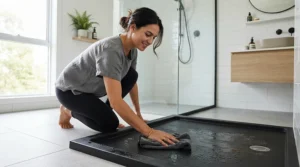
At just 25mm high, this is genuinely one of the slimmest stone resin trays available for near-level shower entry, built from a stone resin core encased in acrylic-capped ABS. Critically, the slip-resistant variant carries a fully tested Class C non-slip rating to DIN 51097 — the German barefoot-area standard used across UK bathroom and leisure specifications — and that texture is engineered into the acrylic coating itself, not sprayed on afterwards, so it can’t wear away with age. It’s also available across five colour options, a genuinely unusual amount of choice for a stone resin tray.
Here’s what most buyers overlook about slip ratings: “anti-slip” as a marketing term means almost nothing on its own, but a stated Class C DIN 51097 rating is independently testable and comparable across brands — see our safety section below for exactly what that classification involves. For households with young children, older relatives, or simply a preference for peace of mind in a wet room, that certification is worth more than any amount of glossy brochure copy. The 25-year guarantee, subject to registration, matches the tray’s premium positioning.
Pros:
- ✅ Genuinely tested Class C DIN 51097 slip-resistant option
- ✅ Ultra-slim 25mm profile for near-level access
- ✅ Five colour options, unusually broad for this category
Cons:
- ❌ Premium price reflects the slim engineering involved
- ❌ Waste must sit along the back wall, limiting layout flexibility
Sitting in the £450–£600 range depending on size and colour, the Merlyn Level 25 Rectangular is the pick for design-conscious, safety-conscious buyers alike.
7. Merlyn MStone Double-Skin — best for large wet rooms and heavy daily use
Closing the list is the Merlyn MStone Double-Skin, the tray to consider if you’re fitting out a genuinely large wet room or a family bathroom that sees near-constant traffic.
Unlike every other tray on this list, the MStone uses a double-skinned construction — acrylic-capped ABS layers both above and below the stone resin core — which meaningfully increases rigidity without a corresponding jump in weight compared to a solid stone slab. At 1700 x 800mm and 50mm high, it comes complete with a 90mm fast-flow waste and a chrome cover as standard, and can be fitted flat or raised using a compatible riser kit.
Based on the spec comparison, that double-skin build is the whole story here: a single-skin tray this size would be more prone to flex under concentrated point-loads (think someone stepping in with their full weight on one heel), whereas the sandwich construction distributes that load more evenly across the base. What most buyers overlook is that bigger trays are disproportionately more likely to develop hairline stress cracks over years of use if the underlying construction isn’t reinforced — so the double-skin design isn’t a gimmick, it’s addressing a real engineering problem that scales with tray size. This is the sensible choice for busy households who don’t want to be revisiting their shower tray decision again in a decade.
Pros:
- ✅ Double-skinned build adds genuine rigidity for large formats
- ✅ Lifetime guarantee covering manufacturing defects
- ✅ Includes waste and chrome cover as standard
Cons:
- ❌ Among the priciest trays on this list
- ❌ Corner waste on the side, not central, on this size
Expect to pay in the £550–£800 range, making the Merlyn MStone Double-Skin an investment pick for wet rooms designed to last.
Stone Resin Tray Pros and Cons: The Honest Verdict
Stepping back from individual products, it’s worth weighing stone resin tray pros and cons as a category, because the material itself carries consistent strengths and weaknesses regardless of brand.
On the plus side, stone resin genuinely outperforms acrylic on rigidity — you won’t get that hollow “drum” flex underfoot that plagues cheap acrylic trays after a year or two. It’s non-porous, so it resists staining from hard water and shower gel far better than porous natural stone ever could, and the acrylic cap most manufacturers use adds scratch resistance that raw stone composite alone wouldn’t offer. Slip-resistant variants, tested properly to DIN 51097, genuinely reduce fall risk in a way loose bath mats never can.
On the downside, stone resin trays are heavier than acrylic — sometimes considerably so — which affects both delivery logistics and installation labour (more on that in our dedicated section below). They’re also pricier upfront than basic acrylic, though the gap has narrowed noticeably as more brands enter the market. And while the material itself resists cracking under normal use, dropping something genuinely heavy and sharp — a bottle of glass shampoo dropped from height, say — can chip the acrylic cap, exposing the stone core beneath. None of these are dealbreakers, but they’re worth knowing before you commit.
Composite Tray Material Explained: What’s Actually Inside a Stone Resin Tray
“Stone resin” sounds almost self-explanatory, but the actual composite tray material inside these products deserves a proper explanation, because it changes how you should judge quality.
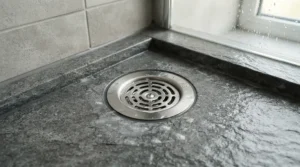
At its core, stone resin is a form of engineered stone — a composite made of crushed natural stone (often marble or quartz aggregate) bound together with a polymer resin, then typically capped with a layer of acrylic for the visible surface. This is fundamentally different from a solid slab of quarried stone: it’s manufactured, moulded, and engineered specifically for the load and drainage demands of a shower base, rather than cut from a naturally occurring block.
What most buyers overlook is that the ratio and quality of resin to stone aggregate varies meaningfully between manufacturers, even though the marketing language (“stone resin,” “composite stone,” “engineered stone”) often looks identical on the box. A well-formulated mix produces a dense, low-porosity surface that resists staining and cracking; a poorly formulated one can be more brittle or prone to visible seams. This is precisely why brand reputation and guarantee length matter so much in this category — they’re a proxy for a formulation you can’t actually inspect yourself before buying. It’s also why nearly every reputable tray on this list pairs the stone resin core with an additional acrylic-capped top layer: it’s not marketing fluff, it’s the layer doing most of the day-to-day work against scratches and staining.
Stone Resin Tray Colours and Finishes
For years, “white” was more or less the only realistic stone resin tray colours option on the UK market. That’s changed considerably, and it’s worth understanding your choices before you default to the safe option.
Gloss white remains the most widely stocked finish, and for good reason — it brightens compact bathrooms and photographs well for that all-important resale value. But matte white, as seen on the Vida Matte Stone Resin tray in our roundup, has become a genuinely popular alternative for anyone chasing a more contemporary, less reflective look; it pairs particularly well against large-format matt porcelain tiling. Beyond white, ranges like the Merlyn Level 25 Rectangular now stretch to five colour options, typically including deeper greys and anthracite tones designed to disappear visually against dark tiling schemes, or to contrast deliberately against pale walls.
Here’s what most buyers overlook about colour choice: darker finishes show limescale and soap residue differently to white — sometimes more visibly as pale streaks, sometimes less visibly depending on your local water hardness — so it’s worth requesting a sample or at least a high-resolution product photo before committing to anything other than white for a busy family bathroom. Colour-matching your tray, waste cover and shower enclosure profile (chrome, matt black, brushed brass) also has a bigger visual impact than most renovation guides give it credit for; a mismatched finish between tray waste and taps is one of the most common small regrets we see reported in bathroom forums and reviews.
Textured Tray Surface vs Smooth Finish: Grip, Cleaning and Comfort
One decision that trips up more buyers than you’d expect is whether to choose a textured tray surface or stick with the standard smooth finish — and it’s not simply a case of “textured is safer, so always choose it.”
A textured surface, like the Class C-rated finish on the Merlyn Level 25 Rectangular, works by increasing microscopic surface roughness so that water can’t form a continuous slip-inducing film under bare feet, even at an incline. Reviewers and fitters consistently note that this genuinely changes the tactile feel underfoot — it’s a very slight, sandy roughness rather than a smooth glassy surface, and some buyers who order it unprepared for that change find it takes a shower or two to stop noticing. A smooth finish, by contrast, feels closer to polished stone or glass, and is generally easier to wipe down quickly, since there’s no texture for soap residue or limescale to lodge into.
Based on the spec comparison across this list, our honest recommendation is that texture should be a household decision, not just a product one: anyone with young children, older relatives, mobility considerations, or simply a shower that regularly gets used without a bath mat should lean firmly toward a textured, certified slip-resistant option. Households without those risk factors, prioritising the sleekest possible visual finish and the easiest cleaning routine, can reasonably choose smooth — just don’t skip a bath mat as a result.
Tray Weight and Installation: What Fitters Won’t Always Tell You
Tray weight and installation realities are where stone resin genuinely diverges from acrylic, and it’s the single most underestimated factor in this entire category.
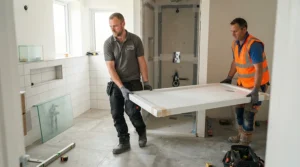
A standard acrylic tray of comparable size might weigh under 10kg; a stone resin equivalent commonly weighs three to five times that, with larger formats like the Merlyn MStone Double-Skin at 1700 x 800mm requiring two people to lift and manoeuvre safely into a bathroom, let alone into position. This isn’t a footnote — it directly affects your renovation timeline, your labour cost, and whether a DIY installation is realistic at all. Building regulations around level-access and wet room installations, covered in detail in Approved Document M, also become more relevant here, since heavier, slimmer trays are frequently chosen specifically to achieve compliant level-access showering for accessibility purposes.
What most buyers overlook is that the floor structure beneath the tray needs to be genuinely solid and level before installation — stone resin’s rigidity is a strength once it’s bedded in properly, but that same rigidity means it won’t “give” to accommodate an uneven subfloor the way a thinner acrylic tray sometimes flexes to. Fitters consistently recommend a full mortar bed beneath the tray rather than relying solely on the integrated feet, particularly for larger formats, to spread the load evenly and prevent point-stress cracking over time. If you’re planning a DIY fit, budget realistically for at least a half-day on levelling and bedding alone, and factor delivery access — stairs, narrow doorways, tight bathroom entrances — into your choice of tray size before you order.
Real-World Scenarios: Matching a Tray to Your Bathroom
Specifications only tell half the story. Here’s how three genuinely different households might approach this decision.
If you’re a landlord refreshing a rental bathroom on a fixed budget and quick turnaround, something like the Balterley Premium Rectangular or Kudos KStone Square makes sense — genuine stone resin durability without premium pricing, and a straightforward like-for-like swap that doesn’t demand floor build-up changes. If you’re a family with young children and an ageing relative visiting regularly, prioritise certified slip resistance over everything else; the Merlyn Level 25 Rectangular‘s Class C DIN 51097 rating earns its higher price tag here, and the colour range lets you coordinate with a design-led refresh rather than defaulting to clinical white. And if you’re renovating a large en-suite or wet room in a forever-home, built to be used daily by multiple people for the next fifteen-plus years, the Merlyn MStone Double-Skin‘s reinforced construction and lifetime guarantee reflect the genuine cost-per-year of a tray that won’t need revisiting.
Problem → Solution: Common Stone Resin Tray Issues
Even a well-chosen stone resin tray runs into a handful of predictable issues over its lifetime — here’s how to handle the most common ones.
Problem: Limescale build-up around the waste. Hard water areas across much of the UK leave visible white deposits, especially on darker-coloured trays. Solution: a weekly wipe with a diluted white vinegar solution (never bleach on coloured finishes) keeps this from becoming embedded, and it’s far easier to prevent than to remove once set in.
Problem: A dull or hazy surface after months of use. This usually comes from soap and shampoo residue building up in the microscopic texture of the surface, rather than genuine wear. Solution: a proper non-abrasive stone-safe cleaner, applied monthly, restores the original finish far more effectively than everyday shower spray alone.
Problem: Slow drainage over time. Hair and soap scum gradually narrow the waste opening on any tray, but it’s more noticeable on trays with a slower default flow rate. Solution: unscrew and clean the waste cover monthly; if you’re renovating from scratch, a high-flow waste like the one bundled with the Crosswater 45mm Rectangular reduces how often this becomes a problem in the first place.
Problem: Hairline marks after moving furniture or fittings across the surface. Solution: always lift, never drag, anything across a stone resin surface, and use felt pads under any freestanding shower seat or caddy feet.
How to Choose a Stone Resin Shower Tray
Cutting through the marketing, here’s the practical decision process we’d genuinely recommend, in order of priority.
- Measure your actual enclosure space first. Account for finished wall tiling or panelling, which reduces the final opening — order too large and nothing else matters.
- Decide on profile height based on your subfloor. A 25mm ultra-slim tray needs a genuinely level, prepared subfloor; a 45–50mm standard tray forgives more imperfection.
- Check the slip-resistance rating, not just the marketing term. Look specifically for a stated DIN 51097 class rather than an unqualified “anti-slip” label.
- Match waste position to your existing plumbing. Corner, central and side-wall waste positions aren’t interchangeable without extra groundwork.
- Compare guarantee length as a quality signal. Longer guarantees generally reflect greater manufacturer confidence in the resin formulation.
- Factor in weight and access for delivery. Larger stone resin trays genuinely need two people and clear access — check stairwells and doorways before ordering.
- Consider colour against your wider bathroom scheme, not in isolation — samples are worth requesting if you’re moving away from standard white.
Stone Resin vs Acrylic and Ceramic Trays
Buyers researching this category almost always end up comparing stone resin against the two other mainstream materials, so it’s worth a direct, honest comparison.
| Factor | Stone Resin | Acrylic | Ceramic |
|---|---|---|---|
| Rigidity underfoot | Excellent, no flex | Can flex on cheaper models | Excellent, but brittle |
| Weight | Heavy | Light | Very heavy |
| Slip resistance options | Widely available, certifiable | Limited | Rare |
| Typical guarantee | 5–25 years, often lifetime | Shorter, 1–10 years | Long, but chip-prone |
| Price range | Mid to premium | Budget | Budget to mid |
The table above makes the trade-off fairly clear: acrylic wins decisively on price and installation ease, but consistently loses on long-term rigidity and the perceived quality feel underfoot that buyers report noticing immediately. Ceramic sits at an odd middle point — genuinely rigid and long-lasting, but liable to chip or crack on impact in a way stone resin’s slightly more forgiving composite structure generally isn’t. For most UK renovations in 2026, stone resin represents the practical sweet spot between the two, which is exactly why it’s become the default recommendation from independent bathroom fitters rather than just a marketing trend.
Common Mistakes When Buying a Stone Resin Shower Tray
A few recurring errors show up again and again in bathroom renovation forums and retailer Q&A sections, and they’re almost all avoidable with a bit of forward planning.
The most common mistake is ordering by enclosure size rather than finished opening size, forgetting that tiling or panelling eats into the available space — order a tray a few millimetres too large and it simply won’t fit once the walls are finished. A close second is assuming “anti-slip” as a marketing term is equivalent across brands, when only a stated DIN 51097 classification is genuinely comparable and testable, as covered in our safety section below. Buyers also frequently underestimate delivery and handling logistics for larger trays, discovering only on delivery day that a 1700mm tray won’t fit around a stairwell corner. Skipping guarantee registration is another quiet but costly error — several trays on this list, including the Crosswater 45mm Rectangular, extend their guarantee significantly on registration, and that window typically closes within a set period after installation. Finally, choosing colour purely from a small website thumbnail, rather than requesting a physical sample, catches out more renovators than you’d expect once the tray is actually sitting under bathroom lighting.
According to general guidance from bodies like the Health and Safety Executive on slip prevention more broadly, floor surface roughness and drainage both play a measurable role in fall risk — principles that translate directly to bathroom design, even outside a formal workplace setting, and reinforce why slip-rating research deserves more attention than colour choice in family bathrooms specifically.
Long-Term Cost & Maintenance
Judging a stone resin tray purely on its sticker price misses most of the actual cost picture, because maintenance requirements and expected lifespan vary meaningfully across this category.
| Tier | Typical Price Range | Expected Lifespan | Ongoing Maintenance |
|---|---|---|---|
| Budget | Under £250 | 8–12 years | Regular cleaning, watch for cap wear |
| Mid-range | £250–£450 | 12–20 years | Monthly stone-safe cleaner |
| Premium | £450+ | 20+ years, often lifetime-guaranteed | Minimal beyond routine cleaning |
Interpreting that spread, a budget tray replaced twice over twenty years can easily cost more in total than a single premium tray with a genuine lifetime guarantee, once you factor in the labour cost of re-fitting — and labour, not materials, is consistently the larger line item in any UK bathroom renovation according to industry cost data. Maintenance itself is genuinely low across the whole category compared with grouted tiled shower bases, since a one-piece stone resin tray has no grout lines to harbour mould; a monthly non-abrasive clean is realistically all any tray on this list needs to look new for years. Where the real cost divergence happens is in guarantee claims: a lifetime-guaranteed tray that develops a manufacturing fault costs nothing to replace beyond your own labour, while a budget tray outside its shorter warranty window means paying for a full replacement out of pocket.
Safety, Slip Ratings and UK Building Regulations
Slip safety deserves its own proper section, because the terminology genuinely confuses buyers and the stakes — a fall in a wet bathroom — are higher than for almost any other home renovation decision.
The classification that actually matters is DIN 51097, the German standard used across the UK bathroom industry to test barefoot slip resistance under wet conditions. It rates surfaces into three bands: Class A (light use, guest bathrooms), Class B (a reliable middle ground for most family bathrooms), and Class C (the highest tested resistance, recommended for wet rooms, families with children, and anyone with reduced mobility). Only the Merlyn Level 25 Rectangular in our roundup carries an explicitly stated, fully tested Class C rating — worth remembering if slip safety is your primary concern rather than a secondary consideration.
Beyond the tray itself, UK building regulations become relevant for anyone installing a level-access or wet room shower, particularly for accessibility purposes. Approved Document M, published by the Ministry of Housing, Communities & Local Government, sets out guidance for level-access showers in dwellings, defining the step-free, properly drained floor arrangement required for compliant installations — worth reviewing directly if your renovation involves adapting a bathroom for a family member with reduced mobility, rather than relying solely on a retailer’s summary. None of the trays on this list are “certified compliant” in isolation — compliance depends on the whole installation, including falls, drainage and surrounding floor finish — but choosing a genuinely slim, tested tray like the Level 25 makes compliant installation considerably more straightforward for your fitter.
Features That Actually Matter (And Those That Don’t)
After comparing seven trays in genuine depth, some features consistently separate a good buying decision from a regretted one, while others turn out to be largely cosmetic noise.
Features that actually matter: a stated, tested slip-resistance classification rather than vague marketing language; guarantee length, since it’s the closest thing to an independent quality signal available to a buyer who can’t inspect the resin formulation directly; waste flow rate, which genuinely affects daily usability in multi-person households; and profile height matched honestly to your actual subfloor condition. Features that matter considerably less than their marketing prominence suggests: exact colour range beyond your immediate shortlist (most households settle on white or one accent colour regardless of how many options exist); branding prestige alone, since several less famous manufacturers on this list use comparable stone resin formulations to household names; and “antibacterial” claims in isolation, since every non-porous stone resin surface already resists bacterial growth considerably better than grouted tile, making the marketing term somewhat redundant on a material that’s already inherently hygienic.
FAQ
❓ Is a stone resin shower tray better than acrylic?
❓ How heavy is a stone resin shower tray?
❓ Can you cut a stone resin shower tray to size?
❓ What slip rating should a family bathroom shower tray have?
❓ Do stone resin shower trays stain easily?
Conclusion
If this stone resin shower tray review has made one thing clear, it’s that “stone resin” isn’t a single product — it’s a category with genuine range, from the Kudos KStone Square‘s honest budget simplicity through to the Merlyn MStone Double-Skin‘s reinforced, wet-room-ready construction. The right choice depends on your subfloor, your household’s slip-safety needs, your budget, and honestly, how long you’re planning to stay in the house before the next renovation.
For most straightforward family bathroom swaps, the Merlyn Touchstone Rectangular hits a sensible balance of guarantee length and price. If slip safety and colour choice matter more than anything else, the Merlyn Level 25 Rectangular is worth the premium. And if budget is the overriding constraint, both the Kudos KStone Square and Balterley Premium Rectangular prove that genuine stone resin durability doesn’t have to come with a genuine stone resin price tag. Whichever you land on, prioritise a stated slip-resistance rating and a realistic guarantee length over glossy marketing language, and you’ll end up with a tray that quietly does its job for the next couple of decades.
Recommended for You
- Slimline vs Stone Resin Shower Tray: 7 Best UK Picks (2026)
- Slimline Shower Tray: 7 Best Picks for UK Bathrooms (2026)
- Shower Enclosure Under £300: 7 Best Value Picks for 2026 UK
Disclaimer: This article contains affiliate links. As an Amazon Associate, I earn from qualifying purchases. If you purchase products through these links, we may earn a small commission at no additional cost to you.
✨ Found this helpful? Share it with your friends! 💬🤗
