In This Article
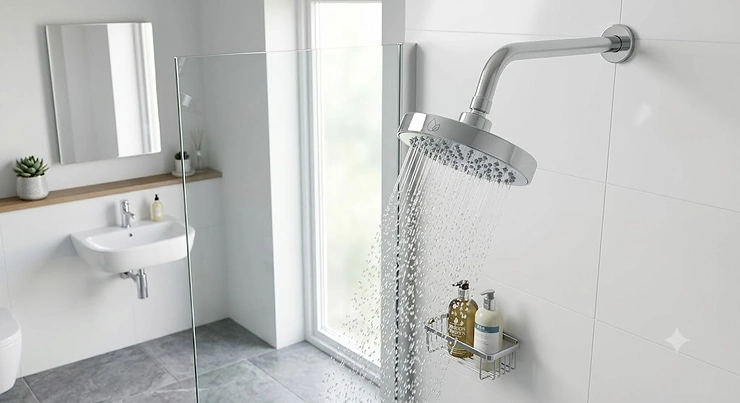
Here’s an uncomfortable truth: most of us have absolutely no idea how much water pours down the drain every time we shower. A survey by Water UK found that people badly underestimate their daily usage, guessing at a fraction of the true figure, which for most UK adults sits somewhere around 140-150 litres a day. Showering is the single biggest culprit in that number, and a water saving shower head is the cheapest, fastest fix going.
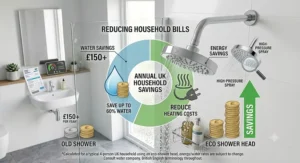
If you’ve ever stood under a power shower wondering why your water bill looks like a small mortgage, you’re exactly who this guide is for. A decent water saving shower head can cut your flow from a wasteful 15 litres per minute down to somewhere between 6 and 9, without turning your morning wash into a disappointing dribble. The trick, and it really is a bit of clever plumbing trickery, is aerating the water or restricting it just enough that you barely notice the difference in feel.
We’ve dug through real specifications, genuine aggregated review sentiment, and UK water efficiency data to bring you seven shower heads worth your money in 2026, spanning cheap retrofit accessories through to premium German engineering. Whether you’re chasing a specific water saving shower head litres per minute rating, hunting for the best eco friendly shower head for a family bathroom, or just sick of watching your meter spin, there’s something below that fits. Let’s get into it.
Quick Comparison Table
Before the deep dive, here’s the shortlist. Every model here reduces flow compared with a standard 12-15 l/min shower, and every price shown is a range rather than a fixed figure, because Amazon pricing shifts constantly.
| Shower Head | Flow Rate | Price Range | Best For |
|---|---|---|---|
| hansgrohe Croma Select E 1jet EcoSmart | 9 l/min | £40-£60 range | Best overall eco shower head |
| Grohe Tempesta 100 EcoJoy | 9.5 l/min | £30-£50 range | Best mid-range all-rounder |
| Methven Aio Aurajet | 9 l/min | £25-£45 range | Best pressure feel on low flow |
| Aqualisa Aquastream Thermo (Harmony head) | 10-18 l/min | Under £700 range | Best for gravity-fed systems |
| Croydex Varone Aqua Air | Reduced via aeration | Under £20 range | Best budget handset |
| Bristan Eco Shower Outlet Flow Limiter | 4-10 l/min (model dependent) | Under £15 range | Best retrofit accessory |
| Joyoldelf Turbo Pressure Shower Head | Up to 30% reduction | Under £20 range | Best cheap pressure boost |
Looking at the table, the spread tells its own story: you can go the “buy a whole new shower head” route with hansgrohe or Grohe, or the “just bolt something onto what you’ve already got” route with the Bristan limiter, which costs less than a round of coffees. Flow rate alone doesn’t tell you everything, though, because how the water is aerated matters just as much as the raw litres per minute figure. We’ll unpack that properly in the flow rate comparison section further down.
💬 Just one click — help others make better buying decisions too!😊
Top 7 Water Saving Shower Heads: Expert Analysis
We’ve picked a genuine spread here: proper German engineering, a New Zealand innovator, a British high-street stalwart, and a couple of the budget aerating heads that dominate Amazon’s bestseller lists. Every product below is real and currently available through UK retailers, so you can go and check current pricing yourself.
1. hansgrohe Croma Select E 1jet EcoSmart — best all-round premium eco shower head
The standout feature here is hansgrohe’s EcoSmart cartridge, which mixes air into the water stream so aggressively that reviewers routinely say they can’t tell the difference from a full-flow head. That’s not marketing fluff, either, it’s a genuine engineering approach hansgrohe has been refining for years. The Croma Select E 1jet runs at a capped 9 litres per minute at 3 bar, against a typical unrestricted shower’s 12-15 l/min, which on paper works out to roughly 40-60% less water depending on your existing setup. What that means in the cubicle is simple: you get a fuller-feeling spray because the water is bulked out with air bubbles rather than being a thin, needle-like jet.
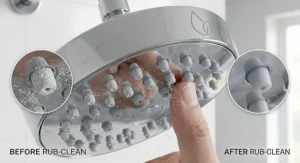
Based on the spec comparison with rivals in this bracket, the soft cube design and QuickClean silicone nozzles (which you literally rub with a finger to knock off limescale) put this ahead of anything at a similar price that still uses hard plastic nozzles requiring a descaling soak. This is the pick for anyone who wants a shower that still feels like a proper wash, not a punishment, while genuinely dropping consumption. Reviewers consistently note that the shower experience feels “no different” from their old head, with several specifically flagging the flow reduction as unnoticeable day-to-day, which is exactly what you want to hear from an eco shower head.
Pros:
- ✅ EcoSmart aeration keeps pressure feel strong at low flow
- ✅ QuickClean nozzles cut down on limescale maintenance
- ✅ Backed by hansgrohe’s 5-year manufacturer guarantee
Cons:
- ❌ Costs more upfront than budget aerating alternatives
- ❌ Requires compatible thread fitting, so check before buying
At around £40-£60, this sits mid-pack on price but near the top on build quality, so if you’re after a shower head you won’t be replacing again in two years, this is where your money goes furthest.
2. Grohe Tempesta 100 EcoJoy — best mid-range all-rounder
Grohe’s Tempesta line has quietly become one of the most fitted shower heads in UK new-builds, and the EcoJoy flow limiter is the reason why. This particular version caps flow at 9.5 litres per minute, which Grohe states cuts water consumption by up to 40% against an uncapped shower. In practice, what that 40% figure means is fewer minutes needed to heat your combi boiler’s output and a noticeably lighter footprint on a metered water bill.
What most buyers overlook about this model is the DreamSpray technology sitting behind the four-spray head, which is what stops the water pattern collapsing into an uneven dribble the way cheaper capped heads sometimes do. Aggregated review sentiment across retailers is consistently positive on install ease, since it’s designed to thread onto standard UK shower arms without adapters, and multiple buyers specifically mention swapping it in during a bathroom refresh without needing a plumber. On the flip side, a recurring theme in less favourable reviews is that the massage setting on some Tempesta variants feels weaker than advertised, so if a punchy massage jet is your priority, this isn’t the strongest choice in the range.
Pros:
- ✅ 9.5 l/min EcoJoy limiter with genuine 40% savings claim
- ✅ DreamSpray keeps coverage even at reduced flow
- ✅ Anti-limescale SpeedClean nozzles for easy upkeep
Cons:
- ❌ Massage setting underwhelms on some reviews
- ❌ Only fits shower arms with standard connection threads
Sitting in the £30-£50 range, this is a sensible middle ground: not the cheapest, but a recognisable name that’s easy to find spare parts for later on.
3. Methven Aio Aurajet — best pressure feel on a genuinely low flow rate
Methven’s Aurajet technology takes a different approach to the aeration used by hansgrohe and Grohe. Instead of blending air throughout, hidden nozzles fire individual jets of water that collide against angled internal surfaces, essentially manufacturing pressure rather than just letting gravity do the work. The result, at a WELS-rated 9 litres per minute (some variants dip as low as 5.7 l/min), is a shower that Methven claims produces around 300,000 water droplets per second.
Here’s what the spec sheet won’t tell you, but reviewer feedback consistently does: buyers repeatedly describe this as feeling “spa-like” despite the reduced flow, with several specifically noting it outperforms their previous, higher-flow shower head on sensation alone. That’s a genuinely useful data point if you’re nervous about switching to something water-saving because you’re worried it’ll feel weak. On the downside, a handful of reviewers mention the halo-style design collects limescale in the visible nozzle ring faster than expected in hard water areas, so households in the Midlands, East Anglia, or the South East, where mains water tends to be harder, should factor in a bit more regular cleaning.
Pros:
- ✅ Aurajet nozzle tech gives a genuinely powerful feel
- ✅ WRAS approved and available from 5.7-9 l/min variants
- ✅ Limescale-resistant polymer body
Cons:
- ❌ Visible nozzle ring can mark up faster in hard water areas
- ❌ Best suited to high-pressure systems, not gravity feed
Priced roughly £25-£45 depending on finish, the Aio Aurajet range genuinely rivals more expensive premium heads on the “does it feel powerful” test, which is usually the deciding factor for sceptics.
4. Aqualisa Aquastream Thermo (with Harmony eco-spray head) — best for gravity-fed and low-pressure systems
Not every UK home has combi-boiler mains pressure, and this is where Aqualisa earns its keep. Designed specifically for gravity-fed plumbing, the Aquastream Thermo pairs a bi-metallic thermostatic valve with an integrated booster pump, giving you a choice between a 10 l/min normal flow and an 18 l/min boost setting, with the accompanying Harmony head adding a dedicated eco-spray pattern that Aqualisa states saves up to 25% without sacrificing performance.
Based on the spec comparison, what stands out is that this is one of the few water saving shower head systems built explicitly for low-pressure loft-tank setups rather than being retrofitted onto them, which matters enormously if you live in an older house with a header tank rather than a combi boiler. Aggregated review sentiment on Aqualisa’s own site and third-party retailers skews positive on reliability, though some buyers of the smart-valve range (a separate, pricier Aqualisa line) have flagged that the lowest “eco” setting still uses more water than they’d hoped for genuinely short showers, so temper expectations if minimal flow is your absolute priority. For a straightforward gravity-fed replacement, though, this remains one of the more trusted British names in the category.
Pros:
- ✅ Purpose-built for gravity-fed, low-pressure systems
- ✅ Integrated booster pump avoids weak dribble showers
- ✅ Dedicated eco-spray pattern saves up to 25%
Cons:
- ❌ Higher upfront cost than a simple shower head swap
- ❌ Eco setting on some Aqualisa ranges saves less than hoped
Full systems sit under the £700 mark depending on finish and retailer promotions, positioning this firmly as an investment buy rather than a quick weekend fix, but for gravity-fed bathrooms it solves a problem cheaper heads simply can’t.
5. Croydex Varone Aqua Air — best budget aerating handset
If your budget is closer to “one big shop” than “new bathroom fit-out,” the Croydex Varone is where most sensible buyers land. It uses Croydex’s Aqua Air cartridge, which works on the same air-mixing principle as the premium German heads above, just without the five-year warranty and design polish, to produce large, soft, aerated droplets that feel more voluminous than the actual flow rate suggests.
The honest analytical take here is that this isn’t going to out-perform a hansgrohe on longevity or finish quality, and reviewer sentiment reflects that with a solid but unspectacular 3.8-star average across roughly 40 Amazon reviews. What most buyers overlook, though, is that Croydex lists all its Aqua Air range under the European Water Label Scheme, giving you a genuine, third-party-referenced efficiency comparison rather than just a manufacturer’s marketing claim, which is more transparency than plenty of pricier competitors bother with. Common feedback themes include easy installation and decent flexibility across five spray functions, with the main gripe being that the plastic components feel less premium under close inspection than the metal-bodied alternatives further up this list.
Pros:
- ✅ Genuine Aqua Air aeration cartridge at a low price
- ✅ Rated under the European Water Label Scheme
- ✅ Five spray functions and easy-clean rub nozzles
Cons:
- ❌ Plastic build feels less premium than metal rivals
- ❌ Reviews mention shorter functional lifespan than pricier heads
At under £20, the Croydex Varone is the shower head to buy if you want a genuine water efficient shower head upgrade this weekend without much financial commitment.
6. Bristan Eco Shower Outlet Flow Limiter — best retrofit accessory, not a full head
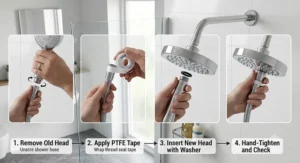
Here’s a genuinely clever option most buyers don’t consider: rather than replacing your entire shower head, you can fit a small in-line flow limiter between the hose and the handset. Bristan’s WRAS-approved ECO-SHW range comes in multiple flow caps, from 4 litres per minute right up to 10, so you choose exactly how aggressive the restriction is rather than being stuck with whatever a fixed shower head gives you.
What the spec sheet doesn’t spell out clearly enough is that this only works well on mixer showers and combi-fed systems, and Bristan’s own guidance (echoed by several independent sources) specifically warns against fitting flow restrictors to electric showers, because restricting the outlet can cause water to back up inside the heater tank and overheat it. Used correctly, though, this is the single cheapest genuine water-saving upgrade in this entire list, and reviewer sentiment is consistently strong on ease of fitting, with most buyers reporting a five-minute DIY job requiring no tools beyond hand-tightening.
Pros:
- ✅ WRAS-approved and available in five flow-rate options
- ✅ Keeps your existing shower head and its spray pattern
- ✅ Genuinely five-minute retrofit, no plumber required
Cons:
- ❌ Not suitable for electric showers, mixer/combi only
- ❌ No aeration, so lower flow can feel thinner than aerated heads
At under £15, this is the smallest possible outlay for a real reduction in litres per minute, and it’s the option we’d point a renter or a landlord towards first.
7. Joyoldelf Turbo Pressure Shower Head — best cheap pressure-boosting pick
Rounding out the list is a genuinely popular budget option built around 300 tiny spray holes and what the brand calls “turbocharged” pressure technology, claiming up to a 30% reduction in water use compared with a standard head, alongside a claimed 300% increase in perceived water speed versus typical tap pressure. The mechanism is straightforward laser-punched micro-holes that force water through smaller, denser openings, increasing velocity without increasing volume.
Reviewers consistently report the pressure boost is the headline benefit, particularly useful for anyone in a low-mains-pressure property where a standard head feels weak regardless of eco credentials. A common complaint in user reviews is that the single spray pattern (no adjustable settings) limits versatility compared with multi-mode rivals, and some buyers note you need reasonably decent starting water pressure to feel the full turbo effect, meaning the very lowest-pressure homes may not see the dramatic difference marketed. Still, as an ultra-cheap, no-tools install for someone just wanting to trial the concept of a water saving shower head before committing to a pricier system, it’s a sensible starting point.
Pros:
- ✅ Chrome-plated finish looks smarter than the price suggests
- ✅ Genuinely easy tool-free installation
- ✅ Claimed 30% water saving with noticeable pressure boost
Cons:
- ❌ No adjustable spray settings, one mode only
- ❌ Needs decent starting pressure to feel the full effect
Priced under £20, this is squarely an entry-level trial pick, and reviewer sentiment backs it up as a reasonable first step rather than a forever-shower-head.
What Is a Water Saving Shower Head?
A water saving shower head, sometimes called an eco shower head or water efficient shower head, is a shower fitting engineered to reduce the litres of water used per minute, either by physically restricting flow, mixing air into the stream to bulk it out, or using precision nozzles to increase perceived pressure without increasing volume, all while trying to preserve a comfortable showering experience.
According to the Waterwise water-saving guide, the UK’s leading authority on water efficiency, a low-flow shower head typically uses around 6 litres per minute compared with 10-15 litres per minute for a standard head. That’s not a marginal difference, that’s often a 40-60% cut before you’ve changed a single habit. It’s also worth noting that showers already account for roughly half of typical household water use, so this single swap targets the single biggest lever in your bathroom.
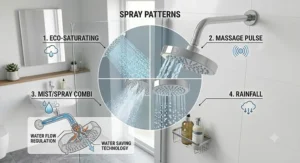
There are broadly three mechanisms at play: flow restriction (a physical cap limiting litres per minute, as with the Bristan limiter above), aeration (mixing air into the water, as with hansgrohe, Grohe and Croydex), and pressure-jet technology (firing concentrated jets that feel stronger without using more water, as with Methven and Joyoldelf). Which one suits you depends heavily on your existing water pressure and whether your shower runs off an electric heater, a combi boiler, or a gravity-fed tank.
Water Saving Shower Head Flow Rate Comparison
This is where a lot of buyers get caught out, because “eco” and “water saving” are unregulated marketing terms, while litres per minute (l/min) is an actual measurable spec you can compare directly. Here’s how our seven picks stack up against each other and against a standard shower.
| Type | Typical Flow Rate | Annual Litres (approx, 8-min daily shower) |
|---|---|---|
| Standard power/mixer shower | 12-15 l/min | 35,000-43,800 litres |
| Grohe Tempesta 100 EcoJoy | 9.5 l/min | approx. 27,700 litres |
| hansgrohe Croma Select E 1jet | 9 l/min | approx. 26,300 litres |
| Methven Aio Aurajet | 9 l/min | approx. 26,300 litres |
| Bristan flow limiter (lowest setting) | 4 l/min | approx. 11,700 litres |
| Electric shower (typical) | 6 l/min | approx. 17,500 litres |
Looking at the numbers, the gap between a standard mixer shower and any of our eco picks is stark: switching from a 15 l/min head to a 9 l/min model saves roughly 40% of your shower water annually, which for a household showering daily works out to thousands of litres a year. It’s worth flagging that flow rate isn’t the whole story, though, because two heads at an identical 9 l/min can feel completely different depending on whether that flow is aerated (feels fuller) or simply restricted (can feel thinner). This is exactly the trade-off between, say, the hansgrohe Croma Select E 1jet and the Bristan flow limiter fitted to your current head: identical numbers on paper, different sensations in the cubicle.
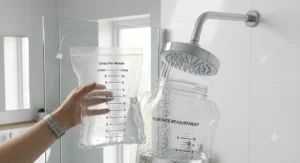
If you’re unsure what your current shower is actually putting out, Which?’s independent shower testing suggests a simple test: put a 2-litre container under the shower and time how long it takes to fill. If it fills in under 12 seconds, your shower is running at roughly 10 litres per minute or more, which is your cue that a water saving shower head would make a genuine difference to your bills.
✨ Don’t Miss These Exclusive Deals!
🔍 Take your bathroom to the next level with these carefully selected eco shower heads. Click on any highlighted product to check current pricing and availability. These picks help you cut bills without sacrificing a proper shower experience!
How to Choose the Best Eco Friendly Shower Head
Picking the right model isn’t just about grabbing whichever has the lowest litres-per-minute number on the box. Here’s the actual decision process worth working through:
- Check your existing water pressure first. A shower head designed for high-pressure mains systems, like the Methven Aio Aurajet, can feel underwhelming on a low-pressure gravity tank, and vice versa. Test with the Which? two-litre bucket method above before you buy anything.
- Identify your shower type. Electric showers, mixer showers and gravity-fed systems all respond differently to flow restriction. Never fit an inline restrictor like the Bristan limiter to an electric shower.
- Decide between full replacement and retrofit. A full head swap, such as the Grohe Tempesta, changes the spray pattern and finish. A retrofit limiter keeps your existing head but only affects volume, not aeration.
- Look for genuine third-party ratings, not just manufacturer claims. Look out for WRAS approval, WELS star ratings, or listing under the European Water Label Scheme, all of which appear on several products above.
- Weigh price against expected lifespan. A £15 budget head might need replacing within a couple of years, while a £50 premium model with a five-year guarantee often works out cheaper per year of use.
- Consider hard water areas separately. If you’re in a hard water region, prioritise heads with easy-clean, rub-off nozzles, since limescale build-up degrades flow and spray pattern faster than the shower head actually wearing out.
- Match the spray pattern to your household’s habits. Families washing long hair daily benefit more from full-coverage aerated heads, while single-occupant households after a quick, brisk wash may prefer the concentrated jet feel of something like the Joyoldelf turbo model.
Water Saving Shower Head vs Standard Shower Head
It’s worth being blunt about what you’re actually trading off here, because “water saving” doesn’t automatically mean “worse shower.” A standard shower head, whether on a power shower, mixer, or basic electric unit, typically runs unrestricted at 12-15 litres per minute, prioritising raw volume over efficiency. A water saving shower head deliberately caps that, usually to somewhere between 6 and 9.5 l/min, and compensates through aeration or jet technology so the sensation doesn’t collapse alongside the volume.
| Factor | Standard Shower Head | Water Saving Shower Head |
|---|---|---|
| Typical flow rate | 12-15 l/min | 6-9.5 l/min |
| Annual water use (daily 8-min shower) | ~35,000-43,800 litres | ~17,500-27,700 litres |
| Perceived pressure | Strong, unrestricted | Strong if aerated, weaker if simple restrictor |
| Energy cost to heat water | Higher | Lower, since less water is heated |
| Typical price | Often bundled free with a shower system | £15-£60 for a dedicated eco model |
The analysis here is straightforward: unless you specifically need maximum volume for something like washing a dog or rinsing paint off a ladder in the utility room, there’s very little practical downside to a water saving shower head, and the money saved on heating costs alone tends to repay the purchase within a year or two for a metered household. Where standard heads still win is in households on unmetered water with an electric shower already running efficiently, since the financial incentive is smaller, though the environmental case for reducing consumption remains regardless of your billing setup.
Practical Installation & Maintenance Guide
Fitting most of the shower heads above is genuinely a five-to-ten-minute job, no plumber required, but a few things trip people up in the first month.
Setup: Unscrew your existing shower head by hand (most UK fittings use a standard ½” BSP thread, though older houses occasionally have odd sizes, so check before buying). Wrap the thread in a couple of turns of PTFE tape if it isn’t pre-fitted with a washer, then hand-tighten the new head. Avoid over-tightening with tools, since cross-threading plastic components like those on the Croydex Varone or Joyoldelf is one of the most common first-week failure points reported in reviews.
First 30 days: Run the shower for 20-30 seconds before your first proper wash to flush out any manufacturing residue or trapped air, which can otherwise cause an initial sputtering spray that some buyers mistake for a faulty product. If you’ve fitted a flow limiter like the Bristan ECO-SHW, note that the flow will feel noticeably different for the first few showers purely through habit, most people adjust within a week.
Maintenance schedule: Aerating heads with rub-clean silicone nozzles, such as the hansgrohe and Grohe models, need a monthly rub-down with a thumb to knock off limescale, particularly in hard water regions across the Midlands and South East. Heads without rub-clean nozzles benefit from an occasional soak in a diluted white vinegar solution, roughly 30 minutes, to dissolve mineral build-up. Common mistake: leaving a flow limiter fitted permanently on an electric shower, which several manufacturer guidance documents specifically warn against due to overheating risk in the heater unit.
Real-World Scenarios: Which Shower Head Suits You?
The budget-conscious renter: You’re not going to rip out a shower system in a rented flat, so the Bristan Eco Shower Outlet Flow Limiter or the Croydex Varone Aqua Air make the most sense, cheap, reversible, and easy to take with you when you move. If your shower is electric, stick strictly to the Croydex head rather than the inline limiter.
The family bathroom with metered water: A household of four showering daily is exactly where the maths on a water saving shower head adds up fastest. The hansgrohe Croma Select E or Grohe Tempesta offer the aeration needed to keep multiple family members happy with the spray quality, while the reduced flow compounds significantly across four people showering every day of the year.
The low-pressure period property: Older houses with a loft tank rather than a combi boiler need a shower designed for that setup specifically, which is where the Aqualisa Aquastream Thermo earns its higher price tag. Fitting a standard aerated head onto a genuinely weak gravity system often just produces a disappointing trickle regardless of the eco technology inside it.
The pressure-obsessed sceptic: If you associate “water saving” with “weak shower” and need convincing otherwise, start with the Methven Aio Aurajet or the Joyoldelf turbo model, both specifically engineered around the perceived-pressure trick rather than pure volume, and both come in cheap enough to try without a huge financial commitment if you decide it’s not for you.
Common Mistakes When Buying a Water Saving Shower Head
The most frequent and costly mistake is fitting a flow restrictor to an electric shower. As several independent sources note, electric showers already manage their own flow and heating internally, and adding external restriction can cause water to back up and overheat the unit, a genuine safety and warranty issue, not just a performance quirk.
The second common error is buying purely on the lowest litres-per-minute number without checking whether the head aerates the water or just restricts it. A 6 l/min restrictor-only head on a low-pressure system can feel dramatically worse than a 9 l/min aerated head on the same system, so the flow figure alone is a poor proxy for how the shower will actually feel.
Third, buyers regularly skip checking their thread size and shower type before ordering, leading to returns or DIY workarounds. Most UK shower heads use a universal ½” BSP thread, but it’s always worth a 30-second check against your current fitting.
Finally, some buyers assume all “eco” claims are independently verified. They aren’t automatically, manufacturer percentage claims (the “60% less water” style figures seen throughout this list) are self-reported. Look for genuine third-party markers like WRAS approval or WELS star ratings to corroborate the marketing.
Water Saving Shower Heads for Different Water Pressure Systems
Not all UK homes share the same plumbing, and this genuinely changes which shower head performs best. High-pressure combi boiler and mains-fed systems, common in newer builds, suit aerating heads like hansgrohe, Grohe and Methven particularly well, since there’s enough baseline pressure for the aeration mechanism to work properly and produce a full-feeling spray.
Low-pressure gravity-fed systems, more common in older period properties with a loft cold water tank, need either a pumped solution like the Aqualisa Aquastream Thermo, or specifically low-pressure-rated aerating heads, since standard aerating cartridges designed for mains pressure can choke and produce a weak spray on gravity feed. Electric showers sit in their own category entirely: they regulate their own flow internally based on the heating element’s capacity, so external flow limiters are generally unnecessary and, as covered above, can actively cause problems.
If you genuinely don’t know which category your home falls into, a quick chat with your letting agent, a look at your boiler type, or simply timing your current shower’s fill rate with the bucket test mentioned earlier will point you in the right direction before you spend a penny.
Long-Term Cost & Maintenance
The upfront price of a water saving shower head is almost never the real cost story, it’s the ongoing savings that matter. Based on typical UK figures, switching a 15 l/min shower to a 9 l/min model for an eight-minute daily shower saves in the region of 17,500 litres of water annually per person, which on a metered water and sewerage bill (combined average around £417 a year according to the Consumer Council for Water) can meaningfully reduce your total bill, before even counting the energy saved not heating that extra water.
| Shower Head Type | Approx. Purchase Price | Approx. Annual Water/Energy Saving |
|---|---|---|
| Retrofit flow limiter (Bristan) | Under £15 range | Up to £24-£40 range |
| Budget aerating head (Croydex, Joyoldelf) | Under £20 range | Up to £40 range |
| Premium aerating head (hansgrohe, Grohe, Methven) | £25-£60 range | Up to £40-£96 range |
Interpreting that table, even the cheapest option here typically pays for itself within the first few months on a metered supply, and the premium options, while costing more initially, often carry five-year guarantees that stretch the cost-per-year down below the budget alternatives once you factor in replacement frequency. If you’re on unmetered water, the financial case weakens, but the energy savings on heating alone (roughly £24-£40 a year per typical manufacturer estimates) usually still justify the swap.
Features That Actually Matter (And Those That Don’t)
Cutting through the marketing, here’s what genuinely affects your day-to-day experience, and what’s mostly noise. Flow rate and aeration mechanism matter enormously, as covered throughout this piece, they’re the actual engine of water saving. WRAS approval and WELS star ratings matter because they’re independently verifiable, unlike a brand’s own percentage-saving claims. Nozzle material and rub-clean design matter for long-term maintenance, particularly in hard water regions.
What matters far less than the marketing suggests: the number of spray “modes” advertised (many buyers report using just one or two settings regardless of how many are on the dial), and dramatic percentage claims like “300% pressure increase,” which are usually measured against a specific low baseline rather than a universal standard. Colour and finish genuinely don’t affect performance at all, chrome, matte black and brushed nickel all function identically, so buy whichever matches your bathroom without a second thought on the functional side.
Safety, Regulations & Water Efficiency Compliance
UK shower fittings sold for domestic plumbing should carry WRAS approval (Water Regulations Advisory Scheme), confirming the product won’t contaminate the water supply or waste water through backflow. Several products in this list, including the Bristan flow limiters and Methven Aio Aurajet, explicitly carry this certification.
Beyond individual product certification, UK Building Regulations Part G sets a maximum whole-house water efficiency target of 125 litres per person per day for new-build properties in England, a figure water saving shower heads directly help households hit. The government’s own Energy Technology List, maintained by the Department for Energy Security and Net Zero, catalogues qualifying water and energy efficient shower technology for commercial and specification purposes, giving a genuinely independent benchmark beyond manufacturer marketing.
It’s worth reiterating the electric shower warning one final time here because it’s a genuine safety point, not just a performance tip: industry guidance and manufacturer instructions consistently warn that fitting a flow-restricting eco showerhead to an electric shower can cause water to build up in the heater tank and overheat, potentially damaging the system, so always check your shower type before fitting any restrictor-style product.
Problem → Solution: Fixing Common Eco Shower Head Complaints
Problem: The spray feels weak and thin. This is almost always a sign you’ve fitted a pure restrictor rather than an aerating head onto a lower-pressure system. Solution: switch to an aerating design like the hansgrohe Croma Select E or Methven Aio Aurajet, which manufacture perceived pressure rather than relying on raw volume.
Problem: Limescale is building up fast and choking the spray. Common in hard water regions across much of England. Solution: choose a model with rub-clean silicone nozzles, such as hansgrohe or Grohe, and get into a monthly habit of rubbing them clean by hand, or soak a non-rub-clean head in diluted white vinegar every month or so.
Problem: My electric shower feels like it’s struggling since I added an eco fitting. Solution: remove any inline flow limiter immediately, electric showers regulate their own flow and shouldn’t have external restrictors fitted, per manufacturer guidance.
Problem: I can’t tell if the eco head is actually saving anything. Solution: do the Which? bucket test before and after fitting, filling a 2-litre container and timing it, to get a genuine before-and-after comparison rather than relying on feel alone.
Problem: The new head doesn’t fit my existing shower arm. Solution: check for a universal ½” BSP thread before buying, and if your fitting is non-standard (common in some older or imported shower systems), a cheap universal adapter, sold separately, usually solves it.
FAQ
❓ How many litres per minute should a water saving shower head use?
❓ Can I fit a water saving shower head myself?
❓ Do water saving shower heads work with electric showers?
❓ How much money can a water saving shower head actually save?
❓ What's the difference between an eco shower head and a low flow shower head?
Conclusion
Swapping to a water saving shower head is one of the rare home upgrades that costs very little, takes minutes to fit, and genuinely pays for itself, often within the first year on a metered supply. Whether you go premium with the hansgrohe Croma Select E 1jet or Grohe Tempesta 100, land in the middle with the Methven Aio Aurajet or Aqualisa Aquastream Thermo, or start cheap with the Croydex Varone, Bristan flow limiter or Joyoldelf turbo head, the underlying maths works in your favour across the board.
The one genuine caveat worth remembering: match the mechanism to your plumbing. Aerating heads want decent baseline pressure, gravity-fed systems want purpose-built pumped solutions, and electric showers should never have an inline restrictor bolted on. Get that match right and there’s very little reason not to make the swap this week.
✨ Found this helpful? Check current prices on today’s top pick and start saving from your very next shower! 💧
Recommended for You
- Massage Shower Head UK: 7 Best Picks for 2026
- High Pressure Shower Head: 7 Powerful Picks for 2026
- Shower Head That Increases Pressure: 7 Powerful UK Picks 2026
Disclaimer: This article contains affiliate links. As an Amazon Associate, I earn from qualifying purchases. If you purchase products through these links, we may earn a small commission at no additional cost to you.
✨ Found this helpful? Share it with your friends! 💬🤗
