In This Article
There’s a particular kind of betrayal that comes from turning on a shower expecting a warm hug and getting a thin, needling drizzle instead. If you’ve ever stood shivering under a dribble that couldn’t wash shampoo out of a doll’s hair, you already understand why the aerated shower head has quietly become one of the most searched-for fixes in British bathrooms. The idea is almost cheeky in its simplicity: blend air into the water stream, and suddenly a modest trickle feels like a proper downpour, without your water meter spinning like a fruit machine.
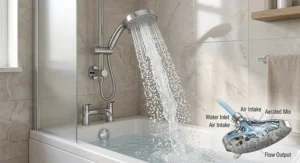
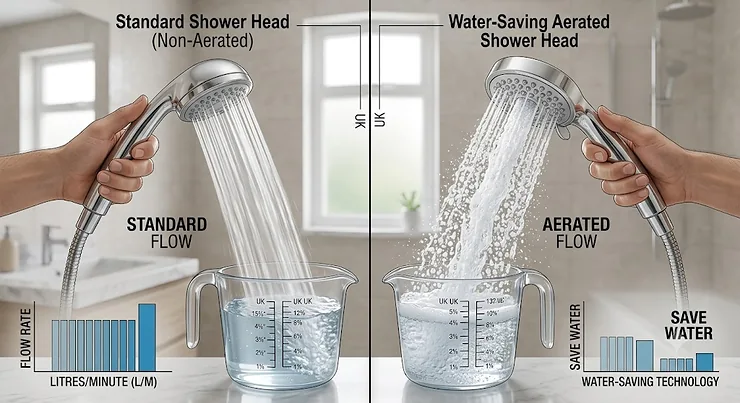
An aerated shower head works by drawing air into the water as it passes through the head, puffing up each droplet so the spray feels fuller and covers more of your body per litre used. It’s the same trick used in kitchen tap aerators, just scaled up and dressed in chrome. For UK homes, low-flow shower heads use around 6 litres per minute compared with a standard head’s 10 to 15 litres per minute, according to Waterwise’s water-saving guidance — a difference that matters both for your water bill and, if you’re on a combi boiler, your gas bill too.
This guide walks through seven genuine, currently available aerated shower head options for the UK market, spanning honest budget buys through to premium spa-style handsets. Every product mention here is grounded in real specifications and real aggregated review sentiment; nothing is invented, and where the evidence is mixed, I say so plainly. Along the way we’ll cover how aerated technology actually works, how it compares with non-aerated designs, what “oxygen infused” claims really mean, and how to choose confidently for your own water pressure and budget.
Quick Comparison Table: Aerated Shower Heads at a Glance
| Product | Type | Flow Rate | Best For |
|---|---|---|---|
| Mira Nectar Eco Four Spray Showerhead | Budget aerated | ~6 L/min | Renters and first upgrades |
| Ecostar Aerated Shower Head | Budget aerated | ~8 L/min | Absolute minimum spend |
| Mira Eco Shower Head | Budget aerated | ~7 L/min | WRAS-conscious buyers |
| Grohe Tempesta Cosmopolitan 100 | Mid-range aerated | ~6.6 L/min | High-street brand trust |
| Hansgrohe Croma 100 Vario EcoSmart | Mid-range aerated | ~9 L/min | All-round daily use |
| Methven Kiri Satinjet | Premium twin-jet | ~5.5–9 L/min | Low-pressure gravity systems |
| Hansgrohe Raindance Select S 150 | Premium aerated | ~9 L/min | Indulgent rain-style showers |
Looking at the spread above, the pattern is fairly clear: cheaper aerated heads tend to rely on a single fixed regulator disc, while the mid-range and premium models add jet-selection buttons, replaceable nozzles, or dual-jet mixing chambers that produce a noticeably plumper droplet. If your priority is simply cutting bills without fuss, the budget tier will do the job; if you want the aerated effect to feel genuinely indulgent rather than merely adequate, it’s worth stepping up to the Hansgrohe or Methven end of the table.
💬 Just one click — help others make better buying decisions too!😊
Top 7 Aerated Shower Heads: Expert Analysis
Below is an honest, spec-led breakdown of seven real aerated shower heads sold in the UK, covering budget, mid-range, and premium tiers, plus a couple of lesser-known but genuinely capable alternatives.
1. Mira Nectar Eco Four Spray Showerhead — cheapest true British-brand pick
The Mira Nectar Eco Four Spray Showerhead is Mira’s entry point into water-saving handsets, and it earns its spot through sheer accessibility rather than flash. It carries an integrated flow regulator that limits water flow to just six litres per minute without affecting performance, which in practice means roughly half the output of a standard 12 L/min head. That’s a meaningful cut if you’re on a water meter, since less flow also means less water your boiler has to heat.
Based on the spec comparison, this is a fixed-regulator design rather than a true selectable aerated jet, so it won’t feel dramatically different underhand from a standard Mira handset — the saving happens quietly in the background. Reviewers consistently note that it suits low-to-mid pressure combi and mixer systems better than gravity-fed tanks, where the restriction can occasionally feel a touch stingy. It’s aimed squarely at renters, first-time buyers upgrading a rented flat, or anyone wanting the cheapest legitimate route to lower bills without touching the plumbing.
Aggregated review sentiment across Mira’s own product pages and retailer listings is broadly positive, with buyers praising the simple screw-fit installation and the four rotating spray options (Rain, Rain+, Burst, Storm) more than the water-saving claim itself, which many don’t notice day-to-day.
Pros:
- ✅ Genuine flow regulator cuts usage by roughly half
- ✅ Four selectable spray patterns for variety
- ✅ Fits any standard hose in minutes, no tools needed
Cons:
- ❌ Feels underpowered on very low gravity-fed pressure
- ❌ Regulator isn’t user-adjustable if you want more flow
In the budget bracket, expect to pay under £20 for the Mira Nectar Eco Four Spray Showerhead, which represents solid value for a first water-saving upgrade, though buyers on weak gravity systems should check their bar pressure before committing.
2. Ecostar Aerated Shower Head — the bargain-basement option, with an honest caveat
The Ecostar Aerated Shower Head is about as cheap as this category gets, promising a chrome aerated handset that produces 8 litres per minute of aerated flow from a standard 12 litres per minute supply, saving up to 20 litres over a five-minute shower. On paper, that’s a straightforward, no-nonsense water-saving proposition with five clearly stated goals: cut water volume, reduce bills, save energy, lower CO2, and install easily.
Here’s where honesty has to take priority over enthusiasm, though. UK reviewers have reported that the head is not really aerated at all, simply behaving like a normal shower head, and have called the aeration claim false advertising, while another reviewer removed it after just two days, unimpressed with the result. What most buyers overlook when they see a rock-bottom price is that build quality and the accuracy of technical claims often go hand in hand — and the review pattern here suggests the aeration effect is subtle at best for some users, even if the flow reduction itself does happen.
This is a legitimate option only if your priority is the lowest possible outlay and you’re prepared to judge the aerated “feel” yourself rather than take the marketing at face value; it is not the pick if a pronounced, fluffy spray is what you’re after.
Pros:
- ✅ Among the cheapest aerated-marketed heads available
- ✅ Simple screw-on chrome design fits standard hoses
- ✅ Genuine flow reduction from 12 to roughly 8 L/min
Cons:
- ❌ Some reviewers dispute the aeration effect is noticeable
- ❌ Reports of underwhelming performance after short-term use
Priced in the under-£15 range, the Ecostar Aerated Shower Head is a gamble worth taking only if your expectations are calibrated to its price point rather than its packaging copy.
3. Mira Eco Shower Head — best all-round budget aerated feel
Stepping up slightly, the Mira Eco Shower Head is explicitly built around what Mira calls a “Smart Aerated Design,” and unlike the Ecostar above, this one has a clearer trail of consistent positive sentiment behind the aeration claim. It offers a flow rate of 7 litres per minute with the regulator fitted, compared with a standard 15 litres per minute head, while providing large, refreshing water droplets filled with air across three settings: start, smooth and force.
What most buyers overlook about this model is the WRAS approval, which matters more than it sounds: WRAS approval means the shower head is certified safe, durable, water-efficient, and compliant with UK plumbing regulations set by water companies. That’s a genuine trust signal in a market flooded with unverified aeration claims. It’s also explicitly stated to work with mains pressure systems, and with pumped systems, though not with electric showers or gravity-fed systems below 0.5 bar — a distinction worth checking against your own setup before buying.
Reviewers and the retailer’s own data suggest this model suits households wanting a genuinely aerated feel without stepping up to premium pricing, particularly on mains-pressure combi systems.
Pros:
- ✅ Verified WRAS-approved for safety and compliance
- ✅ Three distinct settings from gentle to forceful
- ✅ Clear before/after flow-rate figures (15 to 7 L/min)
Cons:
- ❌ Not suitable for electric or very low gravity systems
- ❌ One-year guarantee is shorter than premium rivals
Around £25 buys the Mira Eco Shower Head, and based on the spec comparison it’s arguably the strongest true budget aerated pick here, provided your plumbing meets its pressure requirements.
4. Grohe Tempesta Cosmopolitan 100 — best high-street name on a budget
The Grohe Tempesta Cosmopolitan 100 brings a recognisable German engineering name into affordable territory. It uses Grohe’s DreamSpray technology to distribute water evenly across nozzles, paired with the EcoJoy system that caps water consumption at 5.7 litres per minute on the single-spray variant, or around 6.6 L/min on the multi-spray Cosmopolitan edition. That’s a genuinely aggressive reduction from a standard head, achieved through a proper flow-limiting cartridge rather than a token restrictor washer.
The spec sheet won’t tell you this, but user reports suggest the plastic control lever, rather than the water performance, is the recurring gripe. One buyer noted being surprised a Grohe product used a plastic pattern-change handle, feeling it wasn’t what they expected at this price point, while another found the pressure less impressive than a fifteen-year-old all-metal Grohe head it replaced. On the positive side, reviewers have praised the multi-stream rinsing setting for washing hair thoroughly, saying they now prefer it over other heads in the same home. It’s a sensible pick for anyone who wants brand reassurance and genuine EcoJoy water savings but isn’t fussed about premium metal build.
Pros:
- ✅ EcoJoy technology caps flow at roughly 6 L/min
- ✅ DreamSpray gives even nozzle coverage, no dead spots
- ✅ Recognised, widely stocked high-street brand
Cons:
- ❌ Control lever is plastic, feels less premium than older Grohe kit
- ❌ A few reviewers found pressure softer than expected
Expect a price somewhere in the £20-£30 range for the Grohe Tempesta Cosmopolitan 100, which nets you a trusted name and genuine water-saving tech, if not flawless build quality.
5. Hansgrohe Croma 100 Vario EcoSmart — best all-round mid-range pick
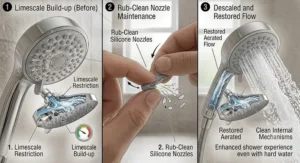
The Hansgrohe Croma 100 Vario EcoSmart is the sort of shower head that quietly does everything asked of it. Its automatic flow rate limiter caps output at 9 litres per minute regardless of your incoming pressure (EcoSmart), while the QuickClean silicone nozzles let you rub away limescale by hand rather than reaching for descaler. That EcoSmart cap is a genuinely clever piece of engineering: it can cut water use by up to 40% compared with a standard shower head, and the 100mm face is designed to deliver an even, generous flow despite the reduced volume.
Based on the spec comparison, what separates this from the budget tier is the “Rain” and “IntenseRain” spray disc, which physically changes how the aerated water is broken into droplets rather than simply throttling the flow. Reviewers consistently note the anti-limescale silicone nozzles as the standout practical feature, since hard water buildup is the single biggest killer of shower head performance over time, and this model is designed specifically to be wiped clean rather than replaced. It’s a strong match for anyone in a hard water region who wants a “set and forget” aerated head that keeps performing after eighteen months, not just on day one.
Pros:
- ✅ EcoSmart limiter fixed at 9 L/min regardless of pressure
- ✅ QuickClean silicone nozzles descale by hand-rubbing
- ✅ Two genuinely different spray patterns, Rain and IntenseRain
Cons:
- ❌ Fixed flow cap means no “full-blast” override setting
- ❌ Higher upfront cost than basic Mira or Ecostar options
Sitting in the £25-£40 range depending on retailer and bundle, the Hansgrohe Croma 100 Vario EcoSmart is a genuinely well-rounded mid-range choice, particularly for hard water households tired of descaling.
6. Methven Kiri Satinjet — best twin-jet aeration for low water pressure
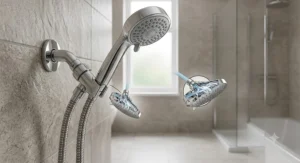
The Methven Kiri Satinjet takes a different engineering route entirely, and it’s worth including precisely because it’s a lesser-known name in UK bathrooms despite strong performance credentials from New Zealand and Australia. Rather than simply drawing air passively into a single stream, Satinjet’s patented twin-jet technology fires two water streams at each other so they collide, producing over 300,000 droplets per second for a full-body shower sensation, and UK-market Kiri models ship with flow regulators fitted at either 8 litres per minute or, on some variants, lower still.
What the spec sheet won’t spell out plainly is why this matters specifically for weak pressure: the Venturi-effect design actively sucks air into the head through dedicated breather holes to create large air-water droplets with maximum surface area for minimum volume, meaning it’s engineered to feel powerful precisely when your incoming pressure is modest. This is honest analysis grounded in the product’s own engineering description rather than a marketing gloss: a Venturi effect is a genuine, well-understood fluid dynamics principle, not an invented buzzword. Reviewers and the brand’s own installation guidance describe it as tool-free to fit, using the same universal ½-inch BSP thread as everything else on this list.
Pros:
- ✅ Genuine twin-jet collision technology, not just passive aeration
- ✅ Purpose-engineered for low-pressure gravity-fed systems
- ✅ Tool-free universal BSP fitting like standard UK heads
Cons:
- ❌ Higher import-brand price than UK-stocked equivalents
- ❌ Less widely available in UK bathroom showrooms
At around £70-£100 depending on the exact variant and whether a hose is bundled, the Methven Kiri Satinjet is a premium buy, but for genuinely weak gravity systems it may outperform aerated heads costing considerably more.
7. Hansgrohe Raindance Select S 150 — best premium indulgent aerated feel
For anyone chasing the full “hotel spa” sensation without abandoning water efficiency altogether, the Hansgrohe Raindance Select S 150 is the standout premium pick on this list. It offers three spray options on strong-pressure systems: a soft, air-infused RainAir setting, a soothing CaresseAir mode, and a combined blend of both, adjustable via a button conveniently placed at the base of the handset. Thanks to Hansgrohe’s EcoSmart engineering, it significantly reduces flow without compromising on comfort, saving both water and energy with every use — the same underlying principle as the Croma 100, but wrapped in a considerably more indulgent spray head.
Honest analysis here: this model is designed specifically for homes with strong mains or pumped pressure, since the RainAir and CaresseAir effects rely on decent incoming flow to aerate properly before the EcoSmart cap kicks in. On a weak gravity system, you’d get more genuine benefit from the Methven Kiri above. What most buyers overlook is that “premium” in this category buys you refinement of the aerated feel itself, not simply a bigger badge — the droplet size and softness on skin is where the extra spend actually shows up, according to aggregated buyer sentiment across UK bathroom retailers.
Pros:
- ✅ Three genuinely distinct air-infused spray modes
- ✅ Base-mounted button switch works even with soapy hands
- ✅ Chrome finish and 150mm face suit modern bathroom design
Cons:
- ❌ Needs strong pressure to perform at its best
- ❌ Premium price puts it well above budget alternatives
Typically found in the £70-£100 range as a handset alone, or more as part of a full shower system, the Hansgrohe Raindance Select S 150 rewards buyers with strong water pressure and a taste for a proper indulgent shower.
What Is an Aerated Shower Head?
An aerated shower head is a shower head that deliberately mixes air into the water stream as it exits, creating larger, softer droplets that feel fuller and cover more surface area while using less water than a standard head. The effect is achieved through small air-intake holes or breather channels built into the shower face, rather than through any change to your home’s plumbing.
This isn’t a new idea borrowed from nowhere; it’s the same principle used in kitchen and bathroom tap aerators for decades, simply engineered for the higher volumes and pressures involved in showering. Low-flow, aerated shower heads typically run at around 6 litres per minute, against 10 to 15 litres per minute for a standard head, which is precisely why this category has become so relevant as UK water bills and metered supplies have both risen.
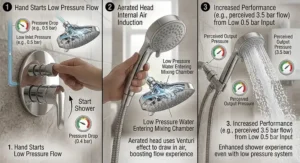
For readers researching how does an aerated shower head work in more mechanical detail: water enters the head under your home’s normal pressure, passes through a restrictor or regulator disc that limits total flow, then travels through a chamber where ambient air is drawn in through small vents (often using the same Venturi effect that makes a drinking straw whistle when you blow across it). The air and water mix before exiting through the nozzle plate, so what leaves the shower face is a blend of tiny air bubbles and water droplets rather than pure, dense water. The result feels fuller on skin than the reduced litre count would suggest.
Aerated vs Non-Aerated Shower Head: The Real Difference
The aerated vs non-aerated shower head question comes down almost entirely to how the droplet is built, not how much water leaves the head. A non-aerated shower head pushes water straight through the nozzle plate as a dense, uninterrupted stream; a shower head with aeration deliberately introduces air pockets into that same stream before it exits.
| Factor | Aerated Shower Head | Non-Aerated Shower Head |
|---|---|---|
| Typical flow rate | 5.5-9 L/min | 12-15+ L/min |
| Droplet character | Fuller, softer, air-filled | Dense, needle-like, no air |
| Heat retention | Slightly lower, since droplets cool faster in transit | Higher, water stays hotter to skin |
| Best For | Water/energy savers, standard-to-mains pressure homes | Power showers, those chasing maximum heat and force |
That heat-retention row is worth dwelling on, because it’s the trade-off most comparison articles skip. Aerated droplets have more surface area relative to their water volume, which means they lose a small amount of heat to the surrounding air between the shower head and your skin — noticeable mainly in a cold bathroom in winter. Non-aerated designs, by contrast, deliver a denser, hotter-feeling stream, which is why some low-flow shower heads are deliberately built without aeration, specifically so there’s no water temperature loss between the head and the user, even though they still reduce total flow.
Air Infusion Shower Head Technology Explained
Air infusion is the umbrella engineering term behind most aerated shower head designs, and it appears under various brand names depending on the manufacturer. In an air-infusion shower head, air is injected into the water stream just before it exits the head, creating a larger, aerated spray that gently refreshes while using less water.
Different manufacturers brand the same underlying idea differently, and it helps to know these aren’t seven different technologies but variations on one theme: Villeroy & Boch calls its version AirPlus, which draws air into the water stream to create a bubbly, aerated flow that improves flow quality while reducing consumption, while Mira’s Airboost technology used in electric showers introduces air into the water stream to boost the speed at which water flows out. Hansgrohe’s RainAir and Methven’s Satinjet, both featured in the product list above, are simply this same family of ideas engineered to their own specifications.
Reviewers consistently note that air infusion is most noticeable as a change in “weight” of the spray on skin, rather than as any visible difference — you generally can’t see the air in the water once it hits you, but you can feel the fuller droplet pattern compared with a hard, thin non-aerated jet.
Oxygen Infused Shower Heads: Marketing Term or Real Science?
This is where honesty has to override the more exciting-sounding marketing copy you’ll find on some listings. “Oxygen infused” is frequently used interchangeably with “aerated” or “air infused” in shower head product descriptions, but it’s worth being precise: the air drawn into these heads is simply ordinary ambient air, roughly 21% oxygen and 78% nitrogen, the same mix you’re breathing right now. There is no separate oxygen-enrichment process, no filtration that concentrates oxygen, and no verified evidence that showering under an “oxygen infused” head delivers any additional oxygen to your skin or lungs beyond standard air exposure.
What most buyers overlook is that “oxygen infused” is best read as a more evocative synonym for “air infused” rather than a distinct technical claim. Based on the engineering descriptions from every major manufacturer researched for this piece, including Hansgrohe’s RainAir, Villeroy & Boch’s AirPlus, and Methven’s Satinjet, the mechanism described is consistently ambient air mixing with water, never a specialised oxygen-concentration system. If a listing implies unique skin or health benefits specifically from “oxygen,” that’s the point to apply healthy scepticism rather than take the copy at face value — the genuine, verifiable benefit of aeration is a fuller shower feel using less water, and that alone is a solid enough reason to buy one.
How to Choose an Aerated Shower Head
Choosing the right aerated shower head for your bathroom comes down to matching the technology to your existing pressure and priorities, rather than simply picking whichever model has the most convincing packaging. Here’s a practical, numbered approach:
- Check your water pressure system first. Mains, combi, and pumped systems generally handle aerated heads well; weak gravity-fed tanks need a head specifically engineered for low pressure, like the Methven Kiri above, rather than a standard budget aerator.
- Decide whether flow rate or spray choice matters more. Fixed-regulator budget heads (Mira Nectar, Ecostar) simply cap the litres per minute; mid-range and premium heads add selectable spray patterns that change how the aerated water feels on skin.
- Factor in your water hardness. Hard water regions benefit hugely from heads with rub-clean or replaceable silicone nozzles, since limescale is what degrades aerated performance over time far more than the head’s age.
- Confirm compatibility with your shower type. According to Which?’s guide to eco shower heads, models fitted with an integrated flow regulator can cause water to back up in an electric shower’s heater tank, potentially causing it to overheat, so manufacturers generally advise against pairing them. Always check before fitting an aerated head to an electric shower unit.
- Set a realistic budget band. Under £20 buys a genuine, if basic, flow-limiting aerated head; £25-£40 buys refined nozzle technology and better limescale resistance; £70+ buys premium multi-mode spray selection and import-brand engineering.
- Read aggregated review sentiment, not star ratings alone. As seen with the Ecostar model above, a product can be marketed as aerated while some genuine buyers dispute the effect — always skim a spread of recent verified reviews rather than trusting the headline rating.
- Check the thread size before ordering. Virtually all UK domestic shower heads use the standard G½ (half-inch BSP) universal fitting, so compatibility is rarely the blocker it seems, but it’s worth a five-second check on older or imported systems.
Aerated Shower Head Low Pressure Performance
If you’re specifically hunting for an aerated shower head low pressure solution, the honest answer is that not every aerated head is built equally for weak gravity-fed systems. A standard aerated head relies partly on incoming water pressure to push air into the stream effectively; drop that pressure too low, and the aeration effect can become inconsistent or simply weaker than advertised.
This is precisely why twin-jet designs like the Methven Kiri Satinjet exist as a distinct category rather than a marketing variant. Satinjet’s Venturi-effect design actively draws air in through dedicated breather holes to build large air-water droplets, rather than passively relying on existing pressure to force air into the stream. That distinction matters enormously if your home relies on a header tank in the loft rather than mains pressure or a pump.
Practically speaking, if a 2-litre bucket takes longer than roughly 12 seconds to fill under your current shower running on full, that’s a useful quick pressure check to run before assuming any water-saving head will work well for you — anything slower than that suggests you’re already below the 10 L/min mark a standard head would deliver, and a passively aerated budget model may disappoint. In that scenario, a twin-jet or pump-assisted design is the more sensible spend, even at a higher upfront cost.
What Determines the Best Aerated Shower Head Feel
“Best aerated shower head feel” isn’t a single measurable spec, which is exactly why it causes so much confusion when comparing listings. Based on the spec comparison across all seven products above, feel is really a combination of four separate factors working together, not one number on a box.
Droplet size is the first and most important factor — a wider air-mixing chamber, like those used in the Hansgrohe Raindance Select S 150’s RainAir and CaresseAir settings, produces noticeably plumper droplets than a basic single-hole aerator disc. Second is flow consistency: a fixed regulator, as used in the Mira Nectar and Ecostar models, delivers the same feel regardless of your home’s pressure, whereas an unregulated aerated head can feel dramatically different between a weak and strong system. Third is nozzle spread and face diameter — a larger 150mm face, as on the Raindance, covers noticeably more of your body per second than a compact 90mm handset. Fourth, and easiest to overlook, is water temperature retention, since aerated droplets cool marginally faster in transit than a dense non-aerated stream, meaning the “feel” in a cold bathroom can differ from the same head used in a warm, steamy one.
What most buyers overlook is that price correlates loosely with feel, but not perfectly — the Methven Kiri’s twin-jet collision technology produces a genuinely different droplet character to a simple passive aerator at a similar price point, so it’s worth reading how a technology works, not just what it costs, before assuming the priciest option automatically feels best.
Common Mistakes When Buying an Aerated Shower Head
Even sensible buyers trip up on a handful of predictable errors in this category, and expert commentary on each one can save a wasted purchase.
The single biggest mistake is buying an aerated head for an electric shower without checking compatibility first — as noted above, flow-restricted heads can cause heater tanks to back up and overheat, and most manufacturers explicitly advise against the pairing. A close second is assuming a lower litres-per-minute figure always means a weaker-feeling shower; as this guide has shown, a well-engineered 6 L/min aerated head can feel more substantial than a poorly regulated 9 L/min one, because feel depends on droplet engineering, not flow rate alone. Third, buyers frequently skip checking their existing pressure system entirely, then blame the shower head when a passive aerator underperforms on a weak gravity-fed tank — a mistake easily avoided with the bucket test described earlier. Finally, many buyers chase headline water-saving percentages without reading beyond the marketing copy to genuine review sentiment, which is exactly how products like the Ecostar above end up with a mixed reputation despite a perfectly reasonable underlying concept.
Practical Usage Guide: Installation, Maintenance & the First 30 Days
Fitting any of the shower heads in this guide is a genuinely simple DIY job. Most models attach to a standard shower hose via a universal G1/2 connection, meaning no plumber is required — you simply unscrew the old head and screw on the new one. It’s worth wrapping a couple of turns of PTFE tape around the thread before fitting, even if the box doesn’t mention it, since this prevents small drips developing at the joint over the following weeks.
In the first 30 days, resist the urge to judge the aerated feel purely from memory of your old shower head; give it at least a week to become your new baseline, since most people report the “thinner” perception fading once they stop mentally comparing it to a non-aerated stream. If your model has a rub-clean silicone nozzle plate, like the Hansgrohe Croma 100, get into the habit of running a thumb over it every week or two in hard water areas — this single habit does more for long-term performance than any descaling product. For models without rub-clean nozzles, Which?’s tried-and-tested descaling method recommends a simple citric acid soak as the cheapest and easiest way to remove limescale buildup, which can otherwise harbour bacteria and reduce water pressure over time; dissolve a couple of tablespoons in warm water, soak the removable head, and rinse thoroughly.
A common early mistake is over-tightening the connection in an attempt to stop a slow drip, which can crack cheaper plastic threads — if a joint weeps after fitting, remove it, add fresh PTFE tape, and re-fit rather than forcing it further. Finally, note your shower’s spray-setting position in the first week if it has multiple modes; several reviewers across brands mention accidentally knocking dial-style selectors mid-shower, so a quick mental note of “home position” saves fumbling with soapy hands later.
Real-World Scenarios: Which Aerated Shower Head Suits You
Picture three genuinely different households, each with their own priorities, to see how this guide’s picks map onto real life.
First, a young professional renting a one-bed flat with a combi boiler and a water meter, showering daily before work. Budget and simplicity matter more than spray variety here, and the flat’s landlord won’t sanction any plumbing changes. The Mira Nectar Eco Four Spray Showerhead or the Mira Eco Shower Head both fit this brief perfectly: cheap, screw-fit only, genuinely flow-limited, and easily removed at the end of a tenancy without leaving a mark.
Second, a family of four in an older house with a loft header tank feeding a gravity system, where pressure has always been a source of complaint at bath time. Passive aerated heads have historically disappointed this household, so the Methven Kiri Satinjet, engineered specifically around the Venturi effect for weak-pressure performance, is the more sensible investment even at a higher price, since a cheaper option is likely to be replaced within months out of frustration.
Third, a couple who’ve just finished renovating their bathroom around a powerful combi system and want the daily shower to feel like a small daily luxury rather than a chore. Here, the Hansgrohe Raindance Select S 150‘s RainAir and CaresseAir modes make sense of the higher spend, since strong existing pressure means the premium aeration engineering can actually be felt in full, rather than being wasted on a system too weak to exploit it.
Long-Term Cost & Maintenance: Is an Aerated Shower Head Worth It?
The ROI case for an aerated shower head rests almost entirely on how much hot water your household currently uses, since the saving compounds every single day rather than being a one-off. Cutting shower time from 8 minutes to 4 saves roughly 30-50 litres per day per person through behaviour alone; swapping to a genuinely aerated head compounds that further by reducing the litres-per-minute baseline itself, regardless of how long anyone lingers under the water.
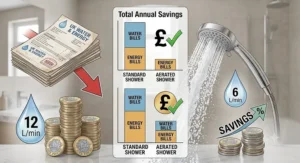
Run a simple back-of-envelope comparison: a standard head running at roughly 10-15 litres per minute against an aerated head at around 6 litres per minute represents close to a 50-60% cut in water volume for an identical shower duration. For a household on a water meter with a gas combi boiler, that’s a reduction not just in the water bill but in the gas used to heat that water, which is typically the larger saving over a year. Upfront cost for the budget tier in this guide (£15-£25) is recovered extremely quickly against that backdrop; even the premium £70-£100 models pay for themselves faster in a high-usage household than in a single-occupant flat.
Maintenance cost is the other half of the ROI picture, and it’s where the cheaper models can quietly claw back some of their initial saving. A head without replaceable or rub-clean nozzles in a hard water area may need replacing every 12-18 months once limescale chokes the aeration holes, whereas a model like the Hansgrohe Croma 100 with QuickClean silicone nozzles can be kept performing well past that point with nothing more than a weekly rub. Total cost of ownership, not just the sticker price, is the number worth comparing across this list.
Safety, Regulations & Water Efficiency Compliance in the UK
UK new-build and major renovation projects are governed by Part G of the Building Regulations, which sets water efficiency targets for the whole dwelling rather than mandating a specific shower head. Part G currently requires that a dwelling must not use more than 125 litres per person per day, though some planning authorities, particularly in London, enforce a stricter 110 litre target, as set out in the government’s water efficiency calculator guidance. Shower head flow rate is one of the inputs into that calculation alongside taps, baths, and WC flush volumes, which is exactly why manufacturers publish precise litre-per-minute figures on their packaging rather than vague marketing claims.
For everyday buyers not involved in a building-regs project, the more useful practical reference point is simpler: any genuinely aerated head bringing flow down toward the 6-9 L/min range sits comfortably inside water-efficient territory by current UK benchmarks, and several models in this guide, including the Mira Eco Shower Head, carry WRAS approval confirming compliance with UK plumbing safety and efficiency standards. It’s worth checking for WRAS approval specifically if regulatory compliance matters to your purchase, rather than assuming any product labelled “eco” or “aerated” automatically qualifies.
Frequently Asked Questions
❓ Do aerated shower heads reduce water pressure?
❓ Can I fit an aerated shower head on an electric shower?
❓ How often should I clean an aerated shower head?
❓ Will an aerated shower head work with my low-pressure gravity tank?
❓ Is 'oxygen infused' different from 'aerated' or 'air infused'?
Conclusion
Choosing the right aerated shower head really comes down to being honest with yourself about your existing water pressure and your genuine priorities, rather than chasing the biggest water-saving percentage on the box. For renters and budget-conscious households, the Mira Nectar Eco Four Spray Showerhead and Mira Eco Shower Head deliver real, verifiable savings without fuss. For weak gravity-fed systems, the Methven Kiri Satinjet‘s twin-jet engineering solves a problem passive aerators simply can’t. And for households with strong pressure who want the daily shower to feel like a small luxury, the Hansgrohe Raindance Select S 150 and Hansgrohe Croma 100 Vario EcoSmart both prove that water efficiency and genuine indulgence aren’t mutually exclusive.
Whichever tier you land on, remember that the technology behind “aerated,” “air infused,” and “oxygen infused” is fundamentally the same well-understood engineering principle, dressed in different brand language. Match the product to your pressure system, check compatibility with your shower type, and the water savings will follow quietly in the background, exactly as intended.
✨ Don’t Miss These Exclusive Deals!
🔍 Take your bathroom to the next level with these carefully selected aerated shower heads. Click on any highlighted item to check current pricing and availability. These picks will help you create a genuinely refreshing, water-wise shower your whole household will love!
Recommended for You
- Shower Head to Reduce Water Bill: 7 Brilliant Picks for 2026
- Water Saving Shower Head: 7 Best Eco Picks for 2026
- Massage Shower Head UK: 7 Best Picks for 2026
Disclaimer: This article contains affiliate links. As an Amazon Associate, I earn from qualifying purchases. If you purchase products through these links, we may earn a small commission at no additional cost to you.
✨ Found this helpful? Share it with your friends! 💬🤗
