
In This Article
Every UK bathroom has one awkward corner. It’s usually the one where the radiator, the door and your ambitions collide. Get the tray wrong and you’ll be shuffling sideways for a decade. Get it right and a cramped corner turns into a shower you actually enjoy. The offset quadrant shower tray vs quadrant tray decision is where most corner-shower projects are won or lost.
What Is the Difference Between an Offset Quadrant Shower Tray vs Quadrant Tray?
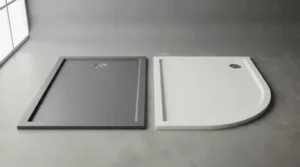
An offset quadrant shower tray is a corner tray with a curved front and two unequal straight sides, one long and one short. A standard quadrant tray has two equal sides. The offset version buys you extra standing room along one wall. You still get the sweeping curve that keeps the door swing tidy.
That sounds like a small tweak. In practice it changes how the shower feels, how the enclosure fits and how forgiving your walls need to be. Mira’s shower tray buying and fitting guide makes the core point plainly: tray and enclosure must match in shape and size, or water finds the gap.
Below you’ll find seven real trays and kits, the maths behind the dimensions, and layout advice that goes beyond the listing. Some of it will save you a costly reorder.
Quick Comparison Table: Standard Quadrant vs Offset Quadrant
| Feature | Standard quadrant tray | Offset quadrant tray |
|---|---|---|
| Typical sizes | 800 x 800, 900 x 900, 1000 x 1000mm | 900 x 760 up to 1400 x 800mm; 1200 x 800 and 1200 x 900 most common |
| Sides | Two equal straight sides | One long, one short straight side |
| Handing (left/right) | Not needed | Essential |
| Bounding-box area | 0.81 m² (900 x 900) | 0.96 m² (1200 x 800) |
| Best For | Square corners, compact en suites: Aquadart Quadrant 900 x 900 | Rectangular corners, family bathrooms: Elegant Ultra-Slim Offset Quadrant, Aquadart Offset Quadrant 1200 x 800 |
The bounding-box row is my own arithmetic, and it explains most of the decision. A 1200 x 800 offset footprint is roughly 19% larger than a 900 x 900 square envelope before the curve trims it. Most of that extra length runs along one wall, and that’s the wall you stand against.
If your corner is genuinely square and tight, Aquadart Quadrant 900 x 900 is the sensible baseline. If one wall has room to give, the offset shapes buy comfort without abandoning the curve.
💬 Just one click — help others make better buying decisions too!😊
Top 7 Shower Trays: Expert Analysis
I’ve chosen a spread from budget-friendly to premium, including one standard quadrant as a yardstick. Availability and sellers change often, so check current listings on Amazon before you commit. Prices below are indicative only.
A note on reviews. Deep, verifiable review pools were thin for several of these listings when I researched them, so I won’t invent ratings or quotes. Where reviewer sentiment isn’t verifiable I say so, and lean on specs and UK buyer-guide consensus instead.
1. Elegant 1200×800 Ultra-Slim Offset Quadrant — light enough for one-person handling
The Elegant Ultra-Slim Offset Quadrant is a 1200 x 800mm right-handed tray, made from acrylic-capped stone resin at just 40mm high. That height means it sits close to the floor, which suits low-profile installs where you want minimal step-over.
The specs are practical. Mineral anti-torsion beams add rigidity, and the tray is light enough for one person to carry. That matters in a first-floor bathroom with a narrow staircase. A 90mm fast-flow waste is included, so you’re not hunting for a compatible waste. An optional riser kit converts it to a raised install for trays up to 1200mm.
Who’s it for? DIYers or single-handed fitters who’d rather not manoeuvre a 35kg slab. It’s also a good fit for anyone matching an offset enclosure from the same brand.
Reviewer sentiment: I couldn’t verify a meaningful pool of independent reviews, so treat this as spec-led. The recurring buyer-guide warning for every offset tray applies here, and that’s to confirm handing from the diagram.
Pros:
- ✅ Light enough for one-person carrying
- ✅ 40mm profile for low step-over
- ✅ Waste included in the package
Cons:
- ❌ Right-hand only in this listing
- ❌ Needs a riser kit for solid floors
Price band: mid-range; check current price. Verdict: strong value if you want light and low.
2. Aquadart Offset Quadrant 1200 x 800 — the British-made benchmark
The Aquadart Offset Quadrant 1200 x 800 is cast from stone resin and capped in gloss ABS. The manufacturer builds them in West Yorkshire, and the tray is 45mm high with a 90mm waste hole. Stone resin tolerates load well, so the tray feels solid underfoot rather than drummy.
The ABS cap is non-porous and easy to wipe. That’s a genuine advantage over cheaper acrylic trays, which can mark more readily. Riser leg and panel packs are sold separately, and the range is designed to pair with Aquadart quadrant enclosures. That helps enclosure-tray compatibility if you buy within the brand.
Retailers differ on whether the waste comes included, so read the listing. It’s a small detail that turns a “bargain” into a same-day trip to the merchant.
Reviewer sentiment: not verifiable at meaningful depth. This is a spec-led recommendation.
Pros:
- ✅ Made in Britain with solid stone resin core
- ✅ Gloss ABS cap wipes clean easily
- ✅ Riser packs available for raised installs
Cons:
- ❌ Waste inclusion varies by seller
- ❌ Left and right versions need careful ordering
Price band: mid-range; check current price. Verdict: the dependable default for most 1200 x 800 corners.
3. Bathlab Slate Effect Offset Quadrant 1200 x 800 — dark slate look, lifetime guarantee
The Bathlab Slate Effect Offset Quadrant 1200 x 800 is a right-hand tray in dark grey, textured to mimic slate. At 40mm high it’s a low-profile option, and the front-centre waste position keeps the drain away from where you stand.
The material is a polyurethane resin and volcanic-ash composite. That makes it lighter than a conventional stone resin tray, which helps installation. A flat underside makes levelling easier. A fast-flow waste is included, and the manufacturer offers a lifetime guarantee on the tray, with five years on the waste.
The design point matters. A dark tray hides limescale streaks less forgivingly than you’d think, so plan a weekly squeegee habit. It looks superb against matt black brassware and large-format tiles, though.
Reviewer sentiment: not verifiable at depth. Choose this for aesthetics and warranty, not for review-backed reassurance.
Pros:
- ✅ Lightweight composite eases handling
- ✅ Lifetime guarantee on the tray
- ✅ Textured slate finish adds grip
Cons:
- ❌ Dark surface shows limescale marks
- ❌ Right-hand version only in this listing
Price band: mid-to-upper; check current price. Verdict: a design-led pick that earns its premium.
4. Aquacast Deep Offset Quadrant 1200 x 800 — anti-slip family pick
The Aquacast Deep Offset Quadrant 1200 x 800 is a stone resin offset quadrant with an anti-slip surface, in white and right-handed. The “Deep” in the name is a cue to check the listed height before ordering. A deeper tray needs more clearance for the waste trap, but it handles more water at the threshold.
Anti-slip texture is the feature I’d prioritise for households with children or older relatives. Wet acrylic is slippery, and a textured surface reduces that risk. The trade-off is cleaning. Textured surfaces trap soap film, so a soft brush earns its keep.
At the time of research one retailer listed it for under £200, which places it at the sensible end of the 1200 x 800 market.
Reviewer sentiment: I couldn’t verify independent review data, so no claims here.
Pros:
- ✅ Anti-slip surface suits family use
- ✅ Stone resin construction feels rigid
- ✅ Competitive under-£200 bracket
Cons:
- ❌ Texture needs regular brushing
- ❌ Height must be checked before fitting
Price band: under £200; check current price. Verdict: the pragmatic family option.
5. London Offset Quadrant 1000 x 800 — the compact mid-size value pick
The London 1000 x 800 sits between the tight 900 x 760 and the roomy 1200 x 800. It’s 45mm high, weighs around 35kg and uses acrylic-capped stone resin with a gloss white finish. The range spans 900 x 760 up to 1200 x 900, in both handings, so you can step up or down without switching brand.
It needs a 90mm waste, sold separately. That adds a line to your shopping list, so factor it in when comparing prices. Listings I saw put the tray itself in roughly the £120-£180 range, which makes it the cheapest offset here.
1000mm suits a bathroom where a 1200 tray would eat the door clearance. Think of it as the tray for a room that says “almost, but not quite”.
Reviewer sentiment: the retailer page I checked showed only a handful of reviews, too few to draw conclusions.
Pros:
- ✅ Lower price for a genuine offset
- ✅ Wide size range in both handings
- ✅ 45mm height suits most floors
Cons:
- ❌ Waste sold separately
- ❌ Very small verified review pool
Price band: £120-£180 range; check current price. Verdict: best budget entry to offsets.
6. Aquadart Quadrant 900 x 900 — the standard quadrant yardstick
Here is the baseline. The Aquadart Quadrant 900 x 900 is a standard quadrant tray: 900mm each way, 45mm high (with a ±5mm tolerance), ABS-capped stone resin, British-made. The 90mm waste hole is standard, and a riser leg and panel pack is optional for raised installs.
The tolerance detail matters more than it sounds. A ±5mm height variation means you shouldn’t design a flush tiled surround to the millimetre. Leave adjustment room, and use flexible sealant at the edges.
It’s the right answer when your corner is properly square and you value floor space. A quadrant corner leaves more walkway than a square tray of the same nominal size, because the curve removes the sharp front corner. Retailers differ on whether waste is included, so check.
Reviewer sentiment: not verifiable at depth. This is a spec-led recommendation.
Pros:
- ✅ Compact footprint frees floor space
- ✅ Wide enclosure choice for standard quadrants
- ✅ No handing to get wrong
Cons:
- ❌ Less standing room than any offset
- ❌ Waste inclusion varies
Price band: budget; check current price. Verdict: the sensible pick for square, small corners.
7. Diamond 8mm Offset Quadrant Enclosure 1000 x 800 with Non-Slip Tray — the kit that removes guesswork
Rather than buy tray and enclosure separately, the Diamond Offset Quadrant Kit bundles both. The enclosure is 8mm framed glass, offered in 900 x 760, 1000 x 800, 1200 x 800 and 1200 x 900, in left or right entry. It meets BS EN 14428, the enclosure performance standard.
The tray is a non-slip low-profile design, and there’s a raised version with an easy-plumb panel kit. The included 90mm waste has a chrome top and complies with BS EN 1329/1 and 1451/1. One clever detail: the enclosure doesn’t sit flush to the tray edge, leaving a gap for tiling.
A kit is the surest route to enclosure-tray compatibility. You’re buying parts designed to meet in the middle.
Reviewer sentiment: not verifiable at meaningful depth. Listings and sellers vary on Amazon, so verify handing and contents before ordering.
Pros:
- ✅ Tray and enclosure matched by design
- ✅ Non-slip tray surface included
- ✅ Waste and standards compliance detailed
Cons:
- ❌ Higher outlay than tray alone
- ❌ Less flexibility to mix brands
Price band: premium bundle; check current price. Verdict: worth it if compatibility anxiety keeps you awake.
Top 7 at a Glance
| Product | Size | Height | Material | Best For |
|---|---|---|---|---|
| Elegant Ultra-Slim Offset Quadrant | 1200 x 800 | 40mm | Acrylic-capped stone resin | One-person installs |
| Aquadart Offset Quadrant 1200 x 800 | 1200 x 800 | 45mm | ABS-capped stone resin | Dependable all-rounder |
| Bathlab Slate Effect Offset Quadrant | 1200 x 800 | 40mm | Resin/volcanic-ash composite | Design-led bathrooms |
| Aquacast Deep Offset Quadrant | 1200 x 800 | Check listing | Stone resin, anti-slip | Households with children |
| London Offset Quadrant 1000 x 800 | 1000 x 800 | 45mm | Acrylic-capped stone resin | Budget-conscious buyers |
| Aquadart Quadrant 900 x 900 | 900 x 900 | 45mm (±5mm) | ABS-capped stone resin | Square, tight corners |
| Diamond Offset Quadrant Kit | 1000 x 800 | Low or raised | Non-slip tray + 8mm glass | Buyers wanting a matched bundle |
Look at the pattern above. Four of the seven are 1200 x 800, because that footprint dominates the UK offset market. Your real choice then becomes finish, weight and surface texture rather than shape. If budget is decisive, London 1000 x 800 undercuts the rest, while Diamond Offset Quadrant Kit trades cost for peace of mind.
✨ Don’t Miss These Deals on Corner Shower Trays!
🔍 Ready to lock in your corner? Click any highlighted product name to check current pricing and availability on Amazon. Prices and stock move quickly, so a quick check now can save you a reorder later. 🚿
How to Measure and Fit Your Tray: A First-30-Days Practical Guide
This is where a listing can’t help you. Start by measuring from finished wall surfaces, not bare plaster. Tiles, skirting and boxed-in pipework all eat space, and your tray needs to meet the final surface.
Measure both walls from the corner, at two heights. Take readings at floor level and at about 1.8m. Walls that lean will make an enclosure hang wrong. If the two walls differ by more than about 50mm, an offset shape is worth considering.
Dry-fit before you glue anything. Place the tray, check it’s level in both directions and mark the waste position on the floor. A tray that rocks now will crack sealant later.
Sealing and first-month care. Use a quality silicone sealant and leave it to cure fully before the first shower. In the first 30 days, watch for the classic errors:
- Skipping the pre-fit test of waste alignment.
- Over-tightening the waste and stressing the tray.
- Leaving the protective film on textured surfaces.
- Using abrasive cleaners on a gloss cap.
Then check the perimeter seal weekly for a month. If a hairline gap opens, reseal promptly, because water behind a tray is a costly problem.

Real-World Scenarios: Three Bathrooms, Three Trays
Scenario 1: The narrow terrace en suite. A first-floor en suite in a Victorian terrace, with a tight door and a budget of roughly £400 for tray and enclosure. The corner is square, and floor space is precious. A Aquadart Quadrant 900 x 900 keeps the walkway clear, and the shower is used daily by two adults. Standard quadrant wins on space.
Scenario 2: The family bathroom with a long wall. A loft-conversion bathroom, showering four times a day, with a long side wall and a shorter back wall. Here the Aquacast Deep Offset Quadrant delivers anti-slip grip and extra length for a child to stand while an adult washes their hair. Budget: around £200 for the tray. Offset wins on comfort and safety.
Scenario 3: The ground-floor renovation on concrete. A bungalow with a solid concrete floor and a project budget of £700-£900 for the whole shower. You can’t easily run pipework below, so a raised tray or riser kit is essential. The Diamond Offset Quadrant Kit in its raised version, or Aquadart Offset Quadrant 1200 x 800 with a riser pack, both fit. Enclosure compatibility drives the choice here.
Buyer’s Decision Framework: If This, Choose That
Use this quick checklist to settle the offset quadrant shower tray vs quadrant tray question in under five minutes.
- If your corner is square and under about 1000mm along both walls, choose a standard quadrant. It saves floor space and simplifies enclosure choice.
- If one wall runs 1000mm or longer, choose an offset. The extra length becomes usable standing room.
- If you have a concrete floor, choose a raised tray or a riser kit, because you can’t easily bury the waste.
- If you have children or older users, prioritise an anti-slip surface such as Aquacast Deep Offset Quadrant.
- If you hate compatibility guesswork, buy a matched kit such as Diamond Offset Quadrant Kit.
- If the budget is tight, start with London 1000 x 800 and add a waste.
The logic is simple. Wall length picks the shape, the floor picks the height, and the household picks the surface. Money picks the brand last.
Quadrant Tray Shapes Explained
A quick tour of the family helps. Standard quadrant trays have two equal sides and a curved front, typically 800 x 800, 900 x 900 or 1000 x 1000mm. Offset quadrant trays keep the curve but stretch one side, with sizes from 900 x 760 to 1400 x 800mm. Square trays have a sharp front corner and sit at 760, 800 or 900mm. Rectangular trays suit a full-width alcove or walk-in layout, and 1200 x 800 is a very popular choice.
Why does the curve matter? A curved front removes the corner you’d otherwise bump into, and it reduces the swing radius of a sliding door. A curved-door enclosure takes up less floor space than a square-cornered one.
Offset shapes add a subtle bonus. The straight back edges tuck neatly into corners, while the front curve keeps the door footprint small. If you like the softness of a quadrant but resent its stinginess, the offset is the polite compromise.
Offset Quadrant Tray Dimensions: What the Numbers Really Mean
Offset dimensions are written as long side x short side, so 1200 x 800 means one wall of 1200mm and one of 800mm. Common sizes are 1000 x 800, 1000 x 900, 1200 x 800 and 1200 x 900. Less common sizes stretch from 900 x 700 up to 1400 x 800.
Here’s the practical translation. A 1000 x 800 tray has the same bounding-box area as a 900 x 900 square, roughly 0.8 m². The difference is the shape. You gain 100mm along the long wall and lose 100mm on the other. If your bathroom is longer than it’s wide, that’s a good trade.
Interior Designer Magazine’s guide to quadrant tray sizes offers a useful rule. If the difference between your two walls is more than 50mm, start with offset sizes. It also flags that low-profile trays typically run 25-40mm high, while deeper ones can reach 90mm or more.
Handing is the dimension nobody prints on the box. Each offset size comes in left-hand and right-hand versions, and the longer section and curved front are configured differently. Never order from the words “left” or “right” alone. Check the manufacturer’s diagram against your room.
Tray Shape for Corner Shower: When the Curve Wins
Choosing a tray shape for a corner shower comes down to three questions: how square is the corner, how much door-swing room do you have, and how do you move through the space?
A curve wins when foot traffic passes the shower. A sharp square corner projects into the walkway, and the curve retreats from it. It also wins where a sliding door is essential, because a curved sliding door needs no outward swing.
A straight-sided rectangle wins when the walls are long and the door sits in the middle of the tray. It’s simpler, and glazing is often cheaper.
Offset quadrants win in the middle ground. They suit a corner where one wall is generous and the other is stubborn. If the shower sits near the bathroom door, the curved front pulls the glass away from the traffic line while the long straight side stays against the wall.
My honest take: the curve is a comfort feature disguised as a style one. It’s worth paying for if you pass the shower regularly, and it’s a needless flourish if the shower is tucked deep in an alcove.
Shower Tray Shape Guide: How to Choose in Seven Steps
The Screwfix shower tray buying guide stresses that tray shape must match the enclosure, since the two must form a tight seal. Use this seven-step shower tray shape guide to get there.
- Measure both walls from the corner. Use finished surfaces, and record floor and shoulder height.
- Check the corner angle. A quadrant needs walls close to a right angle.
- Compare wall lengths. More than about 50mm difference points to an offset.
- Decide your door type. Sliding or curved doors suit quadrants; pivot doors need swing clearance.
- Check the floor. Concrete means raised tray or riser kit; timber floors allow low profile.
- Choose your surface. Anti-slip for families; gloss for easy cleaning.
- Confirm handing and waste position. Match them to your pipework before ordering.
Work through those in order and the shape usually chooses itself.
Corner Bathroom Layout: Doors, Toilets and Traffic
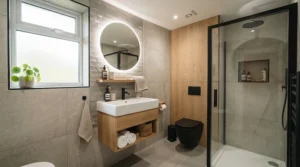
A corner bathroom layout is a puzzle of clearances. The shower shouldn’t fight with the door, the toilet or the basin, and the tray shape controls that battle.
Door swing. A hinged door swings outward, so it needs floor space you may not have. A sliding door on a quadrant or offset avoids that entirely.
Toilet and basin proximity. Offset trays are handy where a cistern or vanity sits close to one wall. Turn the long side away from the obstruction so the curve faces the open floor. One retailer notes offsets suit awkward layouts such as loft conversions and remodelled terraces, where stud walls rarely fall neatly.
Traffic flow. If the shower is close to the door, the curve keeps you and the glass from colliding.
Plumbing. Waste position varies between makers. It can sit at the back corner or at the curved front, so check your existing outlet before buying.
Sketch the room on paper at 1:20. Draw the tray outline, the door arc and a 600mm walkway. If the walkway disappears, downsize the tray or change the door.
Enclosure-Tray Compatibility: Getting the Match Right
This is where offset quadrant shower tray vs quadrant tray choices can go wrong. A standard quadrant enclosure needs a compatible quadrant tray, and an offset enclosure needs an appropriately sized offset tray, in the correct orientation.
Never assume that two products with similar headline measurements will fit. Two enclosures with similar external sizes can have different door openings and entry widths, so compare more than the dimensions.
Three checks prevent trouble:
- Shape and size: the enclosure must match the tray’s exact shape and dimensions.
- Handing: entry side and tray orientation must agree.
- Manufacturer data: read the technical sheet rather than relying on the photograph.
Also allow for adjustment. Some enclosures don’t sit flush with the tray edge, deliberately leaving room for tiling, so read the minimum and maximum adjustment ranges. If you’d rather avoid the puzzle, a bundle such as Diamond Offset Quadrant Kit does the matching for you.
Offset Quadrant Tray vs Square and Rectangular Alternatives
| Feature | Offset quadrant | Standard quadrant | Rectangular |
|---|---|---|---|
| Space efficiency | High on one wall | Highest for tight corners | Best in alcoves |
| Standing comfort | Very good | Moderate | Excellent |
| Door options | Sliding, curved | Sliding, curved | Hinged, pivot, walk-in |
| Handing needed | Yes | No | Sometimes |
| Best For | Elegant Ultra-Slim Offset Quadrant | Aquadart Quadrant 900 x 900 | Large family bathrooms |
Reading the table, the offset sits between two extremes. It gives most of a rectangle’s comfort while keeping the curve that makes corners friendly. Rectangular trays win for walk-in layouts and big rooms, but they demand square-cornered glass and more clear floor.
The honest summary: if you have an alcove, go rectangular. If you have a tight, square corner, go standard quadrant. If you have a corner with one generous wall, the offset earns its place.
Long-Term Cost and Maintenance
Tray prices vary widely, and the sticker tells only part of the story. At the time of research, mainstream offset ranges at one UK merchant ran roughly £120 to £330, with most in the middle of that band.
| Cost factor | Budget route | Premium route |
|---|---|---|
| Tray | London 1000 x 800 | Bathlab Slate Effect Offset Quadrant |
| Waste | Often separate | Often included |
| Riser kit | Extra if needed | Extra if needed |
| Guarantee | Check terms | Lifetime on tray for Bathlab Slate Effect Offset Quadrant |
A trap lurks in the waste line. A cheap tray with a separate waste, a riser kit and a seal can cost the same as a pricier all-in package. Add up the full set before deciding.
On maintenance, stone resin with a gloss cap is forgiving. Wipe after use, avoid abrasive powders and re-seal at the first sign of failure. Over ten years, cost-per-use is tiny, so a longer guarantee and a finish you enjoy scrubbing are worth a modest premium.
Safety, Regulations and Standards
A shower tray isn’t just furniture. It’s part of your drainage system, and the rules matter.
Drainage. In England, the waste must connect properly to your drainage. Approved Document H on drainage and waste disposal sets out the guidance for sanitary pipework and foul drainage. If you’re altering drainage, talk to Building Control or a qualified plumber before you start.
Standards. Look for the BS EN markings on enclosures and wastes. The Diamond Offset Quadrant Kit, for instance, cites BS EN 14428 for the enclosure and BS EN 1329/1 and 1451/1 for the waste.
Slip risk. Wet surfaces are hazardous, and the risk grows with children and older users. An anti-slip finish, such as that on Aquacast Deep Offset Quadrant, is a sensible precaution.
Load. Stone resin and solid-surface trays can support well over 200 to 300kg when fully supported on a proper base, so support matters as much as the tray. Never leave a tray spanning a hollow.
When in doubt, use a qualified installer. It costs less than fixing a leak.
FAQ
❓ Is an offset quadrant tray bigger than a standard quadrant tray?
❓ Can I fit a quadrant enclosure on an offset quadrant tray?
❓ How do I know if I need a left-hand or right-hand offset tray?
❓ Does an offset quadrant tray need a riser kit?
❓ How much does an offset quadrant shower tray cost in the UK?
Conclusion: Curve, Length and Common Sense
So, which wins the offset quadrant shower tray vs quadrant tray contest? Neither, universally. It’s a fit question. A standard quadrant such as Aquadart Quadrant 900 x 900 wins in square, tight corners where every centimetre of floor counts. An offset such as Elegant Ultra-Slim Offset Quadrant or Aquadart Offset Quadrant 1200 x 800 wins where one wall can give, because the extra length becomes real standing room.
Remember the three things that quietly decide the outcome. Measure from finished surfaces, match handing to the manufacturer’s diagram, and choose the tray and enclosure as a pair. If you want the safest route, a bundle like Diamond Offset Quadrant Kit removes most of the guesswork. If budget rules, London 1000 x 800 is the cheapest way in, provided you add a waste to the total.
Whichever you choose, do the dull bits well: a dry fit, a level tray and a patient sealant cure. The showers that last a decade are rarely the fanciest. They’re the ones fitted properly.
Recommended for You
- Anti Slip Shower Tray: 7 Safest UK Picks for 2026
- Anti-Slip Shower Tray for Elderly: 7 Safest Picks (2026)
- Stone Resin Shower Tray Review: 7 Best UK Picks 2026
Disclaimer: This article contains affiliate links. As an Amazon Associate, I earn from qualifying purchases. If you purchase products through these links, we may earn a small commission at no additional cost to you.
✨ Found this helpful? Share it with your friends! 💬🤗
