In This Article
There’s a very specific kind of despair that comes from standing under a shower head for low water pressure and watching the water dribble down like it’s apologising for being there. You turn the dial, you wait, you tap the pipe like that’s ever fixed anything — and still, nothing. If this sounds familiar, you’re in enormous company. Somewhere between old Victorian terraces, hillside cottages, and top-floor flats fed by a header tank in the loft, millions of people across Britain shower under less pressure than a garden hose on a bad day.
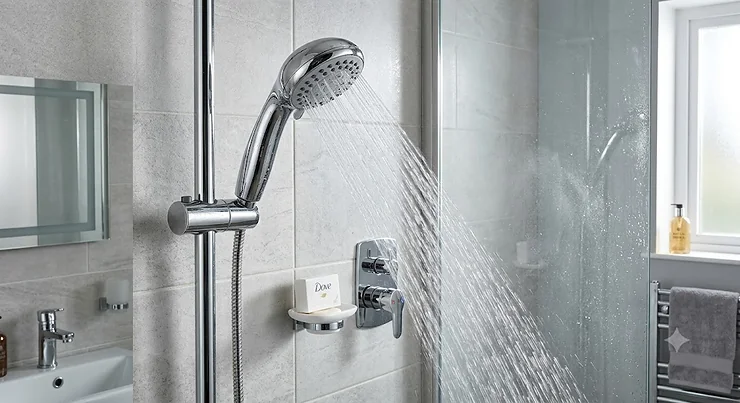
The good news is you very rarely need to rip out your plumbing to fix it. A well-chosen shower head can transform a feeble trickle into something that actually rinses shampoo out before your arm gets tired of holding it there. That’s the whole premise of this guide: real products, real specs, and honest analysis of what actually helps a weak shower feel strong again — not marketing fluff dressed up as advice.
We’ve dug into genuine UK product listings, aggregated review sentiment, and the regulatory detail that explains why your water pressure is what it is, so you can buy with confidence rather than guesswork. It’s worth noting too that a weak shower isn’t purely a comfort issue — the Energy Saving Trust notes that switching to a water-efficient shower head can save a typical household meaningful money each year simply by using less hot water, so getting this right pays off twice over. Whether your home runs on a gravity-fed tank, a combi boiler that never quite delivers, or you’re simply hunting for the best shower head for old house plumbing that wasn’t built with modern power showers in mind, there’s a route through this that doesn’t involve calling a plumber first.
Quick Comparison Table
Before the full breakdown, here’s the shortcut version — useful if you already know roughly what kind of shower you’re dealing with.
| Product | Best For | Price Range | Pump Needed? |
|---|---|---|---|
| Aqualisa Varispray | Simple budget upgrade | Under £20 | No |
| Triton 8000 Series | Electric shower owners | £20-£35 | No |
| Triton Olivia | Universal mixer fit | £25-£40 | No |
| Mira Beat | Gravity-fed, tight budget | Under £15 | No |
| AquaDance 6-Setting Handheld | Removable flow restrictor fans | £25-£40 | No |
| AquaDance 7″ Rainfall Combo | Rain head + handheld together | £45-£65 | No |
| Aqualisa Aquastream Thermo | Genuinely weak gravity systems | £180-£260 | Yes (integrated) |
Looking at the table, the pattern that jumps out is price versus problem-solving power: the first six options are shower heads in the traditional sense, working with whatever pressure already reaches your pipe, while the Aqualisa Aquastream Thermo is really a different category of product — a power shower with its own pump built in. If your pressure is only mildly disappointing, a shower head swap is usually enough; if it’s genuinely under 1 bar, only a pumped system reliably fixes it.
💬 Just one click — help others make better buying decisions too!😊
Top 7 Shower Heads for Low Water Pressure: Expert Analysis
We’ve grouped these across budget, mid-range and premium so there’s a sensible option whatever your starting point. Every one is a real, currently listed product — no invented models, no fictional brands.
1. Aqualisa Varispray — best simple universal upgrade
The standout feature here is how unfussy it is: this is a straightforward adjustable shower head built to bolt onto Aqualisa mixer, electric and digital systems without any faff. Aqualisa’s own product literature confirms these heads are engineered with anti-limescale silicone nozzles and a concentrated spray pattern specifically aimed at performing reliably in lower-pressure homes, which matters more than it sounds because a badly designed nozzle plate can choke flow that was already marginal. Based on the spec comparison with pricier rivals, what you’re paying for here is essentially the fundamentals done properly rather than any bells and whistles — no multi-setting dial, no rainfall face, just a head engineered not to fight the pressure you’ve already got. It’s best suited to anyone whose existing Aqualisa shower still works fine but whose original head has gone gummed up with limescale, or who wants the cheapest legitimate fix before spending on anything more elaborate. Aggregated Amazon UK review sentiment for Aqualisa’s shower head range points to easy toolless fitting and a noticeable improvement over ageing factory-fitted heads, though the flip side is that buyers occasionally note the spray pattern is narrower than a full rainfall head, which is a deliberate trade-off for pressure, not a flaw.
Pros:
- ✅ Purpose-built for low-pressure Aqualisa systems
- ✅ Anti-limescale nozzles reduce maintenance faff
- ✅ Genuinely tool-free installation
Cons:
- ❌ Narrower spray than full rainfall heads
- ❌ Best matched to Aqualisa-compatible systems specifically
At under £20, this sits at the true budget end, and the value verdict is simple: if your system already suits it, there’s very little reason not to start here first.
2. Triton 8000 Series — best for electric shower low flow boost
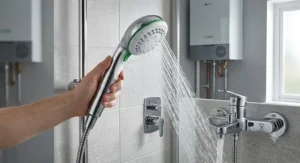
Triton has been the UK’s leading electric shower brand since 1975, and the 8000 Series shower head leans hard into that heritage with a five spray-pattern dial (Full, Drench, Rain, Blast and Jet) designed specifically to work within the modest flow that electric showers typically deliver. What most buyers overlook about electric showers is that their pressure ceiling is partly set by the unit’s kW rating restricting how much water it can heat on the fly, so no shower head can create pressure the unit itself can’t push through — but a well-designed head can make that available flow feel far more forceful by concentrating it. That’s exactly Triton’s pitch here: all five spray patterns are tuned for high perceived flow rather than simply wide coverage. It’s the right call for anyone whose electric shower has become the bottleneck in an otherwise reasonable water system, particularly older terraced houses on combi boilers where an electric shower was fitted as a compromise years ago. Reviewers consistently report that this head fits electric and mixer showers equally well and performs noticeably better than the OEM head it typically replaces, with a smaller number of aggregated comments noting the rub-clean nozzles need occasional descaling in hard-water areas.
Pros:
- ✅ Five spray patterns tuned for perceived pressure
- ✅ Fits both electric and mixer showers
- ✅ Made in Britain with 1-year guarantee
Cons:
- ❌ Can’t exceed what the electric unit itself supplies
- ❌ Needs periodic descaling in hard water zones
Sitting around £20-£35, this is a smart mid-budget pick specifically when an electric shower is the limiting factor, not the household’s overall pressure.
3. Triton Olivia — best universal mixer-friendly option
The Olivia carries the same five-setting spray dial as the 8000 Series but in a slightly more contemporary head shape, and it’s built as a genuinely universal fit rather than being tied to one shower family. In practice, this means the spray plate’s hole pattern is engineered with tighter apertures than a standard rainfall head, which increases exit velocity for the same volume of water — basic fluid dynamics, but it’s the actual mechanism behind why a “high pressure” shower head can feel stronger on identical plumbing. Here’s what to weigh: buyers with genuinely combi-boiler mains pressure (2 bar or above) will feel less of a difference than those on marginal gravity systems, because there’s a ceiling to how much a head alone can compensate for genuinely low incoming flow. It suits budget-conscious buyers who want one head that will fit whatever they replace next, since Triton accessories are designed to be interchangeable across the brand’s shower range. Aggregated review sentiment highlights the universal fitting and the five spray options as the most praised features, with a smaller share of buyers noting the chrome finish shows watermarks more visibly than a matte finish would.
Pros:
- ✅ True universal fitting across shower types
- ✅ Five distinct spray settings
- ✅ British-made with UK-based support
Cons:
- ❌ Chrome finish shows limescale marks easily
- ❌ Limited benefit on already-strong mains pressure
Priced around £25-£40, the Olivia earns its place as a safe, flexible mid-range pick that won’t need replacing if you change your shower valve later.
4. Mira Beat — best budget pick for gravity-fed homes
Mira has manufactured showers in Britain for over 90 years, and the Beat is its entry-level handheld head — a simple single-spray design rather than a multi-setting dial. On paper this means fewer features, but that’s actually the point: aggregated customer feedback specifically from gravity-fed shower owners describes this head as delivering a noticeably firmer stream than their previous head specifically because of its fine-hole jet design, which concentrates a modest gravity-fed flow into a tighter, more forceful pattern rather than spreading it thin across a wide rainfall face. Reviewers consistently note this as one of the few genuinely affordable heads that meaningfully helps on tank-fed systems rather than just claiming to. It’s best suited to anyone on a strict budget who has confirmed their issue is genuinely low gravity-fed pressure rather than a blocked or scaled-up head, since the single-spray design won’t offer the variety that pricier multi-setting heads do. The trade-off is a simpler, more basic-looking fixture with a shorter typical lifespan than premium alternatives, according to aggregated wear-related comments in the reviews.
Pros:
- ✅ Specifically praised by gravity-fed system owners
- ✅ Rub-clean nozzles resist limescale build-up
- ✅ Lowest price point in this line-up
Cons:
- ❌ Single spray setting only
- ❌ Feels basic compared with multi-function heads
At under £15, this is about as cheap as a genuinely useful fix gets, which makes it a sensible first attempt before spending more.
5. AquaDance 6-Setting Handheld — best high-flow head with removable restrictor
AquaDance built its reputation on independently tested high-pressure handheld shower heads, and the 6-setting model with stainless steel hose is the brand’s most widely reviewed UK listing. The standout mechanical detail is the removable flow restrictor tucked behind the face plate — a small disc that, when taken out, opens up meaningfully more flow for households where the restrictor was calibrated for higher mains pressure than they actually have. Here’s what most buyers overlook: flow restrictors exist to meet water-efficiency standards, and removing one is a genuine option for low pressure shower head flow restrictor removed setups, but it does increase water and energy use, so it’s a trade worth making deliberately rather than by default. Reviewers consistently mention strong pressure and the ergonomic handheld grip as highlights, with a smaller cluster of aggregated comments noting the plastic face plate feels less premium than the metal-bodied alternatives further up this list. It suits anyone who specifically wants a handheld format for flexibility around baths, pets, or awkward-shaped cubicles, alongside the option to fine-tune flow themselves.
Pros:
- ✅ Removable restrictor for extra flow when needed
- ✅ Six genuinely distinct spray settings
- ✅ Independently tested performance claims
Cons:
- ❌ Plastic face plate feels less premium
- ❌ Removing the restrictor increases water usage
Around £25-£40, this is strong value if flexibility and DIY flow control matter more to you than a wall-mounted fixed head.
6. AquaDance 7″ Premium Rainfall Combo — best dual rain-and-handheld upgrade
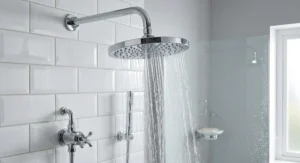
This is a 3-way system: a 7-inch angle-adjustable rainfall head, a separate 6-setting handheld unit, and a diverter that lets you run either or both together. The honest analytical take is that a wide rainfall face is usually the worst-performing format on genuinely low pressure — more surface area spreads the same flow thinner — but AquaDance addresses this with a high-power click-lever dial and rub-clean jets engineered to concentrate flow even across the wider face, which is precisely why this model appears repeatedly in low-pressure buying guides despite the rainfall format’s usual reputation. What most buyers overlook is that running the rain head and handheld together roughly halves the pressure reaching each outlet, so on marginal gravity systems it’s often better used as one or the other rather than simultaneously. It’s the right call for anyone who wants the rainfall aesthetic without fully sacrificing pressure, and who’s happy to use the handheld alone on days when flow feels weaker than usual. Aggregated review sentiment is strongly positive on build quality and the tool-free four-connection install, with the most common criticism being that the diverter mechanism can feel stiff when brand new.
Pros:
- ✅ Rainfall and handheld heads in one kit
- ✅ Engineered nozzle design counters wide-face pressure loss
- ✅ Tool-free installation in minutes
Cons:
- ❌ Using both heads together roughly halves flow to each
- ❌ Diverter can feel stiff initially
At £45-£65, this sits at the upper-mid price point, and the value case holds up well if you actually want the rainfall look rather than settling for it.
7. Aqualisa Aquastream Thermo — best premium pick for 1 bar and gravity-fed systems
This is the genuine outlier in the list: not a shower head at all in the traditional sense, but a complete thermostatic power shower with an integrated pump, designed explicitly for gravity-fed systems where the header tank simply can’t deliver enough natural pressure. Aqualisa’s own specification is blunt about the physics involved — the mixer casing must sit below the base of the cold water cistern for the system to work at all, which is a structural requirement rather than a suggestion. Based on the spec comparison with every other product here, this is the only option that actively boosts pressure rather than working smarter within whatever pressure already exists, which is why it’s the honest recommendation for a genuine shower head for 1 bar pressure situation rather than a marginally weak one. It comes with a 90mm Harmony head offering four spray patterns and an eco setting delivering roughly a 25% water saving when selected. Aggregated review sentiment describes strong, consistent temperature control and praises it as one of the more capable power showers on the market, while the most repeated criticism is a brief noisy start-up as the pump draws water in, plus a noticeably higher price than a simple head swap.
Pros:
- ✅ Integrated pump genuinely boosts pressure
- ✅ Separate flow and temperature dials
- ✅ Purpose-built for gravity-fed, low-pressure homes
Cons:
- ❌ Brief pump noise on start-up
- ❌ Significantly pricier than a standard shower head
In the £180-£260 range, this is a real investment, but for households under roughly 1 bar it’s often the only option on this list that will actually solve the problem rather than politely disguise it.
Low-Pressure vs Standard Shower Heads: What Actually Changes
| Factor | Standard Shower Head | Shower Head for Weak Pressure |
|---|---|---|
| Nozzle design | Wide, evenly spaced holes | Tighter, concentrated apertures |
| Spray face | Often large rainfall style | Narrower or engineered dual-track |
| Flow restrictor | Fixed, non-removable | Often removable or absent |
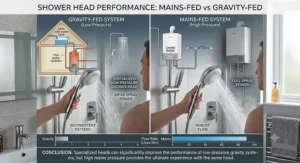
| Best For | Combi boiler / mains pressure homes | Gravity-fed or under 1.5 bar systems |
The core distinction isn’t marketing, it’s plumbing physics: a standard head spreads whatever flow arrives across a wide face, which looks lovely on strong mains pressure but turns feeble the moment pressure drops. A shower head for weak pressure instead narrows the exit points, so the same volume of water is forced through with higher velocity — the equivalent of pinching the end of a garden hose to make it spray further. It’s not free extra pressure, exactly; it’s a smarter redistribution of the pressure you’ve already got, which is why choosing the right head genuinely matters more on marginal systems than on strong ones.
Practical Usage Guide: Installing and Maintaining Your New Shower Head
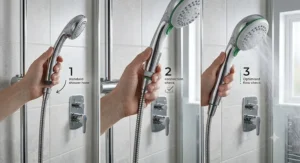
Getting a new shower head fitted correctly takes most people under ten minutes, but a few early mistakes quietly undo half the benefit. Unscrew the old head anticlockwise, checking first whether it simply twists off or needs a spanner if it’s seized with limescale — wrapping the jaws in a cloth prevents scratching the arm’s finish. Before fitting the replacement, wrap two or three turns of PTFE (plumber’s) tape clockwise around the thread; skipping this is the single most common reason for a drip at the joint within the first week. Hand-tighten only, then a light quarter-turn with a wrench if needed — overtightening cracks the internal seating on plastic-bodied heads more often than people expect.
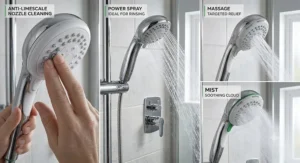
In the first thirty days, resist the urge to remove a flow restrictor immediately if your head has one; run it as supplied for a week first so you have a genuine baseline to judge against. For ongoing maintenance, an occasional soak of the face plate in a 50/50 white vinegar and water solution for thirty minutes dissolves early-stage limescale before it narrows the jets and quietly reduces the very pressure you just paid to improve — hard water areas should do this monthly, softer water areas every couple of months is usually enough.
Real-World Scenarios: Matching the Head to Your Home
The top-floor flat renter on a header tank: limited budget, can’t alter plumbing, and needs something that installs without tools since it’ll likely move house within the tenancy. The Mira Beat or Aqualisa Varispray both fit this brief well — cheap, reversible, and specifically effective on gravity-fed flow.
The family in a Victorian terrace with an ageing electric shower: daily heavy use from several people, an electric unit that’s never felt powerful, and a preference not to touch the wiring. The Triton 8000 Series is the sensible fit here, since it’s engineered around exactly that electric-shower flow ceiling rather than fighting it.
The household stuck below 1 bar with a loft tank: showers that have been genuinely weak for years, not just mildly disappointing, and a willingness to spend properly on a permanent fix. This is where the Aqualisa Aquastream Thermo earns its price — no shower head alone reliably solves pressure this low, and pretending otherwise wastes money on repeat purchases.
What Is a Shower Head for Low Water Pressure?
A shower head for low water pressure is a fixture engineered with narrower or aerating nozzles that concentrate a limited water supply into a stronger-feeling spray, commonly used in homes with gravity-fed tanks, older pipework, or mains pressure below around 1.5 bar. According to Ofwat, the water regulator, water companies should maintain a minimum pressure of seven metres static head in the pipe serving your property, and some modern showers simply won’t work properly below certain pressure levels, which is exactly the gap these products are designed to bridge.
How to Choose the Right Shower Head for Low Pressure
- Test your actual pressure first. Time how long a one-litre jug takes to fill from the shower outlet before buying anything — under 6 seconds is decent, 10 seconds or more is genuinely low.
- Identify your system type. Gravity-fed tanks, combi boilers and unvented cylinders each behave differently, and this determines whether a simple head swap or a pumped power shower is the right category.
- Prioritise nozzle design over spray-setting count. More settings sound appealing, but concentrated, engineered nozzles matter far more to perceived pressure than having eight modes you’ll never use.
- Check the flow restrictor situation. A removable restrictor gives you flexibility; a fixed one locks you into whatever flow the manufacturer calibrated for average UK pressure.
- Match the format to your bathroom. Handheld heads suit flexibility and awkward layouts; fixed heads suit simplicity; rainfall heads look lovely but need genuinely decent pressure to perform.
- Set a realistic budget band. Anything from a genuine sub-1-bar system typically needs a pumped solution, not just a better head, so budget accordingly rather than buying three cheap heads in a row.
- Read aggregated reviews from similarly-pressured homes. A head praised by mains-pressure combi households tells you very little about how it’ll perform on your gravity-fed loft tank.
Best Shower Head for Old House Plumbing
Older British housing stock brings its own quirks: narrow-bore pipework from decades ago, gravity-fed tanks tucked into lofts never designed with modern shower expectations in mind, and hot water cylinders that create pressure imbalance between hot and cold supply. What most buyers overlook about period properties specifically is that the pipe diameter itself can be the bottleneck, not just tank height — a beautifully engineered shower head still can’t push water through pipework that’s partially restricted by decades of scale build-up. For a genuinely old system, the Mira Beat or Aqualisa Varispray are sensible low-cost first attempts, while a property with consistently weak flow throughout — not just in the shower — often benefits more from investigating the pipework itself before spending on fixtures. If the shower is the only weak point and everything else runs fine, the Aqualisa Aquastream Thermo‘s integrated pump sidesteps the old pipework question entirely by boosting pressure at the point of use rather than relying on what arrives.
High Flow Shower Head for Low Pressure: Features That Actually Matter (and Those That Don’t)
Marketing copy on shower heads loves to boast about spray-setting counts, but based on the spec comparison across every product in this guide, three features consistently correlate with genuinely better performance on weak supply, while others are mostly cosmetic.
Actually matters: nozzle aperture size and count (smaller, more numerous holes increase exit velocity); a removable or absent flow restrictor; and a narrower spray face rather than an oversized rainfall plate. Doesn’t matter much: the number of named spray “modes” beyond three or four, since most are minor variations on the same jet pattern; premium finishes like brushed nickel, which affect looks rather than flow; and elaborate LED temperature displays, which are entirely unrelated to pressure. If you’re specifically hunting for a high flow shower head for low pressure, spend your budget on the mechanical fundamentals first and treat everything else as a nice-to-have.
Shower Head for 1 Bar Pressure: What to Expect
One bar sits right at the boundary of what UK regulators consider acceptable — the Consumer Council for Water confirms Ofwat’s guaranteed standards scheme requires water companies to maintain a minimum of seven metres static head, roughly 0.7 bar, at the property boundary, and many gravity-fed homes sit close to or below that internally once you account for pipe losses and height drop. At this level, honestly, a shower head swap alone has real limits — you’ll feel improvement from a concentrated-nozzle head like the Triton Olivia or AquaDance 6-Setting Handheld, but it will still feel gentle rather than powerful. For anyone specifically dealing with confirmed 1 bar or lower, the Aqualisa Aquastream Thermo‘s built-in pump is the only product in this guide that meaningfully changes the physics rather than just working smarter within them, which is worth knowing before spending repeatedly on cheaper fixes that plateau.
Low Pressure Shower Head Flow Restrictor Removed: Should You Do It?
The problem: many shower heads ship with a flow restrictor calibrated for average UK mains pressure, which can feel needlessly stingy if your actual pressure is already below average. The solution: most restrictors, including the one in the AquaDance 6-Setting Handheld, are designed to be removable — usually a small disc sitting just behind the face plate, freed with a flathead screwdriver or even fingernails once the head is unscrewed. Here’s what to weigh honestly: removing it increases both water usage and, if you’re on a meter, your bill, and on genuinely strong mains pressure it can push flow uncomfortably hard. On a confirmed weak gravity-fed or sub-1-bar supply, though, the restrictor was almost certainly never doing its intended job anyway, since there was little excess flow to restrict in the first place — so removal there tends to be low-risk and genuinely useful. If you’re unsure, try the head as supplied for a week, note whether pressure still feels inadequate, then remove the restrictor only if it does.
Best Shower Head Under Gravity Fed System: Safety and Compliance Guide
Gravity-fed systems bring a specific installation requirement that’s easy to overlook: any pumped product, including power showers like the Aqualisa Aquastream Thermo, must be positioned so the pump casing sits below the base of the cold water storage cistern, otherwise it simply won’t draw water correctly. Plumbing work of this kind also falls under the Water Supply (Water Fittings) Regulations 1999, which require that water systems be capable of withstanding an internal pressure of at least one and a half times the maximum pressure they’ll be subjected to in normal operation — relevant if you’re adding a pump to pipework that’s never carried boosted pressure before. In practice this means: always check the manufacturer’s minimum head-height requirement before buying a power shower, have any pump wiring completed by a qualified electrician since these units sit in a bathroom’s zoned areas, and if you’re at all unsure whether your loft tank height is sufficient, a WaterSafe-approved plumber can confirm it in minutes rather than after a failed installation.
Common Mistakes When Buying a Shower Head for Low Water Pressure
The most frequent mistake is buying based on the number of spray settings rather than nozzle engineering — an eight-setting head with wide, evenly spaced holes will underperform a simple three-setting head with genuinely concentrated jets. The second is assuming every low-pressure product is interchangeable, when gravity-fed, combi and unvented systems each respond differently to the same fixture. The third is skipping a genuine pressure test beforehand, buying based on guesswork, then blaming the product when a £15 head predictably fails to fix a fundamentally under-1-bar supply that actually needed a pump. Finally, plenty of buyers remove a flow restrictor on strong mains pressure expecting a bigger improvement than they get, when the restrictor was doing useful, comfortable work all along.
Long-Term Cost and Maintenance
| Product Type | Typical Lifespan | Ongoing Cost |
|---|---|---|
| Budget fixed heads (Mira Beat, Aqualisa Varispray) | 2-4 years | Occasional descaling only |
| Multi-setting mid-range heads (Triton, AquaDance) | 4-6 years | Descaling + occasional washer replacement |
| Pumped power showers (Aqualisa Aquastream) | 7-10+ years | Higher electricity use, periodic pump servicing |
Interpreting that spread, the cheapest heads aren’t necessarily the worst long-term value — a £15 Mira Beat replaced every three years still costs less over a decade than most single premium purchases, provided it’s actually solving your pressure problem in the first place. Where cost genuinely shifts is with a pumped system: the Aqualisa Aquastream Thermo carries a meaningfully higher upfront price and a small ongoing electricity cost from running the pump, but if it’s the only option that actually works on your supply, repeatedly buying and discarding cheaper heads that never quite fix the issue ends up costing more in the long run, not less.
Frequently Asked Questions
❓ Will any shower head fix low water pressure?
❓ Is it safe to remove a shower head's flow restrictor?
❓ Do power showers work on every gravity-fed system?
❓ How do I know if my shower head or my whole house has low pressure?
❓ Are high-pressure shower heads more expensive to run?
Conclusion
A weak shower is one of those problems that’s genuinely fixable, but only if you match the solution to the actual cause rather than the first shiny head that promises “high pressure” on the box. For most homes with mildly disappointing flow, something like the Triton Olivia, Mira Beat or AquaDance 6-Setting Handheld will make a real, noticeable difference for very little money. For genuinely weak gravity-fed systems sitting close to or below 1 bar, only a pumped solution like the Aqualisa Aquastream Thermo properly closes the gap — and knowing that distinction before you buy saves both money and repeated disappointment. Test your pressure honestly, match the product category to what you actually found, and you’ll likely never need to think about your shower again.
✨ Don’t Miss These Exclusive Deals!
🔍 Take your bathroom upgrade to the next level with these carefully selected shower heads. Click on any highlighted product to check current pricing and availability on Amazon UK. These picks will help you create a genuinely stronger, more satisfying shower — whatever your water system.
Recommended for You
- Dual Shower Head with Handheld: 7 Best UK Picks for 2026
- Best Dual Shower Head 2026: 7 Top Combo Picks Reviewed
- Handheld Shower Head for Dogs: 7 Best UK Picks for 2026
Disclaimer: This article contains affiliate links. As an Amazon Associate, I earn from qualifying purchases. If you purchase products through these links, we may earn a small commission at no additional cost to you.
✨ Found this helpful? Share it with your friends! 💬🤗
