In This Article
There’s a very particular kind of disappointment that comes from unboxing a beautiful new shower head, fixing it to the wall arm with the smug satisfaction of a weekend DIYer, turning the valve, and getting… a dribble. If you’ve lived through that moment, you already know why the search for a rain shower head for low pressure is so fraught. Most of the gorgeous, wide-faced rainfall heads photographed in hotel bathrooms were engineered with mains pressure and pumps in mind, not the loft tank and gravity-fed setup that’s still common across huge swathes of UK housing stock.
A rain shower head for low pressure is a fixed or handheld shower head engineered specifically to deliver a wide, even “rainfall” spray pattern while compensating for weak incoming water pressure, typically through air-infusion technology, twin-jet nozzle design, or a reduced spray face that concentrates the available flow. The goal is coverage without the trickle.
The good news is that the last few years have genuinely moved the technology forward. Brands like Methven, Grohe, and Hansgrohe have all built specific low-pressure engineering into their rain-style heads, and even value-focused brands like Mira have followed suit. Before you spend money though, it’s worth understanding what’s actually happening in your pipework, because a shower head can only work with the pressure you give it, not against physics. According to Energy Saving Trust, upgrading to a water-efficient shower head can also meaningfully cut your annual energy bill, which is a nice side benefit while you’re solving the pressure problem. This guide walks through seven genuinely available rain shower head for low pressure options, how gravity-fed systems and combi boilers change your buying decision, and what the litres-per-minute numbers on the box actually mean for your morning routine.
Quick Comparison Table
| Product | Best For | Flow Rate | Pressure Rating | Price Range |
|---|---|---|---|---|
| Methven Kiri MK2 Satinjet (Low Flow) | Gravity-fed budget upgrade | 5.5–8 l/min | 0.3–5.0 bar | Under £70 |
| Grohe Tempesta 210 | Combi boiler value pick | 6.6 l/min | Min. 1.0 bar | £30-£60 range |
| Hansgrohe Croma 220 Air | Air-infused comfort shower | 9 l/min @ 3 bar | Min. 1.0 bar | £60-£100 range |
| Grohe Euphoria 260 SmartControl | Large rainfall face | 9.5-13 l/min | Min. 1.0 bar | £80-£130 range |
| Mira Beat | Absolute budget replacement | Standard flow | Any pressure | Under £25 |
Looking at the numbers above, the pattern is clear: nearly every serious low-pressure rain shower head sits somewhere around 6-13 litres a minute rather than the 15-20 l/min a full-pressure deluge head would happily gulp down. That’s not a compromise so much as the entire point, since a narrower total flow, pushed through smaller, precisely engineered nozzles, is what generates the illusion of strength on weak supply. The Grohe Euphoria 260 proves you don’t have to sacrifice spray-face size to get this benefit, while the Mira Beat shows that budget doesn’t automatically mean bad performance on a gravity tank.
💬 Just one click — help others make better buying decisions too!😊
Top 7 Rain Shower Heads for Low Pressure: Expert Analysis
1. Methven Kiri MK2 Satinjet (Low Flow) — twin-jet tech built for weak supply
The Methven Kiri MK2 Satinjet low-flow shower head is arguably the most purpose-built entry on this list, since Methven’s entire Satinjet system exists to solve exactly the problem you’re facing. Two opposing jets inside the head collide mid-air, shattering the stream into what the brand claims is over 300,000 droplets per second, which in practice reads as a fuller, more velvet-like spray than the flow rate alone would suggest. Rated for anywhere between 0.3 and 5.0 bar, it’s one of the few genuinely “any pressure” rain-style heads on the UK market, and the 5.5-8 l/min flow regulator keeps water bills in check without the spray collapsing into a mist. Based on the spec comparison with other twin-jet designs, this is the head to reach for if your home has a loft tank and you’ve been burned before by rainfall heads that promised the earth and delivered a whisper. Reviewers consistently note that the twin-jet feel is noticeably different from a standard aerating head, describing it as “fuller” rather than simply “more forceful,” which matters if your priority is comfort over raw power. Aggregated feedback also flags the solid architectural design as a bathroom style upgrade in its own right, not just a functional fix. What most buyers overlook is that the quick-fit connector genuinely does remove tools from the installation entirely, which matters if you’re not confident with a spanner. Best for renters and gravity-fed homeowners who want a style upgrade that won’t fight their plumbing.
Pros:
- ✅ Rated for 0.3-5.0 bar, genuinely gravity-fed friendly
- ✅ Twin-jet Satinjet tech feels fuller than the flow rate suggests
- ✅ Tool-free quick-fit installation in minutes
Cons:
- ❌ Spray face is smaller than a full deluge rainfall head
- ❌ Chrome finish shows limescale spots quickly in hard water areas
Prices for the Kiri MK2 typically sit in the low-to-mid £60s range depending on retailer stock, and given the low-pressure engineering baked in, it represents strong value for anyone who has already tried a cheaper aerating head and been disappointed.
2. Grohe Tempesta 210 — the reliable combi boiler entry point
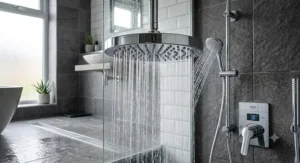
The Grohe Tempesta 210 is the shower head equivalent of a well-worn pair of boots: unglamorous, dependable, and everywhere for a reason. Its 210mm spray face uses Grohe’s DreamSpray nozzle engineering to even out pressure across every hole, while the EcoJoy flow limiter caps consumption at 6.6 litres per minute. In practice that means the spray plate feels evenly saturated rather than patchy at the edges, which is a common failure point on cheaper wide-faced heads under moderate pressure. Here’s what to weigh: Grohe explicitly states a minimum operating pressure of around 1.0 bar, so this is genuinely built for combi boiler or unvented cylinder systems rather than an untreated gravity tank running below that threshold. Reviewers consistently praise the StarLight chrome finish for resisting the dulling that budget chrome plating suffers within a year, and the SpeedClean silicone nozzles make limescale removal a simple thumb-rub rather than a vinegar-soak ritual. One recurring theme in aggregated feedback is that buyers on genuinely weak gravity systems have found the flow underwhelming, which lines up with the manufacturer’s own minimum pressure guidance rather than being a fault with the unit itself. Best for combi boiler households wanting a straightforward rain spray without smart features or a premium price tag.
Pros:
- ✅ Even DreamSpray distribution across the full 210mm face
- ✅ SpeedClean nozzles wipe clean of limescale in seconds
- ✅ Widely stocked with readily available spare parts
Cons:
- ❌ Needs at least 1.0 bar, so weak gravity tanks may disappoint
- ❌ Single spray pattern only, no massage or jet mode
Typically found in the £30-£60 range, the Tempesta 210 remains one of the best value-per-litre picks if your home runs on mains pressure via a combi boiler.
3. Hansgrohe Croma 220 Air — air-infused comfort for a softer, fuller spray
The Hansgrohe Croma 220 Air takes a different technical route to the same destination: rather than a twin-jet collision, it draws air into the water stream through its AirPower nozzles, producing fatter, lighter droplets that feel warmer and softer on skin even though the actual litre count hasn’t changed. At 9 litres per minute measured at 3 bar, with a stated minimum operating pressure of around 1 bar, it sits comfortably in combi boiler and unvented cylinder territory, and reasonably well in pumped gravity systems too. What most buyers overlook about air-infusion heads generally is that they tend to splash less than solid-jet designs, which cuts down on the daily clean-up around a shower enclosure. Based on the spec comparison with the Grohe Tempesta above, the Croma 220 Air’s larger 220mm spray disc gives noticeably wider coverage for a similar flow rate, largely because the air-water mixture spreads the perceived spray without demanding more litres from your pipework. Reviewers consistently highlight the QuickClean silicone nozzles as genuinely effective against limescale in hard water regions, echoing Grohe’s own SpeedClean claims, and several mention that the removable spray disc makes descaling in a bowl of white vinegar far easier than scrubbing in place. Best for anyone who wants the “hotel spa” sensation without an oversized 300mm deluge head that would overwhelm a modest UK shower cubicle.
Pros:
- ✅ AirPower infusion gives a fuller feel per litre used
- ✅ 220mm spray disc is a genuine middle ground on size
- ✅ Removable disc for easy descaling in hard water areas
Cons:
- ❌ Minimum 1 bar rules out unpumped loft-tank systems
- ❌ Air-infused spray can feel cooler in unheated bathrooms
Expect to pay somewhere in the £60-£100 range, which puts it a notch above the Tempesta but below full premium territory, reflecting the German engineering pedigree behind the AirPower system.
4. Grohe Euphoria 260 SmartControl — proof a large rain shower head low pressure setup doesn’t need to feel thin
If you’ve been searching specifically for a large rain shower head low pressure solution because you want that generous overhead coverage without the ceiling-mounted plumbing project, the Grohe Euphoria 260 SmartControl is worth serious consideration. Its 260mm spray plate is genuinely large by UK shower head standards, roughly the size of a dinner plate, yet the centre dial lets you rotate between a focused Jet Spray for rinsing shampoo, a wider SmartRain setting, and a full-face Rain Spray that uses every nozzle at once. On paper this means you’re not locked into full-coverage mode when your pressure can’t support it; dialling back to Jet Spray concentrates the same litres through fewer holes, which noticeably boosts perceived force on a borderline supply. Flow figures vary slightly by retailer listing, with EcoJoy variants sitting near 9.5 l/min and the standard version closer to 13 l/min, so it’s worth checking the specific SKU before ordering if your flow rate is marginal. The spec sheet won’t tell you this, but reviewers note the swivel ball-joint arm is genuinely useful for angling the spray away from a shower screen edge, a small detail that matters more than it sounds once you’re actually showering under it daily. Best for households who want the visual drama of a large rainfall head but need the flexibility to dial down coverage on weaker days, such as when someone else is running a tap elsewhere in the house.
Pros:
- ✅ Genuinely large 260mm face without sacrificing adjustability
- ✅ Three spray zones let you trade coverage for force on demand
- ✅ StarLight chrome and SpeedClean nozzles for long-term upkeep
Cons:
- ❌ Larger face means noticeably weaker full-Rain mode below 1 bar
- ❌ Higher flow variants can strain a marginal combi boiler alongside other taps
Pricing generally lands in the £80-£130 range depending on finish, which is a fair ask given the genuine size and the SmartControl mechanism’s added engineering.
5. Mira Beat — the honest budget replacement
Not every household needs, or can justify, a premium engineered head, and that’s exactly where the Mira Beat earns its place on this list. As a straightforward single-spray fixed head with rub-clean nozzles, it doesn’t pretend to be anything more sophisticated than a reliable, no-fuss replacement, and Mira’s near-century of British shower manufacturing experience shows in the build quality relative to its price point. Aggregated customer feedback repeatedly mentions that buyers specifically chose it for gravity-fed systems, with one common theme being that the finer holes in the spray face noticeably improve on a tired, limescale-clogged original head even without any pressure-boosting technology. Here’s what to weigh: this isn’t an air-infusion or twin-jet design, so don’t expect it to transform a genuinely weak gravity tank into a power shower. What it does deliver, honestly, is a fresh, unblocked spray pattern at a price that makes it a sensible first thing to try before spending on premium engineering. Reviewers consistently praise the rub-clean silicone nozzles for keeping limescale at bay in hard water areas with minimal effort, a detail that matters given how many UK households sit in moderate-to-hard water zones. Best for a first, low-risk upgrade attempt, or as a spare parts style replacement where budget is the primary constraint.
Pros:
- ✅ Genuinely low cost, ideal as a first troubleshooting step
- ✅ Rub-clean nozzles simplify hard water maintenance
- ✅ Backed by Mira’s long UK manufacturing track record
Cons:
- ❌ No dedicated pressure-boosting or air-infusion engineering
- ❌ Single spray pattern with no adjustability
Typically priced under £25, the Mira Beat is the sensible starting point for anyone unsure whether their disappointing shower is a shower head problem or a wider plumbing issue.
6. Aqualisa Varispray Adjustable Shower Head — concentrated spray for genuinely weak supply
There’s an honest wrinkle worth addressing directly here: Aqualisa’s own guidance actually recommends avoiding oversized rainfall heads on unpumped gravity-fed systems, suggesting instead an adjustable head with a concentrated spray pattern. The Aqualisa Varispray adjustable shower head is exactly that recommendation put into product form, and it’s worth including precisely because it represents the more cautious, evidence-based end of this category rather than marketing gloss. Rather than a fixed wide face, the Varispray lets you rotate the head to narrow or widen the spray pattern, effectively letting you dial in a rain-style wide spray when pressure allows and a tighter, more forceful jet when it doesn’t. Reviewers consistently mention swapping in a Varispray as a replacement for a tired original varispray head and noticing a significant improvement in flow and coverage, with several specifically flagging it as a strong performer on gravity-fed systems. What the spec sheet won’t tell you, but user reports suggest, is that the adjustable mechanism can loosen slightly with very frequent twisting over several years, though this is a minority complaint rather than a widespread pattern. Based on the spec comparison with fixed rainfall heads, the trade-off here is candid: you’re accepting a smaller default spray face in exchange for genuine adjustability on a system that can’t always support full coverage. Best for households with a demonstrably weak gravity tank who would rather have honest flexibility than a beautiful head that underperforms daily.
Pros:
- ✅ Adjustable spray genuinely suits fluctuating gravity-fed pressure
- ✅ Backed by Aqualisa’s own low-pressure engineering guidance
- ✅ Straightforward standard hose fitting for easy replacement
Cons:
- ❌ Smaller default spray face than a true rainfall head
- ❌ Premium pricing relative to its adjustable-head competitors
Expect a price somewhere in the £70-£110 range, reflecting the genuine engineering behind the adjustable mechanism rather than simple cosmetics.
7. Methven Waipori Satinjet — the premium pick for a balanced low-pressure spray
Rounding out the list is the Methven Waipori Satinjet, a lesser-known but genuinely well-engineered alternative from the same brand behind the Kiri, aimed specifically at buyers who want the best balance of spray force and coverage on low pressure rather than the sharpest price. Methven’s own product guidance singles out the Waipori collection as designed specifically for low-pressure installations, distinguishing it from siblings optimised more for coverage or more for concentrated force. The geometric, gently curved design differentiates it stylistically from the more architectural Kiri, which matters if you’re coordinating a bathroom refurbishment around a particular aesthetic. On paper this means Waipori buyers are choosing a head that has been engineered from the ground up around the low-pressure use case, rather than a general-purpose rainfall head that happens to cope adequately. Aggregated Methven customer sentiment across the Satinjet range consistently highlights the twin-jet feel as noticeably fuller than competitor low-flow heads at a comparable litres-per-minute rating, which lines up with the underlying droplet-collision engineering shared across the collection. What most buyers overlook is that, being a lesser-known model outside plumbing circles compared to Grohe or Hansgrohe, it can require ordering direct or via specialist stockists rather than being available on every general retailer’s shelf. Best for buyers who have already identified low pressure as their specific problem and want a head engineered around that constraint from day one, rather than adapted from a standard-pressure design.
Pros:
- ✅ Purpose-engineered for low-pressure installations from the outset
- ✅ Distinctive geometric design differentiates it from the Kiri range
- ✅ Same trusted twin-jet Satinjet droplet technology
Cons:
- ❌ Less widely stocked than mainstream Grohe or Hansgrohe options
- ❌ Premium positioning means a higher price than the Kiri MK2
Pricing typically sits in the £70-£100 range, positioning it as a premium but justifiable choice for buyers whose primary constraint really is low pressure rather than budget.
Practical Usage Guide: Installing, Setting Up and Maintaining Your New Shower Head
Getting a rain shower head for low pressure home and fitted is only half the job; the first thirty days of use are where most of the common mistakes happen. Start by removing your existing head by hand or with a wrapped set of pliers to avoid scratching the finish, then clean the shower arm thread thoroughly, since old PTFE tape residue and limescale flakes are a surprisingly common cause of a “new head, same weak flow” complaint. Wrap fresh PTFE tape clockwise around the thread before hand-tightening the new head; most modern UK shower heads use a standard 1/2-inch BSP connection, so compatibility is rarely an issue, but it’s worth double-checking if you’ve inherited an older or continental fitting. Once fitted, run the shower for a minute before judging performance, since trapped air in the pipework after installation can temporarily mimic weak pressure. For ongoing maintenance, build a simple monthly habit: rub silicone nozzles with a thumb to dislodge limescale, and for chrome or metal spray discs in hard water areas, an occasional soak in a bowl of diluted white vinegar for around fifteen minutes keeps flow even across every hole rather than concentrated in the few that stay clear. A genuinely common first-30-days mistake is over-tightening the head onto the arm in an attempt to stop a slow drip, which usually just strips the thread; a drip is almost always solved by fresh tape or a new washer, not brute force. Finally, if your flow still feels disappointing after a fortnight, it’s worth checking whether your specific head has a removable flow restrictor, since some UK retailers fit a stricter default limiter than the model’s rated maximum, and swapping it can restore several litres of usable flow without breaching your local water regulations.
Real-World Scenarios: Matching the Right Rain Shower Head to Your Home
Consider three households with genuinely different plumbing realities. First, a young couple in a 1930s semi with the classic loft cold tank and hot water cylinder, running at roughly 0.3-0.5 bar with no pump; for them, the Methven Kiri MK2 or the Aqualisa Varispray make far more sense than anything demanding a 1.0 bar minimum, since neither of the premium Grohe or Hansgrohe options would perform reliably without an additional shower pump. Second, picture a family who had a combi boiler fitted five years ago during a full renovation, running at a comfortable 1.5-2 bar with decent mains flow; they have the flexibility to choose the Hansgrohe Croma 220 Air or the larger Grohe Euphoria 260, since both need that 1.0 bar minimum comfortably covered and the family’s daily two-shower routine benefits from the wider spray face. Third, imagine a landlord furnishing a rental flat on a tight budget, uncertain of the exact tenant’s pressure situation and prioritising low failure risk over luxury features; the Mira Beat is the sensible, low-cost, low-risk choice precisely because it makes no unsupportable pressure-boosting promises and simply performs reliably as a straightforward replacement across a wide range of conditions. Matching your household’s actual measured pressure, not the pressure you assume you have, to the manufacturer’s stated minimum bar rating is the single most reliable way to avoid post-purchase disappointment in this category.
Problem to Solution: Fixing Common Low-Pressure Shower Complaints
The most frequent complaint, a weak or dribbling spray straight after installation, is usually solved first by checking for trapped air (run the shower a full minute) and second by inspecting whether a factory-fitted flow restrictor is stricter than necessary; removing or swapping it, within your local water byelaw limits, often restores noticeably more flow. The second common issue, patchy spray with some nozzles firing weakly while others gush, almost always points to partial limescale blockage rather than a faulty unit, and a fifteen-minute vinegar soak of a removable spray disc typically resolves it within one cleaning session. Third, temperature fluctuation whenever another tap runs elsewhere in the house is a plumbing-system issue rather than a shower head issue, and no head on this list will fix it; a thermostatic mixer valve or a pressure-stabilised shower system addresses that specific complaint instead. Fourth, a spray that feels “thin” despite a decent litre-per-minute rating on the box often comes down to spray face size mismatch: a 260mm face spreading 9 litres per minute will always feel weaker per square inch than a 210mm face spreading the same volume, so downsizing the spray face, as with the Grohe Tempesta rather than the Euphoria 260, is a legitimate fix rather than a downgrade. Finally, for households genuinely below the 0.3 bar threshold where even purpose-built low-pressure heads struggle, the honest solution isn’t another shower head at all but a dedicated shower pump, which sits outside the scope of this guide but is worth discussing with a qualified plumber.
How to Choose a Rain Shower Head for Low Pressure
Working through these seven steps in order will get you to the right decision faster than browsing specs in isolation.
- Measure your actual water pressure first. Time how long it takes to fill a one-litre jug from your cold tap at full flow; under six seconds suggests reasonable pressure, over fifteen seconds points to a genuinely weak supply needing extra care in your shower head selection.
- Identify your system type. A combi boiler delivers mains pressure directly, typically supporting most heads on this list, while an unpumped gravity tank needs models explicitly rated for very low bar figures, such as the Methven Kiri MK2.
- Decide between fixed spray or adjustable. Fixed rainfall heads like the Grohe Euphoria 260 suit households with consistently adequate pressure, while adjustable heads like the Aqualisa Varispray suit fluctuating or marginal supply.
- Check the stated minimum bar rating against your measurement. A head requiring 1.0 bar minimum on a system delivering 0.4 bar will disappoint regardless of how well-engineered it otherwise is.
- Weigh spray face size against your measured pressure. Smaller faces concentrate the same litres more effectively on weaker supply; larger faces need more pressure to feel even across the whole plate.
- Factor in your water hardness. Hard water areas benefit disproportionately from rub-clean silicone nozzles or removable spray discs, since limescale build-up compounds any existing pressure weakness.
- Confirm your fitting type before ordering. Nearly all UK shower heads use a standard 1/2-inch BSP connection, but continental imports or older fittings occasionally differ, so a five-minute check avoids a returns headache.
Does a Rain Shower Head Need High Pressure?
Not necessarily, though many do. A genuine luxury deluge-style rainfall head with a very wide spray face generally does need higher pressure, typically above 1 bar, to feel satisfying across its whole surface, which is why Aqualisa’s own guidance recommends adjustable, concentrated-spray heads over oversized rainfall designs for unpumped gravity-fed systems. However, a specific sub-category, purpose-built low-pressure rain shower heads using twin-jet or air-infusion technology, is engineered specifically to counteract weak supply, which is precisely why products like the Methven Kiri and Waipori ranges exist and explicitly state working pressures as low as 0.3 bar. The honest answer, then, is that the rain aesthetic and low pressure aren’t inherently incompatible, but they do require you to choose a head engineered for that combination rather than assuming any rainfall-style product will perform equally regardless of your plumbing.
Best Rain Shower Head for a Combi Boiler
Combi boiler systems draw water directly from the mains and heat it on demand, which means, per Vaillant’s own technical guidance, your shower performance is fundamentally tied to your mains water pressure and flow rate rather than anything a pump could later boost, since combi systems can’t accept an additional pump on the supply side. In practice this usually means genuinely decent pressure, often between 1 and 2 bar, which comfortably supports the Grohe Tempesta 210, Hansgrohe Croma 220 Air, and Grohe Euphoria 260 SmartControl on this list, all three explicitly rated for a minimum of around 1.0 bar. The one caveat worth knowing is that combi boilers have a limited maximum flow rate shared across every hot tap running simultaneously, so a household running two showers or a shower alongside a hot tap at the same moment will see a temperature and pressure dip regardless of which shower head is fitted; that’s a boiler sizing issue rather than a shower head fault. For most single-bathroom combi households, the Grohe Euphoria 260 offers the best combination of genuine rainfall coverage and reliable performance given typical combi pressure figures.
Rainfall Shower Head Gravity Fed: Getting It Right
A gravity-fed system relies on a cold water tank in the loft and a hot water cylinder, using the physical height of the tank above the shower to generate pressure rather than mains force, which typically produces noticeably lower bar figures, often well under 1 bar unless a pump has been added. This is genuinely the trickiest scenario for a rainfall-style head, since the wide spray face that defines the aesthetic works against you unless the specific model has been engineered around low pressure from the outset. The Methven Kiri MK2 and Waipori, both explicitly rated down to 0.3 bar, are the standout choices here, alongside the Aqualisa Varispray’s adjustable approach for households wanting flexibility over a fixed wide face. If your gravity tank genuinely can’t support any rainfall-style head satisfactorily even with purpose-built engineering, a dedicated shower pump remains the more permanent solution, though that sits outside a simple shower head swap and is worth a conversation with a qualified plumber about your specific tank height and pipe diameter.
Large Rain Shower Head Low Pressure: Bigger Without the Trickle
The instinct to assume a large rain shower head low pressure combination is a contradiction in terms is understandable but not entirely accurate. Spray face size and pressure requirement are related but not identical; a large face like the Grohe Euphoria 260’s 260mm plate does need more pressure to feel evenly saturated across its whole surface in full Rain mode, but the SmartControl dial’s ability to switch to a narrower Jet or SmartRain setting means the same head can concentrate its available litres through fewer nozzles when pressure is marginal. The genuine trade-off is that you’re not getting full-face luxury on a truly weak supply regardless of the dial setting; you’re getting flexibility to prioritise either coverage or force depending on the day. For households wanting a large spray face and knowing their pressure sits comfortably above the stated 1.0 bar minimum, particularly combi boiler homes, this category delivers real hotel-style drama without the compromises that plagued older-generation large heads.
Rain Shower Head Flow Rate in Litres Per Minute
Flow rate, measured in litres per minute (l/min), tells you the volume of water passing through the head at a given pressure, and it’s arguably a more useful comparison figure than spray face size alone when judging how a head will perform on your specific supply. Across this guide’s seven picks, flow rates cluster between roughly 5.5 and 13 l/min, considerably below the 15-20 l/min a full-pressure deluge head might use, and that’s intentional rather than a limitation, since UK water regulations discourage excessive consumption and most low-pressure engineering deliberately works with less water more efficiently. When comparing two heads’ flow rate, always check the pressure at which it was measured, since a head rated at 9 l/min at 3 bar will deliver considerably less at 0.5 bar; manufacturer figures are a useful guide but your actual measured home pressure ultimately determines real-world performance. Households on a water meter should also note that a lower flow rate head, correctly matched to their pressure, genuinely reduces both water and, indirectly, energy bills from heating that water, which the Energy Saving Trust figures referenced earlier in this guide help quantify.
Common Mistakes When Buying a Rain Shower Head for Low Pressure
The single most common mistake is buying purely on spray face size or aesthetic appeal without checking the manufacturer’s stated minimum bar pressure against an actual measurement of your own system, leading directly to the classic “beautiful head, weak dribble” disappointment. A closely related error is assuming all rainfall-style heads are engineered equally for low pressure, when in reality only specific ranges, such as Methven’s Satinjet collection or products explicitly marketed with pressure-boosting technology, have been designed around that constraint. Buyers also frequently overlook fitting compatibility, assuming universal BSP threading without checking, which occasionally causes returns on older or continental systems. Another recurring mistake is ignoring water hardness when selecting maintenance features; skipping rub-clean nozzles or a removable spray disc in a hard water postcode all but guarantees a gradual pressure decline from limescale within a year regardless of how well the head performed on day one. Finally, some buyers remove flow restrictors without checking local water byelaw compliance in an attempt to boost pressure, which can create both a wasted-water issue and, in more serious cases, a backflow contamination risk that the Water Supply (Water Fittings) Regulations exist specifically to prevent.
Long-Term Cost & Maintenance
Beyond the upfront price range, the ongoing cost of a rain shower head for low pressure comes down almost entirely to water heating and limescale-related wear rather than the unit itself failing outright. A lower flow rate head genuinely reduces the volume of water your boiler or immersion heater needs to warm on every single shower, and over a year that adds up; the Energy Saving Trust’s own bathroom-saving guidance suggests switching to a water-efficient shower head can meaningfully reduce combined water and heating bills for a typical household. Maintenance cost is similarly modest if approached proactively: a monthly thumb-rub of silicone nozzles and an occasional vinegar soak for removable spray discs costs nothing beyond a few minutes, while neglecting this in a hard water area can gradually restrict flow to the point where a perfectly good head starts feeling like a poor one, prompting an unnecessary early replacement. Total cost of ownership therefore favours models with genuinely easy-clean nozzle design, such as the Hansgrohe Croma 220 Air’s removable disc or the Grohe range’s SpeedClean silicone, since these extend genuinely serviceable life well beyond budget models with fixed, harder-to-clean spray plates. For most households, a well-maintained mid-range head from this list should comfortably outlast its warranty period and continue performing close to its day-one flow rate.
Safety, Regulations and Water Byelaws Compliance
Any shower head installed on a UK mains-connected water supply falls under the Water Supply (Water Fittings) Regulations 1999, which exist to prevent waste, misuse, undue consumption, and contamination of the drinking water supply, rather than to restrict your choice of spray pattern. In practice, for a straightforward shower head swap using a standard connection, this rarely creates a barrier, but it does matter if you’re considering removing a flow restrictor entirely or adding a booster pump, since certain modifications require notifying your water supplier. According to WaterSafe’s guidance on the regulations, plumbing work and fittings must comply regardless of whether you notice any practical difference day to day, and using an approved installer or a WRAS-approved product gives useful peace of mind that materials in contact with your drinking water won’t cause contamination risk. For most readers simply swapping a like-for-like shower head, the practical safety takeaway is simpler: ensure any removable flow restrictor swap stays within sensible limits, and if in doubt about a more involved modification such as adding a pump, a quick conversation with your water supplier or a qualified plumber avoids any compliance headache later.
Frequently Asked Questions
❓ Will a rain shower head work with low water pressure?
❓ What flow rate is best for a low pressure shower?
❓ Can I fit a rain shower head to a gravity fed system?
❓ Do I need a plumber to change my shower head?
❓ How do I know if my shower head is causing weak pressure?
Conclusion
Choosing a rain shower head for low pressure ultimately comes down to being honest about your own plumbing before falling for a beautiful spray face in a showroom photo. Gravity-fed households with a genuinely weak loft tank will get far more satisfaction from the Methven Kiri MK2, Methven Waipori, or Aqualisa Varispray, all engineered specifically around that constraint, than from a premium deluge head that needs pressure they simply don’t have. Combi boiler homes running a comfortable 1-2 bar have considerably more freedom, with the Grohe Tempesta 210, Hansgrohe Croma 220 Air, and Grohe Euphoria 260 SmartControl all genuinely capable of delivering the wide, even rainfall experience the category promises. And if budget or uncertainty about your exact pressure situation is the deciding factor, the Mira Beat remains a sensible, low-risk starting point that won’t overpromise. Whichever you choose, matching the manufacturer’s stated minimum bar rating against your own measured pressure, rather than guessing, is the single habit that separates a satisfying upgrade from another disappointing dribble.
✨ Don’t Miss These Exclusive Deals!
🔍 Take your bathroom upgrade to the next level with these carefully selected rain shower heads. Click on any highlighted product to check current pricing and availability on Amazon. These picks will help you create the genuinely satisfying shower experience your low-pressure system deserves!
Recommended for You
- Luxury Rain Shower Head UK: 7 Best High-End Picks for 2026
- Ceiling Mounted Rain Shower Head: 7 Best Picks for 2026
- Rain Shower Head Guide 2026: 7 Best Picks & Honest Review
Disclaimer: This article contains affiliate links. As an Amazon Associate, I earn from qualifying purchases. If you purchase products through these links, we may earn a small commission at no additional cost to you.
✨ Found this helpful? Share it with your friends! 💬🤗
