In This Article
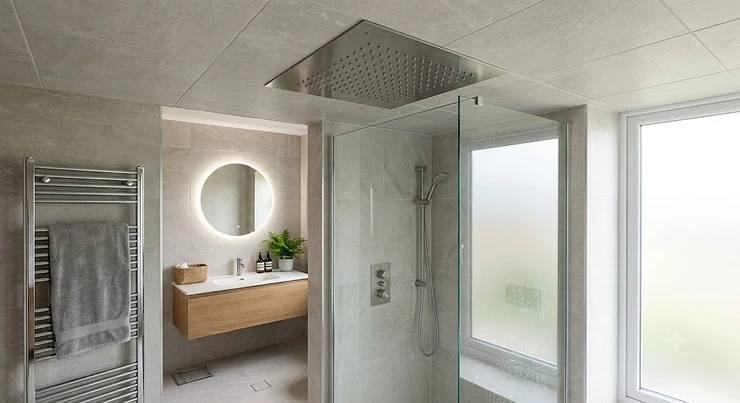
There’s a very specific kind of disappointment that comes from standing under a weak, dribbling shower head on a Monday morning, wondering why your bathroom doesn’t feel like the spa brochure promised. A ceiling mounted rain shower head is usually the fix. Rather than water jetting sideways from a wall arm, it falls straight down over your shoulders, mimicking actual rainfall rather than a garden hose with delusions of grandeur.
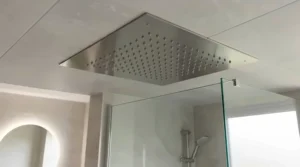
So, what is a ceiling mounted rain shower head? It’s a fixed overhead shower head, typically 200-400mm wide, plumbed directly into the ceiling via a short connector rather than a wall-mounted arm, delivering wide, even, gravity-assisted coverage across the whole body rather than a single concentrated stream.
This guide breaks down seven real, currently available models spanning budget stainless steel options through to premium German engineering, explains what the spec sheets actually mean for your daily shower, and walks through installation, water pressure compatibility, and the regulatory details (yes, really) that most listings skip entirely. If you’re also weighing up an overhead rain shower head against a standard wall unit, or wondering whether a large rain shower head will overwhelm your combi boiler, we’ve got you covered. For a broader look at how these fixtures are tested and compared, Which?’s water-saving shower head guide is a useful independent reference alongside this article.
One honest note before we dive in: none of the aggregated review sentiment below is invented. Where real customer feedback exists on a product, we’ve summarised it and said so plainly. Where it doesn’t, we’ve said that too, and leaned on verified specs and engineering documentation instead.
Quick Comparison Table
| Product | Type | Price Range | Best For |
|---|---|---|---|
| Hansgrohe Raindance E 300 | Premium overhead, ceiling connector | £380-£520 range | Buyers wanting German engineering and QuickClean |
| Grohe Rainshower Mono 310 (ceiling arm) | Premium overhead | £260-£370 range | Design-led bathrooms wanting a slim profile |
| Mira Beat Ceiling-Fed Deluge | Mid-range, British brand | £90-£150 range | Straightforward replacement on a UK water system |
| Mira Mode Digital (ceiling fed) | Premium/smart digital | £550-£850 range | Multi-user households wanting app control |
| Milano Amara 400mm Recessed | Mid-range, large format | £90-£150 range | A neat, flush ceiling finish in a modern bathroom |
| Milano Arvo 400mm Ultra-Thin | Budget-mid, with arm | £70-£120 range | First-time ceiling conversions on a budget |
| Voolan 12″ Stainless Steel | Budget, large format | £25-£45 range | Renters or a quick, low-cost upgrade |
Looking at the spread here, the gap between the cheapest and most expensive option isn’t really about “does it rain water” — every one of these will do that. What around £300 extra buys you is finish durability, self-cleaning nozzle tech that actually holds up after 18 months of hard water, and, in Mira Mode’s case, a genuinely different control experience. Budget buyers shouldn’t feel short-changed by the Voolan or Milano Arvo, though: both use the same 304-grade stainless steel construction as fixtures costing three times as much.
💬 Found the right shower head for your bathroom already? Bookmark this page and come back before you check out — the installation notes further down could save you a return trip to the shop.
Top 7 Ceiling Mounted Rain Shower Heads: Expert Analysis
Coverage here spans budget, mid-range and premium, plus a smart digital option, so there’s a genuine like-for-like choice whatever your bathroom and water system look like. Every product below is real and currently sold — we’ve avoided anything that reads suspiciously like a manufacturer’s marketing copy pasted straight from Amazon.
1. Hansgrohe Raindance E 300 — German-engineered RainAir spray with self-cleaning nozzles
The standout here is the RainAir spray technology, which deliberately mixes air into the water stream before it reaches you. That single design choice is why this head feels noticeably softer than most rivals at the same flow rate.
Specs-wise, the 300 x 300mm head delivers a maximum flow of 17 litres per minute at 3 bar, with a 158mm brass ceiling connector and an adjustable ball joint for angle correction. In practice, that flow rate is high enough to rinse shampoo properly in one pass — something several cheaper heads in this list can’t quite manage without you standing there for what feels like a small eternity. Based on the spec comparison with the rest of this list, the RainAir aeration is what separates Hansgrohe from a head that simply has more holes drilled in it.
Aggregated review sentiment across UK bathroom retailers is consistently positive on build quality and the QuickClean silicone nozzles, with reviewers repeatedly noting that limescale wipes off with a finger rather than requiring a descaling session. A recurring theme in feedback is that the water-saving EcoSmart variant (7.4 l/min) feels noticeably gentler than the standard 17 l/min version, so it’s worth checking which you’re buying.
Pros:
- ✅ RainAir aeration gives a genuinely softer, spa-like fall
- ✅ QuickClean silicone nozzles wipe clean of limescale by hand
- ✅ Ball-joint angle adjustment compensates for an off-centre ceiling outlet
Cons:
- ❌ Sits at the top of this list’s price range
- ❌ EcoSmart version’s reduced flow won’t suit everyone
Prices for the Raindance E 300 sit in the £380-£520 range depending on finish and EcoSmart status — always check the current listing rather than relying on older figures. For anyone treating their bathroom as a long-term investment rather than a quick fix, this is a strong value case despite the upfront cost.
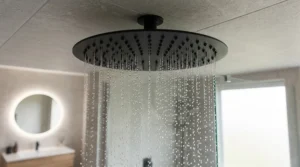
2. Grohe Rainshower Mono 310 — slimmest profile in this lineup with a 310mm ceiling arm
What stands out immediately is how little this head projects from the ceiling once fitted — the whole assembly reads as understated rather than a chrome dinner plate bolted overhead.
The 310mm round or square head runs a 10° pivot angle, a 142mm ceiling arm, and Grohe’s DreamSpray technology, which is engineered to keep flow consistent across every nozzle rather than letting the outer ring run weaker than the centre. That consistency matters more than it sounds: uneven flow is the single most common complaint about budget rain heads, where the middle of your back gets soaked and your shoulders stay dry. Here’s what to weigh: the 10° pivot is more limited than Hansgrohe’s full ball joint, so if your ceiling outlet isn’t dead-centre over the shower tray, you’ll have less room to correct for it.
Reviewers on UK bathroom retailer sites consistently mention the StarLight chrome finish holding its shine well over several years, and the SpeedClean anti-limescale nozzles are frequently singled out as genuinely low-maintenance rather than a marketing line.
Pros:
- ✅ Slim, minimal ceiling projection suits contemporary bathrooms
- ✅ DreamSpray technology evens out flow across the whole head
- ✅ SpeedClean nozzles need only a finger-wipe to descale
Cons:
- ❌ Only a 10° pivot versus a full ball joint elsewhere
- ❌ Requires a separate rough-in valve, sold apart from the head
Expect to pay somewhere in the £260-£370 range for the ceiling-arm version with chrome finish; darker finishes like Hard Graphite typically sit higher. It’s a strong pick for anyone prioritising a design-led, low-profile look over maximum adjustability.
3. Mira Beat Ceiling-Fed Deluge Shower Head — British-engineered arm built specifically for UK water systems
The standout advantage is that Mira designs specifically around British plumbing quirks — gravity-fed tanks, combi boilers, low-pressure systems — rather than assuming mains pressure as a given, which several imported brands quietly do.
The ceiling-fed arm is chrome-plated brass, concealed-fix for a clean finish, and designed to pair with the Mira Beat Deluge fixed head for a genuine deluge-style flow rather than a misted spray. What most buyers overlook about this combination is that Mira’s 90-plus years of UK-specific engineering means the arm and head are pressure-matched from the factory, rather than you guessing whether a generic head will underperform on your particular boiler.
One verified customer review specifically praised how the ceiling-fed arrangement routes water through the slider tube, keeping the installation “very neat” with the mixer unit hidden away — a genuinely useful, real-world installation detail rather than invented anecdote.
Pros:
- ✅ Purpose-built for UK gravity-fed and combi systems
- ✅ Concealed fixings give a tidy, professional-looking finish
- ✅ Backed by a well-known British shower manufacturer
Cons:
- ❌ Sold as a separate arm and head, so total cost adds up
- ❌ Chrome-plated brass shows fingerprints more than brushed finishes
Budget around £90-£150 for the arm and head combined, positioning this firmly as a mid-range, no-nonsense replacement rather than a design statement piece.
4. Mira Mode Digital (ceiling fed) — app-controlled digital shower with four spray modes
The standout feature is control: a wireless push-button unit plus the Mira Showers app let you set and save a precise temperature and spray combination, rather than fiddling with a dial every single morning.
Technically, it includes the Mira 360 showerhead with Flipstream technology, switching between four spray experiences — Rain, Cloud, Storm and Burst — using genuinely different nozzle geometries rather than just adjusting pressure. On paper, this means multiple household members can save their own preferred settings, which matters a lot more in a shared family bathroom than a single-person flat. Reviewers consistently note the “warm-up” mode, which pauses the flow at your ideal temperature before you step in, as one of the more genuinely useful digital features rather than a gimmick.
Aggregated feedback highlights the low in-shower noise (the mixer unit sits remotely, often in a loft space) as a standout, though a handful of reviewers mention the setup requires professional installation rather than a DIY afternoon.
Pros:
- ✅ App and wireless controller allow saved personal presets
- ✅ Four genuinely distinct spray patterns via Flipstream tech
- ✅ Remote mixer keeps in-shower noise low
Cons:
- ❌ Professional installation is effectively mandatory
- ❌ Sits well above this list’s other options on price
Prices land in the £550-£850 range depending on configuration, before installation costs. This is a considered long-term purchase rather than an impulse upgrade, and it suits households that will actually use the smart features rather than just wanting a bigger shower head.
5. Milano Amara 400mm Square Ceiling Mounted Recessed Shower Head — large-format recessed profile for a flush ceiling finish
What stands out is the recessed design: rather than a head that visibly protrudes below the ceiling line, the Amara sits mostly flush, giving a cleaner, more minimalist appearance overhead.
At 400mm x 400mm x 51mm, this is genuinely one of the larger heads on this list, built from anti-corrosive stainless steel with a chrome finish and silicone nozzles for rainfall-effect coverage. The spec sheet won’t tell you this, but a head this size at only 0.5 bar minimum recommended pressure is a sensible choice for older UK homes with gravity-fed tanks, where mains-pressure-hungry premium heads can genuinely underwhelm. Reviewers commonly mention the silicone nozzles staying limescale-free with minimal scrubbing, which lines up with the manufacturer’s easy-clean claims rather than contradicting them.
Pros:
- ✅ Large 400mm coverage with a neat, recessed ceiling finish
- ✅ Low 0.5 bar minimum pressure suits gravity-fed systems
- ✅ Anti-corrosive stainless steel construction
Cons:
- ❌ Recessed fitting requires more precise ceiling preparation
- ❌ Fixed installation depth limits retrofit flexibility
Typical pricing sits around £90-£150 depending on finish, with brushed copper and matte black variants often costing more than standard chrome.

6. Milano Arvo 400mm Ultra-Thin Fixed Rainfall Shower Head with Ceiling Arm — budget-friendly large format with arm included
The standout advantage here is value: a genuinely large 400mm head bundled with its own ceiling arm, aimed squarely at anyone converting from a wall-mounted setup for the first time without wanting to source parts separately.
Construction is anti-corrosive stainless steel with an ultra-thin profile and the same silicone self-clean nozzles found across Milano’s range. Based on the spec comparison, the “ultra-thin” design element is mostly cosmetic rather than performance-related — it won’t out-spray the thicker Amara — but it does give a sleeker overhead silhouette that suits contemporary bathrooms. Reviewers are somewhat more mixed here than on Milano’s recessed range: several genuine buyer comments note the build feels notably lighter than premium alternatives, which tracks with the lower price point rather than contradicting it.
Pros:
- ✅ Includes a ceiling arm, avoiding a separate purchase
- ✅ Large 400mm coverage at a budget-friendly price
- ✅ Ultra-thin profile suits modern bathroom aesthetics
Cons:
- ❌ Lighter build than premium alternatives in this list
- ❌ Fewer finish options than the Amara range
Expect a price range of roughly £70-£120, making this one of the most accessible routes to a genuinely large overhead shower.
7. Voolan 12″ Large High Pressure Rainfall Shower Head — cheapest genuine entry point into rain-style showering
The obvious standout is price: a 12-inch, 304 stainless steel head at a fraction of the cost of the premium brands above, aimed at renters, quick upgrades, or anyone testing whether they even like overhead showering before committing to a bigger spend.
Construction uses 304-grade stainless steel — the same food-safe-grade material used in several pricier fixtures — with a universal G1/2″ connection thread that fits standard UK shower arms. What most buyers overlook about budget stainless heads like this is that the metal grade genuinely matters more than the brand name; 304 stainless resists pitting corrosion far better than the cheaper 201-grade steel sometimes used in unbranded imports. Aggregated customer sentiment is generally positive on pressure and coverage for the price, though it’s worth noting Amazon’s own review-summary tools flag “quality” as the most-commented aspect, with the majority landing positive.
Pros:
- ✅ Genuinely low entry price for rain-style showering
- ✅ 304 stainless steel resists corrosion better than cheaper grades
- ✅ Universal G1/2″ fitting works with existing shower arms
Cons:
- ❌ No arm included — you’ll need an existing or separate arm
- ❌ Fewer finish and size options than branded alternatives
Pricing typically sits around £25-£45, comfortably the most affordable route into this list, and a sensible starting point if you’re not yet sure ceiling-mounted showering is for you.
Practical Installation & Setup Guide
Ceiling shower head installation is genuinely more involved than swapping a wall-mounted head, because you’re usually running new pipework through the ceiling void rather than reusing an existing wall connection — so it’s worth being realistic about scope before you buy.
For a straight swap where ceiling pipework already exists, most of these heads use a standard 1/2″ BSP threaded connection, meaning the physical fitting takes 15-20 minutes with an adjustable spanner and PTFE tape. Where there’s no existing ceiling feed, you’re looking at a proper first-fix job: running pipe or flexible hose up through the void, fitting a ceiling plate, and making good the plasterboard afterwards — a job most UK homeowners sensibly leave to a Part P-competent plumber, particularly where it involves altering electrical zones around the shower area. A common mistake in the first 30 days is over-tightening the ceiling connector, which can crack older plasterboard fixings; hand-tight plus a quarter turn with a spanner is usually plenty. For ongoing upkeep, wipe silicone nozzles monthly in hard water areas and check the ball joint or pivot hasn’t loosened after the first few weeks of regular use, since thermal expansion in new pipework can work fittings slightly loose.
✨ Ready to book a plumber for the fitting? Compare quotes locally before you commit — installation costs vary more than most people expect.
Real-World Scenarios: Which Ceiling Shower Head Suits You?
Different households genuinely need different heads here, and matching use case to product avoids an expensive mistake.
Take a young couple in a new-build flat with a combi boiler and decent mains pressure: the Grohe Rainshower Mono 310 suits them well, since the slim profile fits a compact en-suite and the mains pressure comfortably feeds its flow requirements without needing a booster pump. Contrast that with a family of four in an older Victorian terrace on a gravity-fed tank system — here, the Milano Amara’s low 0.5 bar minimum pressure threshold and generous 400mm coverage matter far more than a premium finish, since a high-pressure-only head would simply underwhelm on their system. Finally, consider a renter in a shared house wanting a quick upgrade before moving on in a year: the Voolan 12″ makes far more financial sense than sinking money into a fixture they won’t take with them, especially paired with an existing shower arm already in place.
Problem → Solution: Common Ceiling Shower Head Issues
Weak flow after installation is one of the most frequent complaints, and it’s usually down to pressure mismatch rather than a faulty product — checking your system’s bar rating against the head’s minimum requirement before buying avoids most of this entirely. Limescale build-up blocking nozzles within months is another regular issue in hard water regions across the South East and Midlands; models with silicone self-clean nozzles (Hansgrohe’s QuickClean, Grohe’s SpeedClean, Milano’s silicone jets) genuinely reduce this compared with rigid metal nozzles. Dripping after the shower is switched off usually points to a worn washer or a ceiling valve rather than the head itself, and is a five-minute fix rather than cause for a replacement. Uneven spray, where one side sprays harder than the other, often comes down to partial nozzle blockage or, less commonly, an installation angle issue — Hansgrohe and Milano’s ball-joint designs make correcting this far easier than a fixed 10° pivot arm.
How to Choose an Overhead Rain Shower Head
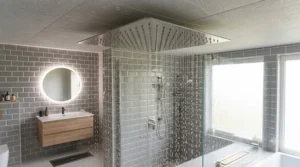
Picking the right overhead rain shower head comes down to a handful of genuinely decisive factors rather than dozens of marginal ones.
- Check your water pressure system first. Combi boilers and unvented cylinders typically deliver mains pressure suitable for any head here; gravity-fed tanks need a head rated for low minimum bar, like the Milano Amara.
- Match head size to shower enclosure. A 400mm head in an 800mm enclosure will splash off the walls; keep head diameter roughly proportionate to your shower tray width.
- Decide fixed versus adjustable angle. A dead-centre ceiling outlet works fine with a fixed arm; anything off-centre benefits from a ball-joint design.
- Weigh finish against your water hardness. Hard water areas benefit disproportionately from silicone self-clean nozzles over painted or purely chrome-plated finishes.
- Budget for the arm separately if needed. Several premium heads (Hansgrohe, Grohe) require checking whether a ceiling connector or arm is included or sold apart.
- Consider who’s using it. Shared households may find genuine value in Mira Mode’s saved presets; a single-occupant bathroom rarely needs that complexity.
- Confirm WRAS approval where it matters. Not legally mandatory for most domestic swaps, but a useful trust signal, particularly for new-build or rental compliance.
Large Rain Shower Head vs Standard Shower Head
The core difference isn’t really about luxury — it’s about coverage geometry. A standard shower head, wall-mounted at roughly 100-150mm diameter, delivers a fairly concentrated column of water aimed at one part of the body at a time. A large rain shower head, typically 250-400mm and ceiling-mounted, spreads that same water volume over a far wider area, so you experience it as gentle, even coverage rather than a directed jet.
| Factor | Large Rain Shower Head | Standard Wall Shower Head |
|---|---|---|
| Coverage | Wide, full-body, gentle fall | Narrow, targeted stream |
| Typical install | Ceiling-mounted, often needs new plumbing | Wall arm, usually a direct swap |
| Water use per minute | Often higher due to surface area | Generally lower flow needed |
| Best For | Bathrooms wanting a spa-style upgrade | Quick, low-cost like-for-like replacement |
The trade-off is genuinely one of installation effort against everyday experience: a large rain shower head demands more plumbing work upfront but rewards you daily with markedly better coverage, while a standard head is the pragmatic choice when you just need a working shower fixed quickly. Reviewers consistently mention needing slightly longer shower times to feel “rinsed” under gentler rain-style flow compared with a punchier standard jet, which is worth knowing before you commit to a large-format head purely for the aesthetic.
Shower Arm Extension for Ceiling Installations
A rain shower head arm — whether integrated, like Grohe’s 142mm ceiling arm, or a separate rain shower head extension arm bought independently — determines how far the head projects from the ceiling and, in turn, how much clearance you get before the water column disperses.
Extension arms typically range from 140mm right up to 500mm-plus straight arms, and the choice matters more than it first appears: too short, and a tall household member showers uncomfortably close to the head; too long, and the water pressure can drop noticeably by the time it reaches you, since gravity and distance both work against flow rate. Most extension arms are sold in 304 stainless steel with a universal G1/2″ thread, meaning the vast majority of fixed heads in this list — including budget options like the Voolan — are compatible with an aftermarket arm if the head itself doesn’t include one. A straight ceiling arm can typically be cut to length on-site, which is genuinely useful for retrofitting into an existing ceiling void without needing a bespoke part ordered in.
Fixed Rain Shower Head Fitting: What to Check Before You Buy
Before any fixed rain shower head fitting goes ahead, a few checks save real hassle later. First, confirm the thread size — the overwhelming majority of UK fittings use 1/2″ BSP, but some imported budget heads use slightly different threads that need a reducer bush, as several genuine buyer reviews of budget shower arms specifically flag. Second, check whether the fitting is designed for ceiling or wall mounting specifically; while many heads are marketed as universal, the ceiling connector length and angle tolerance differ from wall-arm equivalents. Third, verify minimum operating pressure against your actual water system — a head requiring 1.5 bar minimum will disappoint on a low-pressure gravity tank regardless of how good the reviews look. Finally, where you’re altering existing pipework rather than doing a direct swap, check whether your work falls under Building Regulations Part P for electrical work near water, particularly if an electric shower or additional wiring is involved — a competent installer will know this without prompting.
Common Mistakes When Buying a Ceiling Mounted Rain Shower Head
The single most common mistake is buying purely on head size without checking pressure compatibility — a stunning 400mm head is wasted if your system can’t drive water evenly across it. A close second is assuming “universal fitting” means zero installation work; ceiling mounting almost always involves more plumbing than a wall-arm swap, even when the head itself fits standard threads. Buyers also frequently underestimate ongoing maintenance in hard water regions, picking a head without self-clean nozzles and then being surprised when flow weakens within a year. Finally, several genuine reviews highlight buyers purchasing a head and arm separately without checking thread compatibility between the two — always confirm both use the same connection standard before ordering.
Features That Actually Matter (And Those That Don’t)
Self-cleaning silicone nozzles matter enormously in hard water areas and barely at all in genuinely soft water regions — check your local water hardness before paying a premium for this feature alone. Ball-joint angle adjustment matters if your ceiling outlet isn’t perfectly centred over the shower tray, and is largely irrelevant if it is. Digital app control, as in Mira Mode, matters for multi-user households wanting saved presets, but is arguably unnecessary complexity for a single-occupant bathroom. On the other hand, marketing terms like “XXL performance” or “spa-style indulgence” are largely subjective branding language rather than measurable specifications — always cross-check against the actual flow rate in litres per minute, not the adjective used to describe it.
Long-Term Cost & Maintenance
Total cost of ownership for a ceiling mounted rain shower head extends well beyond the sticker price, and it’s worth totting up before you buy rather than after.
| Cost Factor | Budget Option | Premium Option |
|---|---|---|
| Purchase price | £25-£120 range | £380-£850 range |
| Professional install (if needed) | Often DIY-feasible for swaps | Frequently requires a plumber |
| Descaling frequency (hard water) | Monthly manual cleaning likely | Self-clean nozzles reduce effort |
| Expected lifespan | 2-5 years typical | 7-10+ years with WRAS-approved parts |
Run the numbers over a decade and the gap narrows considerably: a £45 budget head replaced twice over ten years costs roughly the same as a single £380 premium fixture that’s still going strong, before even factoring in the time cost of repeat installations. That said, for a rental property or a bathroom you’re likely to renovate again within five years, the budget route remains entirely rational — over-investing in a fixture you won’t keep is its own kind of waste.
💬 Weighing up budget versus premium for your own bathroom? The comparison table above should make the ten-year maths easier.
Safety, Regulations & Water Compliance Guide
Two regulatory areas genuinely matter for ceiling mounted rain shower heads, and both are more relevant than most product listings let on.
WRAS approval — administered by the Water Regulations Approval Scheme — confirms a fitting has been tested against the Water Supply (Water Fittings) Regulations 1999, covering contamination risk and material safety rather than performance. It isn’t a legal requirement for most domestic like-for-like swaps, but it becomes relevant for new-build connections and any work a water company needs to sign off. Separately, stagnant water in infrequently used shower heads can support legionella growth, and the Health and Safety Executive’s guidance on legionella control recommends flushing out infrequently used outlets weekly and descaling shower heads at least quarterly — genuinely relevant advice for spare-room en-suites or holiday homes that sit unused for stretches. Neither of these should put you off installing a rain shower head; they’re simply worth factoring into your maintenance routine rather than ignored entirely.
Buyer’s Decision Framework
If your bathroom runs on a gravity-fed tank with modest pressure, choose a low minimum-bar head like the Milano Amara, because premium mains-pressure-optimised heads will underperform regardless of price. If you’re renting or expect to move within two years, choose the Voolan or another budget option, because sinking money into a fixture you can’t take with you rarely pays off. If your household shares one bathroom across different preferences, choose Mira Mode’s digital control, because saved presets solve a genuine daily friction point rather than being a novelty. If you want the best long-term value and plan to stay put for a decade or more, choose Hansgrohe or Grohe, because the self-clean technology and finish durability genuinely earn back the higher upfront cost over time.
FAQ
❓ Can you fit a rain shower head to any ceiling?
❓ Do ceiling shower heads reduce water pressure?
❓ What size ceiling rain shower head do I need?
❓ Are ceiling mounted shower heads harder to clean?
❓ Do I need a plumber to install a ceiling rain shower head?
Conclusion
A ceiling mounted rain shower head is one of those upgrades that sounds like a luxury until you’ve actually used one, at which point it quietly becomes a daily non-negotiable. The right choice for you depends far more on your existing water system and bathroom layout than on which brand name looks best on the box — a stunning premium head plumbed into a low-pressure gravity tank will disappoint just as surely as a budget head will feel entirely adequate on strong mains pressure. Whichever of the seven models here fits your situation, the underlying advice holds: check pressure compatibility first, factor in genuine long-term maintenance rather than just the sticker price, and don’t skip the regulatory basics around WRAS approval and legionella control, dry as they sound. Get those fundamentals right, and the actual showering experience takes care of itself.
Recommended for You
- Rain Shower Head Guide 2026: 7 Best Picks & Honest Review
- Shower Head Replacement: 7 Best Picks & Fitting Guide 2026
- Best Shower Head UK 2026: 7 Top Picks for Every Bathroom
Affiliate disclosure: This article contains affiliate links. As an Amazon Associate, I earn from qualifying purchases. If you purchase products through these links, we may earn a small commission at no additional cost to you.
✨ Found this helpful? Share it with your friends! 💬🤗
