In This Article
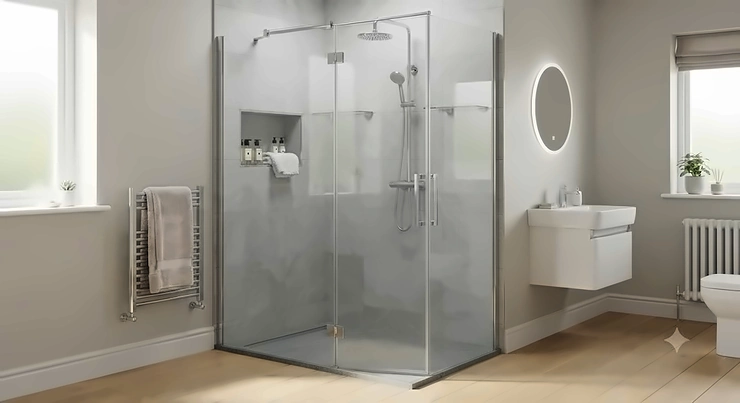
Somewhere between “I’ll just replace the shower curtain” and “let’s rip the whole bathroom out,” most homeowners land on the same decision: a frameless shower enclosure. It’s the upgrade that does the most with the least — no chunky aluminium trim, no grubby sealant lines collecting soap scum, just clean glass doing a very good impression of expensive architecture. A frameless shower enclosure is a cubicle built almost entirely from panels of toughened safety glass, held with minimal metal fixings rather than a full frame, which is exactly what gives it that open, light-filled look modern UK bathrooms are chasing. It’s not a new idea, but it’s finally an affordable one, and that’s largely down to a wave of well-specified imports and British-assembled ranges landing on the market at every price point.
This guide exists because “just buy the nicest-looking one” is a genuinely bad strategy here. Two enclosures can look near-identical in a product photo and be worlds apart in glass thickness, roller quality, and how they’ll survive a British winter’s worth of steam and hard water. So we’ve gone product by product, brand by brand, spec sheet by spec sheet, to work out which frameless shower enclosures actually earn their price tag in 2026 — and, just as importantly, which corners get cut when the price drops.
Across this piece you’ll find seven real, currently available products spanning budget sliding doors through to premium walk-in screens, honest analysis of what each one’s specification means in daily use, and a full breakdown of frameless enclosure glass thickness, toughened glass safety standards, and how to keep the whole thing looking showroom-fresh long after installation day. Whether you’re fitting a compact en-suite or finishing off a minimalist bathroom renovation, there’s a configuration here that fits.
Quick Comparison Table
Before the deep dive, here’s the shortlist. Each of these seven products earns its place for a different reason — budget value, glass quality, or sheer showroom presence — so use this table to narrow things down before reading the full breakdowns below.
| Product | Glass Thickness | Style | Price Range | Best For |
|---|---|---|---|---|
| ELEGANT 1100 Sliding Door | 8mm | Sliding door + side panel | Under £400 | First-time frameless buyers |
| ELEGANT 900 Walk-In Panel | 8mm | Walk-in wet room screen | Under £250 | Compact en-suites |
| Victorian Plumbing Apollo Pentangle | 6-8mm | Pentangle corner enclosure | £250-£350 range | Awkward corner bathrooms |
| Merlyn Ionic Essence Sliding Quadrant | 8mm | Offset sliding quadrant | £500-£650 range | Family bathrooms |
| Merlyn 8-Series Wetroom Screen | 8mm | Walk-in wetroom screen | £550-£750 range | Contemporary wet rooms |
| Merlyn 10-Series Wetroom Screen | 10mm | Statement wetroom screen | £700-£950 range | Design-led renovations |
| Merlyn ARYSTO X | 10mm | Premium hinged enclosure | £900-£1,300 range | Luxury en-suite finishes |
Looking at the spread, the jump from 6-8mm to 10mm glass is really where the “premium frameless shower enclosure” category starts, and it’s reflected squarely in price. Budget buyers shouldn’t feel short-changed by 8mm, though — it’s the industry-standard thickness for a reason, and both ELEGANT products deliver genuinely toughened safety glass at a fraction of the flagship cost. If your priority is a statement single-panel screen rather than a boxed-in cubicle, the two Merlyn wetroom screens are worth comparing side by side before you commit.
💬 Bookmark this comparison — you’ll want it handy when you’re standing in the bathroom with a tape measure!😊
Top 7 Frameless Shower Enclosures: Expert Analysis
We’ve deliberately mixed budget, mid-range and premium options here, plus a couple of shapes you won’t see in every “top 10” list — because a rectangular sliding door isn’t the right fit for every bathroom, and pretending otherwise does readers no favours.
1. ELEGANT 1100 Sliding Door — best entry point into frameless glass
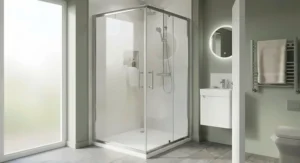
The standout here is the price-to-glass-quality ratio: this is proper 8mm toughened safety glass at a figure that undercuts most “budget” framed alternatives. The ELEGANT 1100 Sliding Door measures 1100mm with an 800mm side panel, reaching 1900mm in height, and the sliding mechanism runs on top-mounted wheels rather than the recessed rollers found on cheaper framed units — a detail that matters because top-mounted wheels are far easier to clean and less prone to jamming with grit over time. The reversible fitting means it’ll suit either a left- or right-hand entry without needing a mirrored SKU.
Based on the spec comparison with framed alternatives in the same price bracket, what stands out is the Easy Clean nano-coating baked into the glass at manufacture, which smooths over the microscopic pitting where limescale usually gets a foothold. Reviewers consistently note that the black-framed hardware (chrome fittings are also available) holds its finish well, though a handful mention the adjustment range — 1060-1100mm — leaves little wiggle room if your opening is slightly out of true, so accurate measuring matters more than usual here. This is the enclosure for someone who wants the frameless look without a frameless budget, particularly first-time renovators nervous about DIY installation, since the fitting kit is well documented.
Pros:
- ✅ 8mm toughened glass at a genuinely budget price point
- ✅ Top-mounted sliding wheels resist grit and jamming
- ✅ Reversible left/right fitting included as standard
Cons:
- ❌ Narrow 40mm adjustment tolerance needs precise measuring
- ❌ Optional tray and waste add meaningfully to the final cost
At around £350-£400 depending on tray configuration, this is hard to beat as a value pick — check current price before ordering, as fittings bundles shift the total.
2. ELEGANT 900 Walk-In Panel — best for compact en-suites
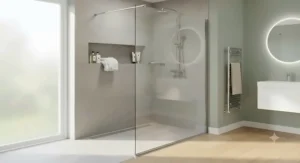
The standout advantage is the sheer simplicity: one 900mm panel of 8mm safety tempered glass, no doors, no tracks, nothing to jam. The ELEGANT 900 Walk-In Panel is designed for wet room-style installations where the floor itself is tanked and gently graded to a drain, with the glass simply acting as a splash barrier rather than a sealed cubicle.
What most buyers overlook about walk-in panels is that they trade a little water containment for a lot of practical upside — there’s no door seal to perish, no rollers to service, and cleaning is a five-second wipe-down because there’s nowhere for grime to hide. With 15mm of inward adjustment and a 1900mm height, it suits ceilings up to standard UK domestic heights without needing a bespoke cut. Aggregated feedback on this style of panel across retailers tends to flag that spray containment depends heavily on shower head positioning — aim the head away from the open edge and you’ll rarely notice the difference from a fully enclosed cubicle. This is the right call for anyone renovating a small en-suite where every centimetre of visual space matters, since an open panel reads as considerably larger than a boxed cubicle of the same footprint.
Pros:
- ✅ Genuinely minimalist — one pane, minimal fixings
- ✅ Nothing mechanical to maintain or replace
- ✅ Makes small bathrooms feel noticeably more spacious
Cons:
- ❌ Requires a properly tanked wet room floor to work well
- ❌ Spray containment depends on careful shower head aim
Priced in the £150-£250 range before tray or wet room kit, it’s one of the cheapest genuine frameless options going, and arguably the best value per visual impact on this list.
3. Victorian Plumbing Apollo Pentangle — best for awkward corner layouts
The pentangle shape is the whole story here: a five-sided enclosure that fits into a corner far more efficiently than a standard quadrant, clawing back precious floor space in bathrooms where every centimetre is contested. The Victorian Plumbing Apollo Pentangle comes in 800x800mm and 900x900mm sizes, both including a matching tray and waste, which simplifies the buying decision considerably compared with sourcing components separately.
On paper this means less glass overall than a rectangular enclosure of similar footprint, which keeps the unit lighter and, in most cases, cheaper to manufacture — savings that get passed on to the buyer. Reviewers on the retailer’s own site describe the build as “well made and good materials,” with one noting the frame could use “some extra adjustment,” a fair criticism of budget pentangle designs generally, where the geometry leaves less tolerance than a straightforward rectangular door. What the spec sheet won’t tell you, but the shape itself makes obvious, is that pentangle doors open outward on a hinge rather than sliding, so you’ll need clear floor space in front of the enclosure — worth checking against your layout before ordering. Best suited to smaller bathrooms and cloakroom conversions where a rectangular or quadrant enclosure simply wouldn’t fit the corner.
Pros:
- ✅ Space-efficient five-sided shape suits tight corners
- ✅ Includes matching tray and waste in the bundle
- ✅ Solid material quality noted in aggregated reviews
Cons:
- ❌ Less installation tolerance than rectangular designs
- ❌ Outward-hinged door needs clear approach space
Expect a price in the £250-£350 range including the tray bundle — genuinely competitive once you account for not having to source a separate tray.
4. Merlyn Ionic Essence Sliding Quadrant — best mid-range family pick
The concealed roller system is the headline feature: rather than exposed wheels sitting on a visible track, the Merlyn Ionic Essence Sliding Quadrant hides its running gear within the frame line, giving a cleaner look while keeping the mechanism protected from limescale and hair build-up. At 1200 x 900mm as an offset quadrant, it’s shaped for exactly the kind of family bathroom layout that needs generous shower space without eating the whole room.
Here’s what to weigh: 8mm toughened glass finished with Merlyn’s MerShield coating, which the brand states reduces limescale and water-spotting versus untreated glass — a genuinely useful feature in the UK’s harder-water regions, where standard glass can develop a persistent white bloom within months. Reviewers on independent DIY forums who’ve fitted the Ionic range consistently rate it above own-brand budget sliding doors for smoothness of operation, specifically citing the concealed rollers as noticeably quieter than exposed-wheel alternatives. Left- or right-hand configurations are both available, and Merlyn backs the range with an extended warranty that outlasts most budget competitors by a considerable margin. For a busy family bathroom seeing multiple showers a day, the combination of a protected roller mechanism and an easy-clean coating genuinely reduces the maintenance burden rather than just promising to.
Pros:
- ✅ Concealed rollers stay cleaner and run quieter
- ✅ MerShield coating meaningfully cuts limescale build-up
- ✅ Offset shape maximises usable shower floor space
Cons:
- ❌ Sits notably above entry-level sliding doors on price
- ❌ Offset quadrant trays cost more than standard shapes
At around £500-£650 depending on handing and tray choice, this is the sweet spot for households wanting daily-use durability without stretching to the premium tier.
5. Merlyn 8-Series Wetroom Screen — best contemporary wetroom statement
The standout feature is the stabilising bar option, which lets a single large glass panel stand rock-solid without a full door frame around it — the defining look of a proper wetroom rather than a boxed shower cubicle. The Merlyn 8-Series Wetroom Screen is fully reversible and available across several widths and heights up to 2015mm, so it scales from a small en-suite screen to a full walk-through wetroom divider.
The spec comparison worth making here is against the ELEGANT walk-in panel above: both are single-pane designs, but the 8-Series adds Merlyn’s engineering pedigree, more finish options (chrome, matt black, and brushed brass among them), and a wider size range for bespoke openings. Based on the spec sheet, the stabilising bar isn’t just cosmetic — it braces the glass against lateral movement, which matters increasingly as panel width increases, since an unsupported pane over roughly a metre wide can flex noticeably underfoot pressure on the floor around it. What reviewers on trade forums consistently flag is installation quality control: because it’s a bespoke-feeling product with several finish and size permutations, getting the wall fixings dead level matters more here than with a boxed cubicle, so this is one where paying a competent fitter tends to pay for itself. It suits design-led bathrooms where the glass itself is meant to be the visual anchor of the room.
Pros:
- ✅ Stabilising bar option braces wide single panels
- ✅ Wide range of finishes including brushed brass
- ✅ Fully reversible across multiple widths and heights
Cons:
- ❌ Installation precision matters more than boxed enclosures
- ❌ Stabilising bar and brackets are usually sold separately
Pricing typically sits in the £550-£750 range before accessories, positioning it as the mid-to-premium bridge on this list.
6. Merlyn 10-Series Wetroom Screen — best for a genuine glass statement
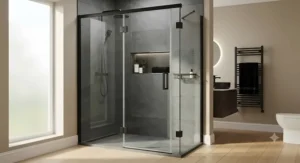
The 10mm toughened glass is the entire pitch: noticeably heavier and more substantial underhand than the 8mm norm, giving the panel an almost architectural presence rather than reading as “just a shower screen.” The Merlyn 10-Series Wetroom Screen is reversible and, like its 8-Series sibling, available across multiple width and height combinations to suit bespoke openings.
What most buyers overlook about the thickness jump from 8mm to 10mm is that it isn’t really about extra safety margin — both thicknesses comfortably exceed BS EN 12150 toughened glass requirements — it’s about rigidity and perceived quality. A 10mm pane simply doesn’t flex the way an 8mm one can on very wide single-panel installations, which is precisely why Merlyn positions this range for larger, statement-format wetroom screens rather than compact en-suite panels. Reviewers and trade installers who compare the two ranges side by side describe the 10-Series as feeling “properly weighty” in a way that’s hard to convey in a product photo, and several note that the thicker edge profile also reads as more premium once installed, even before considering the finish options. The trade-off, as ever, is weight: 10mm glass needs a competent two-person lift and secure wall fixings rated for the extra load, so this isn’t a solo Saturday-afternoon install for most people.
Pros:
- ✅ 10mm glass delivers genuine architectural weight and rigidity
- ✅ Ideal for wide single-panel statement installations
- ✅ Premium edge profile noticeably elevates the finish
Cons:
- ❌ Heavier glass demands a confident two-person installation
- ❌ Meaningful price step up over the 8-Series equivalent
Expect to pay in the £700-£950 range depending on panel width — a fair premium for buyers who’ve decided the glass itself should be the room’s focal point.
7. Merlyn ARYSTO X — best premium all-round enclosure
Self-cleaning rollers are the feature that separates this from everything else on the list: rather than needing periodic manual cleaning to keep the sliding action smooth, the Merlyn ARYSTO X roller system is engineered to shed grime and limescale as it runs, addressing the single most common maintenance complaint about sliding shower doors generally. Built around 10mm luxury glass and finished with an ergonomic towel-rail handle, it’s designed to pair with Merlyn’s Level25 slip-resistant tray for a cohesive, design-matched installation.
Here’s what to weigh against the 10-Series above: where that range is about a single dramatic panel, the ARYSTO X is a fully engineered enclosure system — door, panel, hardware and tray specified as one unit, which removes a lot of the guesswork (and mismatch risk) that comes with assembling components from different ranges. Reviewers consistently point to the smoothness of the self-cleaning rollers as the standout day-to-day benefit, since it’s the difference between a door that glides the same way in year three as it did on day one, versus one that gradually stiffens as grime accumulates in the track. On paper, the combination of 10mm glass, self-cleaning hardware, and a coordinated slip-resistant tray justifies its position as the most expensive product on this list, and it’s the one we’d point luxury en-suite renovations toward without much hesitation. The main caveat is straightforward: this is a considered, fully-specified purchase, not an impulse buy, and it rewards being planned into the bathroom design from the outset rather than retrofitted at the last minute.
Pros:
- ✅ Self-cleaning rollers solve the sliding-door maintenance problem
- ✅ 10mm luxury glass with a genuinely premium hardware feel
- ✅ Coordinated tray and enclosure remove specification guesswork
Cons:
- ❌ The most expensive option on this list by a clear margin
- ❌ Best planned into a full renovation rather than a quick swap
Priced in the £900-£1,300 range depending on configuration, it’s a considered investment rather than an impulse purchase — but for a genuine premium frameless shower enclosure, the spec sheet backs up the price tag.
Practical Usage Guide: Setting Up and Maintaining Your Frameless Shower Enclosure
Getting a frameless shower enclosure from delivery box to daily use without drama comes down to a handful of details that installation instructions tend to gloss over. First, unpack and inspect every glass panel before your installer arrives — toughened glass rarely arrives damaged, but when it does, a hairline chip along an edge is a returns issue, not a “fit it anyway” one, since any edge damage compromises the toughening. Second, dry-fit the frame components against the wall before applying any silicone; walls in older UK properties are rarely perfectly plumb, and shimming the frame now saves a much messier correction later.
Once it’s in, the first 30 days matter more than people expect. Avoid using the shower at full pressure directly onto fresh silicone seals for at least 24 hours, and resist the urge to slam sliding doors shut — the satisfying “clunk” wears rollers faster than a gentle close ever will. A common mistake is over-tightening wall brackets in an attempt to eliminate every last wobble; toughened glass needs a small amount of give in its fixings to handle thermal expansion from hot water, and over-torquing brackets can actually stress the glass at its weakest point, the fixing hole. For ongoing upkeep, a weekly squeegee after the final shower of the day, paired with a monthly limescale treatment suited to your local water hardness, will keep both the glass and the door mechanism running as intended for years rather than months.
Real-World Scenarios: Which Frameless Shower Enclosure Suits Your Life?
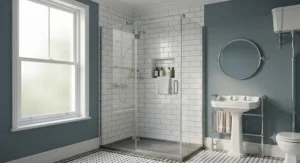
If you’re a first-time buyer renovating a rented-out en-suite on a fixed budget, the ELEGANT 900 Walk-In Panel or ELEGANT 1100 Sliding Door make the most sense — both deliver genuinely toughened frameless glass without the premium price tag, and neither requires ongoing specialist maintenance a tenant might neglect. If you’re a family of four sharing one main bathroom with a shower running most mornings before school and work, the Merlyn Ionic Essence Sliding Quadrant is built for exactly that use pattern, with its concealed, protected rollers designed to handle frequent daily cycling without the mechanism degrading.
For someone finishing a full bathroom renovation where the shower is meant to be the room’s design centrepiece — think an open-plan en-suite off a main bedroom, tiled floor-to-ceiling, underfloor heating — either Merlyn wetroom screen or the Merlyn ARYSTO X earns its keep. The 10mm glass and (in the ARYSTO X’s case) self-cleaning hardware are exactly the kind of details that separate a “nice bathroom” from one that feels genuinely considered. And if you’re dealing with an awkward loft conversion en-suite where the corner geometry rules out a standard rectangular door, the Victorian Plumbing Apollo Pentangle solves a layout problem that no amount of budget thrown at a rectangular enclosure would fix.
Problem → Solution: Fixing Common Frameless Shower Enclosure Headaches
Problem: Limescale keeps building up despite regular cleaning. In hard water regions this is close to unavoidable without intervention — switch to a dedicated limescale remover used weekly rather than a generic bathroom spray, and consider one of the coated glass options like the Merlyn Ionic Essence Sliding Quadrant, whose MerShield finish is specifically engineered to slow mineral adhesion.
Problem: The sliding door has become stiff or noisy. Nine times out of ten this is grit in the track rather than a mechanical fault — remove the door if the design allows and clean the roller channel with an old toothbrush before assuming a warranty claim is needed. Products with concealed or self-cleaning rollers, like the Merlyn Ionic Essence Sliding Quadrant and Merlyn ARYSTO X, are specifically designed to minimise this problem in the first place.
Problem: Water is escaping past a walk-in panel onto the floor. This is almost always a shower head aim issue rather than a design flaw — repositioning the head to angle water back toward the drain, away from the open edge, resolves the vast majority of cases with panels like the ELEGANT 900 Walk-In Panel.
Problem: The enclosure feels wobbly at the top edge. Check the wall bracket torque first; over-tightened brackets can paradoxically cause a faint vibration under water pressure because the glass has no give at its fixing points, while under-tightened ones allow genuine movement. A competent installer can usually resolve this in minutes without replacing anything.
How to Choose a Frameless Shower Enclosure
Working through these seven criteria in order will get you to the right decision faster than browsing product listings at random.
- Measure your opening precisely, twice. Frameless enclosures have less forgiving adjustment tolerances than framed alternatives, so a few millimetres of error can mean an ill-fitting seal.
- Decide between a boxed cubicle and a walk-in panel. Boxed designs contain water more reliably; walk-in panels feel more spacious and need less maintenance, but demand a properly tanked wet room floor.
- Set a glass thickness floor at 8mm. Anything thinner sacrifices the rigidity and premium feel that make frameless designs worth choosing over framed ones in the first place.
- Check the roller or hinge mechanism, not just the glass. The glass rarely fails; the moving parts are what determine your five-year experience of the product.
- Match the finish to your fittings, not just your taste. Chrome, matt black and brushed brass all age differently under hard water, so pick a finish that suits your cleaning habits as much as your colour scheme.
- Confirm handing and reversibility before ordering. Left/right configuration mistakes are one of the most common — and most expensive — returns issues in this category.
- Budget for the tray and installation separately. Many listed prices exclude these, and they can add a meaningful percentage to your total spend.
Frameless Enclosure Glass Thickness Explained
Glass thickness is the single most-asked question in this category, and for good reason — it’s the one spec that affects safety, sound, cost and visual weight all at once. The overwhelming majority of frameless shower enclosures on the UK market use either 6mm, 8mm or 10mm toughened glass, and each step up brings a genuine, noticeable difference rather than a marketing distinction.
Six millimetre glass is the lightest and cheapest option, still fully toughened and safe, but it can flex slightly on wider unsupported panels and tends to feel less substantial when a door is closed. Eight millimetre has become the de facto industry standard for good reason — it’s rigid enough for most standard door and panel widths, keeps weight manageable for a straightforward installation, and strikes the best balance of cost against performance, which is why five of the seven products in this guide use it. Ten millimetre glass, as seen on the Merlyn 10-Series Wetroom Screen and Merlyn ARYSTO X, is reserved for wider single panels or for buyers who specifically want that heavier, more architectural feel underfoot and under hand. Regardless of thickness, UK-market panels should all be produced through the same thermally toughened safety glass process, where controlled heating and rapid cooling compress the outer surfaces so the pane fractures into small, blunt granules rather than dangerous shards if it ever breaks. Whichever thickness you choose, that safety behaviour shouldn’t be negotiable.
Frameless Shower Door vs Framed Shower Door
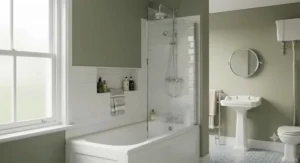
The core difference isn’t just visual, though that’s the most obvious one — frameless doors use minimal metal fixings and thicker glass to stand independently, while framed doors rely on an aluminium perimeter to support thinner, cheaper glass. That structural difference cascades into almost every practical consideration a buyer weighs up.
Framed doors win on upfront price and on water containment, since the frame’s seals and channels are specifically engineered to direct water back into the tray from multiple angles. They’re also generally lighter and easier for a confident DIYer to fit alone. Frameless shower doors win on almost everything else that shows up over years of ownership: there’s no frame channel to trap hair, soap scum and black mould, which is consistently the single biggest maintenance complaint about framed enclosures in aggregated customer reviews across retailers. The visual difference also compounds over time — a framed door’s aluminium trim can pit, discolour or corrode at the fixing points in hard water areas, while toughened glass with a decent coating like MerShield stays visually consistent for years with basic care.
The honest verdict: if your absolute priority is the lowest possible purchase price and you’re comfortable with a slightly higher maintenance routine around the frame seals, a framed door remains a reasonable choice. If you’re weighing five- to ten-year ownership costs, cleaning time, and how the bathroom will look after two winters of daily use, the case for frameless is considerably stronger, which is exactly why it’s become the default recommendation in most contemporary bathroom renovations.
✨ Ready to compare specific models side by side? Check the comparison table above before you decide!
Premium Frameless Shower Enclosure: Is It Worth the Extra Spend?
The jump from a mid-range option like the Merlyn Ionic Essence Sliding Quadrant to a premium pick like the Merlyn ARYSTO X roughly doubles the price, so it’s a fair question to ask what’s actually changing for that money. Based on the spec comparison across this guide, three things reliably improve as you move up the price tiers: glass thickness (8mm becomes 10mm), roller or hinge engineering (standard rollers become self-cleaning or fully concealed systems), and finish coordination (separate components become a single specified system with matched tray).
What most buyers underestimate is how much of that premium spend is actually about reducing future maintenance and callouts rather than buying a “nicer” product in the abstract. A self-cleaning roller mechanism, for instance, isn’t a luxury flourish — it directly addresses the most common reason sliding doors get replaced early, which is roller degradation from limescale and grime. Reviewers who’ve owned premium frameless enclosures for several years consistently report smoother long-term operation than their previous framed or budget frameless doors, which suggests the premium isn’t purely cosmetic. Whether that’s worth it depends entirely on time horizon: a premium enclosure fitted into a forever-home renovation earns back its extra cost in reduced maintenance and replacement risk over a decade, while a landlord fitting out a rental property is almost always better served by the budget or mid-range tiers on this list, where the maintenance differential matters less over a shorter, more transactional ownership period.
Toughened Glass: Why Safety Standards Matter
Every product on this list uses toughened (also called tempered) safety glass, and that’s not incidental — it’s effectively mandatory. UK building regulations classify shower enclosures as a “critical location” for glazing, meaning the glass must meet specific safe-breakage standards precisely because bathrooms combine wet floors, low-level glazing and a higher-than-average risk of accidental impact. Under Approved Document K of the Building Regulations, glazing in these critical locations must either resist breakage or, if it does break, do so in a way that’s unlikely to cause injury — which toughened glass achieves by fracturing into small, granular pieces rather than long, sharp shards.
The relevant manufacturing standard, BS EN 12150, sets out exactly how that safe-breakage behaviour is tested and certified, covering everything from edge finish to thermal stress resistance. In practice, this means a genuinely compliant frameless shower enclosure should come with a manufacturer’s declaration of conformity if requested, and any reputable UK retailer selling into this category — as every product featured in this guide is — will be building to that standard as a baseline, not an optional upgrade. It’s worth flagging as a common mistake: some marketplace listings for unbranded imported enclosures are vague about certification, so if a listing doesn’t mention toughened or safety glass explicitly, that’s a reasonable red flag rather than an oversight to ignore.
Minimalist Bathroom Design: Making Frameless Glass the Centrepiece
There’s a reason frameless shower enclosures have become almost shorthand for minimalist bathroom design over the past few years: glass, by its nature, doesn’t compete with anything else in the room. A framed enclosure adds a visible rectangle of contrasting metal to a space; a frameless one essentially disappears, letting tiling, sanitaryware and light do the visual work instead.
Getting the minimalist effect right comes down to a few deliberate choices beyond just picking a frameless design. Matching the enclosure’s hardware finish to your taps and towel rail — rather than defaulting to whatever chrome fitting came bundled — keeps the eye from snagging on mismatched metal. Choosing clear glass over tinted or frosted options maximises light transfer, which matters enormously in smaller UK bathrooms that often only have one small window, or none at all. And where floor space allows, a walk-in panel like the ELEGANT 900 Walk-In Panel or a wetroom screen like the Merlyn 8-Series Wetroom Screen pushes the minimalist effect further than a boxed cubicle ever can, since there’s no visible door track or hinge line breaking up the sightline at all. The overall goal, and the thing that separates a genuinely minimalist bathroom from one that’s simply sparse, is coherence: every visible element earning its place rather than just being absent.
Glass Cleaning & Maintenance: Keeping Your Enclosure Spotless
Cleaning routine matters more for frameless enclosures than most buyers expect going in, mainly because there’s no frame to hide behind — every water spot and soap streak is immediately visible on bare glass. The good news is that the routine itself is simple and, once established, takes barely two minutes a day.
A daily squeegee pass after the last shower is genuinely the single highest-impact habit here, since it removes the standing water that would otherwise evaporate and leave mineral deposits behind. Weekly, a microfibre cloth with a proper glass or limescale-specific cleaner (rather than generic all-purpose spray, which can leave its own residue) keeps things looking new. How aggressive your monthly routine needs to be depends heavily on where you live: the Drinking Water Inspectorate confirms that water hardness varies significantly by region according to local geology, and homes in harder water areas of southern and eastern England will see limescale build up considerably faster than those in the naturally softer water areas of Scotland, Wales and North West England. If you’re in a known hard water area, a dedicated limescale-dissolving product used weekly, rather than monthly, will keep an enclosure like the coated Merlyn Ionic Essence Sliding Quadrant performing as intended for years rather than gradually dulling. For roller and track mechanisms, an occasional dry brush-out of the channel prevents grit accumulation long before it becomes a stiff or noisy door.
Common Mistakes When Buying a Frameless Shower Enclosure
The single most frequent error is ordering by width alone without checking the return wall or recess depth, which can leave a door unable to open fully in a tight bathroom. A close second is underestimating installation costs — several products on this list are sold as glass-and-hardware only, with tray, waste and professional fitting priced separately, so the on-page price is rarely the final spend. Buyers also commonly overlook handing (left versus right opening), which sounds trivial until you’re staring at a door that swings straight into your toilet or basin.
On the specification side, choosing 6mm glass purely to save money on a wide panel is a mistake that tends to surface a year or two later as noticeable flex and a less premium feel — it’s a decision that’s genuinely hard to reverse without replacing the whole panel. Finally, skipping the manufacturer’s warranty terms is a subtle but costly mistake: some budget ranges cover only the glass itself, not the roller mechanism or hardware, which are statistically far more likely to need attention within the first five years.
Long-Term Cost & Maintenance
Purchase price only tells part of the ownership story, so it’s worth thinking in terms of total cost across a realistic five-to-ten-year horizon rather than the sticker price alone. Budget options like the ELEGANT 1100 Sliding Door carry the lowest upfront cost but, based on the mechanism differences outlined earlier in this guide, are more likely to need roller servicing or replacement within that window, particularly in hard water regions without a disciplined cleaning routine. Mid-range picks like the Merlyn Ionic Essence Sliding Quadrant front-load slightly more spend into coated glass and protected rollers, which tends to reduce both the frequency and cost of that maintenance considerably.
At the premium end, the Merlyn ARYSTO X‘s self-cleaning roller system and 10mm glass represent the clearest case of paying more upfront specifically to spend less on maintenance and replacement later — the sort of total-cost-of-ownership logic that rarely shows up clearly in a simple price comparison. As a rough rule of thumb, factor in an occasional limescale treatment product (a few pounds, every month or two depending on your water hardness) and budget a modest sum every few years for seal replacement regardless of which tier you buy into, since silicone seals are a wear item on every enclosure style, frameless or otherwise.
Frequently Asked Questions
❓ How thick should frameless shower enclosure glass be?
❓ Are frameless shower doors harder to install than framed ones?
❓ Do frameless shower enclosures leak more than framed ones?
❓ What is the best glass coating for hard water areas?
❓ Can I fit a frameless shower enclosure myself?
Conclusion
A frameless shower enclosure isn’t just a shower door with the frame removed — it’s a different set of engineering trade-offs, and understanding them is what separates a purchase you’re happy with in year one from one you’re still happy with in year five. Glass thickness, roller quality and coating all matter more than the finish colour, however tempting it is to shop on looks alone.
For most UK bathrooms, an 8mm sliding or walk-in design from a proven brand hits the sweet spot of price, safety and everyday practicality — the ELEGANT 1100 Sliding Door and Merlyn Ionic Essence Sliding Quadrant both make strong cases at their respective price points. Where budget allows and the bathroom is genuinely design-led, stepping up to 10mm glass and self-cleaning hardware with the Merlyn 10-Series Wetroom Screen or Merlyn ARYSTO X delivers a noticeably different, more considered result. Whichever tier you land on, the research above should leave you specifying with confidence rather than guessing from a product photo.
✨ Don’t Miss These Exclusive Deals!
🔍 Take your bathroom renovation to the next level with these carefully selected enclosures. Click on any highlighted item to check current pricing and availability. These picks will help you create the light-filled, minimalist bathroom your household will actually enjoy using every day!
Recommended for You
- Walk-In Shower Enclosure for Small Bathroom: 7 Best Picks (2026)
- Walk-In Shower Enclosure vs Enclosed Shower: 7 Honest Picks 2026
- Sliding Door Shower Enclosure for Small Bathroom: 7 Best Picks 2026
Disclaimer: This article contains affiliate links. As an Amazon Associate, I earn from qualifying purchases. If you purchase products through these links, we may earn a small commission at no additional cost to you.
✨ Found this helpful? Share it with your friends! 💬🤗
