In This Article
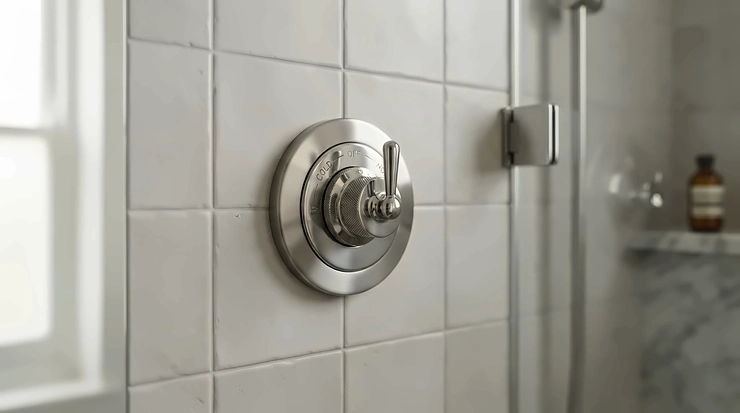
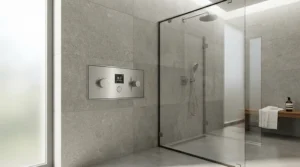
What is a concealed shower valve? A concealed shower valve is a mixing valve that sits inside the wall, or in a purpose-built box behind it, leaving only a slim control plate and handle on show. It blends hot and cold water, usually through a thermostatic cartridge, so the pipework vanishes and the bathroom looks calm instead of cluttered.
Here’s what the glossy showroom photos won’t tell you. That tidy wall hides a fairly unforgiving set of rules. The valve has to match your pipe centres, your water system, your wall depth and, above all, your water pressure. Get one wrong and you’ll be chasing a trickle or a temperature yo-yo behind freshly tiled walls. Not a fun weekend.
A thermostatic mixing valve exists to hold a near-constant outlet temperature and to shut off quickly if one supply fails. That is exactly why a thermostatic concealed shower valve has become the default choice for UK renovations and new builds.
One honesty note before we go further. This guide is built from manufacturer documentation, retailer specifications and the genuine review themes I could find. I haven’t fitted these valves in a bathroom of my own, and I won’t pretend otherwise. Where a review pool couldn’t be verified, I say so.
Below you’ll find seven real models from budget to premium, a plain-English look at concealed vs exposed shower valve trade-offs, and a proper section on choosing a shower valve for low water pressure. There’s also practical advice on chrome finish choices and wall-mounted plumbing details, which decide whether installation day goes smoothly. Prices are ranges only and change often, so check current price before you buy.
Quick Comparison Table: Concealed Shower Valve Picks at a Glance
| Model | Outlets | Min. pressure | Price range | Best For |
|---|---|---|---|---|
| Hansgrohe ShowerSelect S | 2 | 1 bar | £300-£400 (iBox extra) | Premium push-button control |
| Crosswater MPRO Crossbox | 1-3 | 1 bar | £250-£450 | Shallow walls, finish choice |
| Vado Celsius | 1-3 | 0.2 bar or 1.5 bar (variant-specific) | £400-£750 | Low-pressure variants, British brassware |
| Bristan Prism | 1-2 | Check listing | £150-£250 | Everyday all-rounder |
| Hudson Reed Kristal Twin | 2 (diverter) | Check spec | £150-£200 | Tight budgets |
| Hudson Reed Lennox Double | 2 | Check spec | £200-£250 | Flexible pipe centres |
| Milano Arvo 3 Outlet | 3 | Check spec | £200-£400 | Rain head, handset and jets |
Looking at the table, the Hansgrohe ShowerSelect S and Crosswater MPRO Crossbox are the premium end, and both want at least 1 bar of pressure. Vado Celsius is the model to study if pressure is your worry, provided you match the exact variant. The two Hudson Reed valves and the Bristan Prism carry the value story, though you should confirm minimum pressure on each spec sheet before ordering.
💬 Just one click — help others make better buying decisions too!😊
Top 7 Concealed Shower Valves: Expert Analysis
Each pick below follows the same logic: what the specs mean in practice, who the valve suits, and what the reviews I could verify actually say.
1. Hansgrohe ShowerSelect S — best premium push-button control
Press once for water, press again to stop, and the temperature stays exactly where you left it. That Select push-button is the personality of the Hansgrohe ShowerSelect S, and it makes a concealed shower valve feel more like a light switch than a plumbing part.
The numbers behind the polish are worth reading. Two outlets can run together, delivering 25 l/min from the upper outlet and 23 l/min from the lower, both at 3 bar. Minimum operating pressure is 1 bar, and there’s a 40°C safety stop that can be adjusted during installation. That stop is a genuine comfort in a house with kids. The 1 bar floor, meanwhile, tells you this valve wants a decent supply from a combi boiler, an unvented cylinder or a properly specified pump.
Based on the spec comparison, this is the one to choose if you want the bathroom to feel expensive every morning. What most buyers overlook is the iBox universal basic set. It’s a separate purchase, and the valve won’t go in without it. On a gravity system, retailer listings say to specify a universal (negative head) pump.
I couldn’t verify a large pool of independent owner reviews for this exact variant. Treat the praise in UK round-ups about design and ease of use as editorial opinion, not crowd data.
Pros:
- ✅ Push-button on/off with steady temperature
- ✅ Adjustable 40°C safety stop at installation
- ✅ Two outlets can run at the same time
Cons:
- ❌ iBox universal set is a separate purchase
- ❌ 1 bar minimum rules out unpumped gravity setups
Expect roughly £300-£400 for the valve, with the iBox extra, so check current price. Verdict: good value if you’ll keep the bathroom for a decade, overkill for a quick rental refresh.

2. Crosswater MPRO Crossbox — best for shallow walls and finish choice
The clever bit is the box rather than the handle. The Crosswater MPRO Crossbox uses one universal installation core that can deliver one, two or three outlets. Crosswater highlights a minimum installation depth, which is a real gift in modern stud walls and tiled boxing-in.
Retailer specifications list a 1 bar minimum pressure and WRAS approval. On the MPRO two-outlet concealed valve, TMV2 approval and ceramic disc technology are listed as well. Finishes run from chrome to matt black, brushed brass, brushed stainless steel and bronze. Crosswater also says the Crossbox is engineered for quieter operation and simpler servicing, with noise reduction to limit sound travelling to adjoining rooms. In plain English: thinner wall, calmer pipework, and a chrome finish that pairs with most brassware without a fuss.
Here’s what to weigh. If your wall cavity is tight, or you fancy switching finishes across a bathroom refit, this range gives you room to move. The catch is the required universal box, which must be fitted correctly before tiling. That step deserves a plumber’s full attention.
I found plenty of retailer copy but no sizeable independent review pool I could verify, so this pick rests on published specifications rather than crowd sentiment.
Pros:
- ✅ Universal core supports one, two or three outlets
- ✅ Shallow installation depth for tight walls
- ✅ Six finishes including chrome
Cons:
- ❌ Crossbox universal box is a required extra part
- ❌ 1 bar minimum limits unpumped gravity homes
Roughly £250-£450 depending on outlets, finish and retailer. Verdict: strong value at the premium end, particularly for renovators.
3. Vado Celsius — British brassware with low-pressure variants
Vado describes itself as a leading British bathroom brassware manufacturer, and the Vado Celsius range is its thermostatic flagship. Concealed versions come with one, two or three outlets in a polished chrome finish.
The detail that matters is how Vado sorts valves by pressure. Low pressure runs from 0.1 to 0.9 bar, medium from 1.0 to 1.9 bar, and high from 2.0 bar upwards. One retailer lists a concealed twin-outlet Celsius package at 0.2 bar, while Vado’s own catalogue lists other Celsius two-outlet concealed packages for 1.5 bar medium pressure. Same range name, very different demands. That’s where a shower valve for low water pressure decision gets real: check the exact model code, not the family name.
Vado’s FAQ says the temperature range is generally 20°C to 48°C, depending on the model. It also states a two-year guarantee as standard, although some retailers quote much longer terms. Confirm which one applies before you buy.
I couldn’t find a verifiable owner-review pool, so this recommendation rests on specs and manufacturer documentation.
Pros:
- ✅ Low-pressure rated variants exist
- ✅ Pressure classes clearly labelled by Vado
- ✅ High-shine polished chrome finish
Cons:
- ❌ Range name hides very different pressure ratings
- ❌ Guarantee terms vary between sellers
Roughly £400-£750 depending on retailer and configuration. Verdict: worth paying for only if you match the variant to your system properly.
4. Bristan Prism — best everyday all-rounder
Bristan estimates that one in four British homes has one of its taps or showers. The Bristan Prism is the concealed thermostatic option: dual controls (temperature and flow), a rectangular backplate, and one-outlet or two-outlet-with-diverter versions in chrome.
Bristan says its concealed valves fit cavities as shallow as 45mm, use standard 15mm inlets and have a front-access cartridge. In practice that means an easier retrofit in awkward walls and servicing without demolishing tile. A Prism listing on a specialist retailer shows a five-year guarantee. The Amazon.co.uk listing pitches the valve for all plumbing systems, but verify the minimum pressure on the spec sheet before you rely on that.
Reviewers on the Amazon.co.uk listing describe smooth operation, with one calling it a solid four-star product because of minor niggles. One buyer replaced an old valve with 138mm pipe centres and reported it working well. The recurring complaint concerns guarantee conditions: Bristan’s instructions call for servicing every 6-12 months, and one buyer says a cartridge claim was refused without proof of professional maintenance. Another returned a unit after cleaning it twice.
Pros:
- ✅ Slim-depth design suits shallow wall cavities
- ✅ Front-access cartridge simplifies servicing
- ✅ Five-year guarantee on listed versions
Cons:
- ❌ Guarantee reportedly tied to servicing evidence
- ❌ A few buyers report cartridge problems
Roughly £150-£250, so check current price. Verdict: sound value if you commit to the servicing schedule.
5. Hudson Reed Kristal Twin — best budget-friendly twin valve
Twin means two controls: one for temperature and one for flow, with a diverter to swap between outlets such as an overhead rain head and a handset. That layout is what the Hudson Reed Kristal Twin offers in a thermostatic, chrome-finished package.
I’ll stay within what can be verified. The listing is thermostatic, concealed, twin-control, with a diverter. Thermostatic means it compensates when someone flushes a toilet elsewhere, and the diverter means one valve can drive two outlets. Beyond that, read the manufacturer’s sheet for minimum pressure and pipe centres before you order.
A verified purchaser on Victorian Plumbing in early September 2026 said they were very pleased with it. One review isn’t a pattern, so consider it encouraging rather than conclusive. A separate buyer of a different valve (the Cruze Modern Round) noted that actual pipe centres differed from the instructions, and that measuring first saved a wasted install. Good advice for any valve.
Who is it for? Budget-conscious renovators and landlords who want thermostatic safety without the premium bill.
Pros:
- ✅ Thermostatic control at a budget-friendly level
- ✅ Diverter switches between overhead and handset
- ✅ Chrome finish matches most bathroom fittings
Cons:
- ❌ Limited independently verified review depth
- ❌ Minimum pressure needs checking before purchase
Roughly £150-£200 at time of research. Verdict: solid entry point, provided the spec sheet suits your system.
6. Hudson Reed Lennox Double — best mid-range for flexible fitting
If a valve suits awkward pipework, everything downstream gets easier. The Hudson Reed Lennox Double is a double concealed thermostatic valve with DN15 connectors, which suit most UK pipework. One review site notes flexible 150mm pipe centres and clear instructions.
That flexibility is the real selling point. Replacement jobs often fail on pipe-centre mismatches, so a valve that tolerates variation saves tiles. An anti-scald function is also listed, a genuine plus for families.
One caution. The review site that ranked it top of a ten-valve shortlist claims to have analysed over 2,100 customer reviews from retailers including Currys, John Lewis, Argos and Amazon UK, and reports weeks of daily use. I can’t independently verify that methodology, so read those conclusions as a lead worth checking rather than gospel. Ask the retailer about minimum operating pressure too, since the site’s own FAQ raises the low-pressure question without me being able to confirm the answer.
Who should buy it? Someone replacing an old valve in a bathroom they don’t want to retile.
Pros:
- ✅ Flexible 150mm pipe-centre fitting reported
- ✅ DN15 connectors suit most UK pipework
- ✅ Anti-scald protection listed
Cons:
- ❌ Review claims come from a single site
- ❌ Pressure suitability needs checking
Roughly £200-£250, so check current price. Verdict: good value in the middle of the market.
7. Milano Arvo 3 Outlet — best for rain head, handset and jets
Three outlets means three jobs. The Milano Arvo 3 Outlet Triple Diverter can run a rain head, a handset and body jets, or swap a bath filler in, all from one chrome-finished thermostatic concealed valve.
Listings describe solid brass throughout, anti-scald protection, and automatic shut-off if the cold supply fails. That last feature is standard thermostatic behaviour and a real safety net. One UK review aggregator named this valve the clear winner after analysing 5,451 online reviews, though I can’t verify how it weighted them.
Here’s what to weigh. Every extra outlet asks more of your supply. A rain head, handset and jets running together can flatten a modest system, so multi-outlet valves suit high-pressure setups or pumped installs. The wall also needs enough depth for the triple body.
Who is it for? A big-bathroom renovator who genuinely wants layered showering rather than a bigger shower head.
Pros:
- ✅ Three outlets from one concealed valve
- ✅ Solid brass construction listed
- ✅ Automatic shut-off if cold supply fails
Cons:
- ❌ Multi-outlet use demands a stronger supply
- ❌ Ratings come from aggregators I can’t verify
Comparable triple-outlet chrome valves sit in the mid-£200s to £400 range. Check current price. Verdict: good value if you’ll use all three outlets, wasteful if you won’t.
Concealed vs Exposed Shower Valve: Which One Suits Your Bathroom?
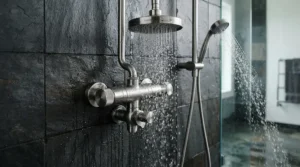
The concealed vs exposed shower valve question comes down to looks against convenience. An exposed valve is a visible bar or body bolted to the wall, easy to reach and simple to swap. A concealed shower valve hides the working parts behind the wall, leaving a slim plate that wipes clean in seconds. Buying guides often position concealed valves as best for full bathroom renovations, since you’re opening the wall anyway.
| Feature | Concealed | Exposed | Best For |
|---|---|---|---|
| Look | Minimalist, flush plate | Visible bar valve | Concealed for modern renovations |
| Installation | Needs wall depth and first-fix work | Surface-mounted, easier retrofit | Exposed for quick swaps |
| Servicing | Front-access cartridges on many models | Whole body visible | Exposed for easy access |
| Cleaning | Few crevices | More surfaces | Concealed for tidy wipe-downs |
The table makes the trade-off plain. If you’re already retiling, concealed wins on looks and cleaning. If you’re replacing a tired valve without touching the wall, exposed saves money and hassle. Either way, thermostatic control matters more than which side of the wall the valve sits on.
Shower Valve for Low Water Pressure: What Actually Works
Choosing a shower valve for low water pressure starts with knowing your system. Mira’s guide to low-pressure gravity systems points out that you probably have one if there’s a cold water tank in the loft and a hot water cylinder in the airing cupboard. Pressure comes from the height of the tank’s water level above the shower head, not the valve. A common rule of thumb is a tank base at least 1m above the shower head.
Pressure and flow aren’t the same thing. Narrow pipework, a half-closed isolator or limescale in the cartridge can starve a shower even when pressure is decent. A mismatch can bite too: feeding high-pressure mains cold and low-pressure gravity hot into one valve can wreck temperature control.
| Pressure class | Range | Typical system | Best For |
|---|---|---|---|
| Low | 0.1-0.9 bar | Gravity-fed, unpumped | Vado Celsius low-pressure variants |
| Medium | 1.0-1.9 bar | Combi boilers, pumped gravity | Crosswater MPRO Crossbox, Hansgrohe ShowerSelect S |
| High | 2.0 bar and above | Unvented cylinders, mains | Any valve on this list |
Class ranges come from Vado’s own FAQ, and a pump can move a gravity home up a class. Only fit a pump to a gravity system, never directly to the mains, and check with your water supplier if unsure. The takeaway: a low-rated valve alone rarely transforms a weak shower, but a matched valve plus a correctly sized pump often does.
How to Choose a Concealed Shower Valve
- Identify your water system. Gravity, combi or unvented decides your minimum pressure. Checkatrade’s mixer shower guide notes thermostatic mixers generally suit combi boilers, while unvented cylinders give strong, consistent pressure.
- Match the pressure rating. Compare the valve’s minimum operating pressure against your measured supply, not your hopes.
- Choose thermostatic. A manual mixer can swing hot or cold when someone else runs a tap. Thermostatic control corrects for that.
- Count your outlets. One outlet for a simple shower, two for rain head plus handset, three only if you’ll use them. Extra outlets need extra pressure.
- Measure pipe centres and wall depth. Get both numbers before you shop, especially on a replacement job.
- Check approvals and guarantees. Look for WRAS, Kiwa or NSF Reg 4 approval and read the guarantee terms.
- Pick the finish last. Cartridge first, chrome finish or black second.
Chrome Finish vs Black, Brass and Bronze: What Actually Matters
Chrome finish remains the safest choice for most UK bathrooms. It matches the widest range of taps, towel rails and shower heads, and it wipes clean with a damp cloth. Retailers also stock brushed brass, matt black, brushed stainless steel and bronze options across ranges like Crosswater MPRO Crossbox, but chrome finish keeps mixing-and-matching painless.
Features that actually matter: thermostatic cartridge quality, honest pressure ratings, serviceable design, decent guarantees and correct approvals.
Features that matter less: handle shape, backplate size and finish. These are cosmetic. A pretty valve on the wrong pressure class is an expensive mistake.
Hard-water areas deserve a mention. Limescale spots show on any finish, so a quick wipe after showering helps whichever you choose. If you’re building a scheme, buy the valve, shower head and slide rail from the same range so tones match. Slightly different chrome finish batches can look surprisingly different side by side under bathroom lighting.
Wall-Mounted Plumbing: Fitting Guide, Pipe Centres and First-30-Day Tips
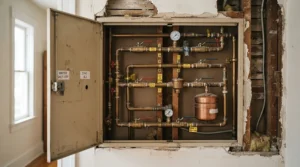
Getting the wall-mounted plumbing right matters more than the trim. Most of the pain happens before a tile goes up.
- Measure first. A buyer of the Cruze valve found real pipe centres differed from the instructions, and measuring first avoided a wrong purchase.
- Check cavity depth. Bristan says its concealed valves fit cavities as shallow as 45mm. Others need more, so compare against the spec.
- Flush before fitting. Debris from new pipework can damage cartridges.
- Set the maximum temperature stop. Many valves let you limit it at installation, as with the 40°C stop on the Hansgrohe ShowerSelect S.
- Fit isolation valves where you can reach them. Future you will be grateful.
- Test before tiling. Pressure-test the wall-mounted plumbing while it’s still open.
Guides suggest most people fitting a thermostatic shower from scratch will need a qualified plumber, and that’s sensible advice. In the first 30 days, watch for slow drips, note the temperature stability, and keep the instruction booklet somewhere findable. Servicing schedules matter later.
Real-World Scenarios: Which Valve Suits Which Home?
Scenario A: family home with a combi boiler, £150-£250 budget. The Bristan Prism suits, thanks to its shallow-cavity design and five-year guarantee on listed versions. Confirm minimum pressure first, and commit to servicing.
Scenario B: Victorian terrace with a gravity system and a planned pump. The Vado Celsius low-pressure variant deserves a look. Here the concealed vs exposed shower valve choice tilts concealed only if the wall has room for the body, so measure carefully.
Scenario C: flat renovation, shallow stud wall, chrome fittings throughout. The Crosswater MPRO Crossbox fits, with its low installation depth and chrome finish matching the rest of the brassware.
Scenario D: landlord refreshing a rental on a tight budget. The Hudson Reed Kristal Twin offers thermostatic safety at the lowest cost here. An exposed valve might be even simpler if the wall isn’t being opened.
The pattern is consistent. Match pressure first, wall depth second, and looks last.
Problem → Solution Guide: Common Concealed Shower Valve Headaches
Temperature drifts mid-shower. Check whether the valve is genuinely thermostatic, and whether the hot and cold supplies are mismatched. High-pressure cold against low-pressure hot is a classic culprit.
Weak flow. Pressure and flow are different problems. Look for closed isolators, narrow pipework and limescale before blaming the valve. On gravity homes, a pump plus a shower valve for low water pressure often solves it.
Stiff handle or fluctuating output. Limescale in the cartridge is a common cause. Bristan’s instructions recommend servicing every 6-12 months, and front-access cartridges make that easier.
Noise or shudder. Crosswater says the Crossbox is designed with noise reduction, so it’s worth considering if adjoining bedrooms are close. Otherwise check pipe clips and pressure.
Guarantee refused. Keep servicing receipts. One Bristan Prism reviewer says a claim stalled without proof.
Safety, Regulations and Approvals for Concealed Shower Valves
In England and Wales, water fittings must comply with the Water Supply (Water Fittings) Regulations 1999. Regulation 4 requires that every fitting is of an appropriate quality and standard and suitable for its use.
WRAS approval is the best-known way to demonstrate compliance. Kiwa’s KUKreg4 and NSF’s Reg 4 scheme are accepted equivalents. The installer, not just the product, carries legal responsibility for compliant work. Some jobs, such as connecting a new shower to the supply pipe, may need notification to your water supplier, so check before you start.
Look for approvals on the listing. The Crosswater MPRO Crossbox is listed as WRAS approved, and the Hansgrohe ShowerSelect S carries Kiwa certification on one retailer page. TMV2 approval, mainly a healthcare-oriented standard, appears on some Crosswater MPRO Crossbox valves as extra reassurance.
Long-Term Cost and Maintenance: What a Concealed Shower Valve Really Costs
The sticker price is only part of the story. Total cost includes the valve, any required box (the Hansgrohe ShowerSelect S needs its iBox and the Crosswater MPRO Crossbox needs its universal box), the trim, labour and tiling.
Here’s a rough illustration. A valve costing around £150 that needs a cartridge swap every few years may cost about the same over a decade as a £400 valve that runs quietly. The cheaper valve isn’t a bad choice, but factor in servicing.
Guarantees vary widely: five years on the Hansgrohe ShowerSelect S and on listed Bristan Prism versions, two years as standard from Vado. Read the conditions. A guarantee that depends on proof of professional servicing is only useful if you keep the paperwork.
Maintenance itself is simple. Descale where you have hard water, keep isolators accessible, and service cartridges as instructed. A concealed shower valve rewards boring, regular attention.
Common Mistakes When Buying a Concealed Shower Valve
- Buying on looks alone. The finish is the last decision, not the first.
- Ignoring pressure ratings. A 1 bar minimum valve on an unpumped gravity system will disappoint.
- Skipping the measurements. Pipe centres and cavity depth sink more projects than any brand choice.
- Forgetting the required extra box. Some valves need a separate universal box or iBox.
- Tiling before testing. Pressure-test the wall-mounted plumbing while it’s open.
- Mixing mismatched supplies. High-pressure cold with low-pressure hot causes drift.
- Skipping servicing. It can void the guarantee and shorten cartridge life.
FAQ
❓ Do you need an access panel for a concealed shower valve?
❓ How deep does a concealed shower valve need to be recessed?
❓ Can you replace a concealed shower valve without retiling?
❓ What does a thermostatic concealed shower valve do if the cold supply fails?
❓ Is a concealed shower valve suitable for a combi boiler?
Conclusion
A concealed shower valve is a beautiful thing when it’s specified properly and a very expensive headache when it isn’t. The good news is that the decision rules are simple. Know your water system, match the pressure rating, measure your pipe centres and wall depth, then pick the finish you love.
For premium push-button control, the Hansgrohe ShowerSelect S leads the list. The Crosswater MPRO Crossbox is the smart pick for shallow walls and finish choice, and the Vado Celsius suits anyone who needs low-pressure variants, provided they match the model code. For everyday value, the Bristan Prism, Hudson Reed Kristal Twin and Hudson Reed Lennox Double each cover a slightly different budget and fitting need, and the Milano Arvo 3 Outlet is the one to choose if you’ll really use three outlets.
Whichever route you take, treat the concealed vs exposed shower valve choice as a real decision, and treat a shower valve for low water pressure as a system question rather than a shopping one. A chrome finish keeps things simple, and clean wall-mounted plumbing keeps future you happy.
Recommended for You
- Thermostatic Shower Valve: 7 Safest Picks For UK Homes (2026)
- Shower Tray For Wet Room Installation: 7 Best Picks (2026)
- Shower Tray Under £150: 7 Brilliant UK Picks (2026)
Disclaimer: This article contains affiliate links. As an Amazon Associate, I earn from qualifying purchases. If you purchase products through these links, we may earn a small commission at no additional cost to you.
✨ Found this helpful? Share it with your friends! 💬🤗
