In This Article
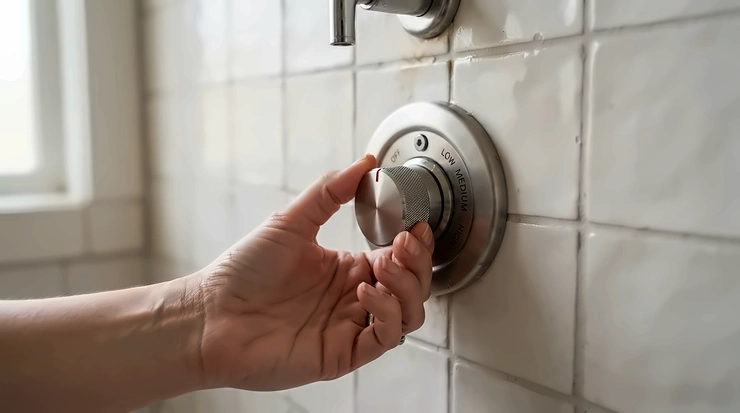
Picture a cold January morning and a manual shower. Nudge the lever left: Arctic. Nudge it right: lava. Then someone downstairs flushes the loo and you’re auditioning for a horror film. 🚿

That little drama is the whole argument. Choosing between a thermostatic vs manual shower valve is really a decision about who does the work. A thermostatic valve holds the temperature you set and corrects itself when the supply wobbles. A manual valve makes you the thermostat, with your wrist as the control loop. Neither is wrong, but they behave very differently in a family home, on a combi boiler or on an elderly gravity-fed system.
This guide compares seven real models, from a no-frills manual bath mixer to a premium German thermostat. It explains what each spec means in daily use rather than just repeating it. Because the valve is only half the story, we also cover riser rail choices, shower head compatibility and how a mixer shower fits into UK plumbing.
A quick honesty note. I haven’t tested any of these products, so you won’t find invented lab results or made-up owner anecdotes. Everything here comes from manufacturer specifications, retailer listings and recognised UK safety guidance. Prices are ranges only, so check current price on amazon.co.uk, because stock and variants change often. Where I couldn’t verify reviews, I say so.
Let’s start with the cheat sheet.
Quick Comparison: Thermostatic vs Manual Shower Valve Options at a Glance
| Product | Control type | Min. pressure | Temperature safety | Best For |
|---|---|---|---|---|
| Bristan Blitz | Manual dual-lever bath/shower mixer | 0.2 bar | None (user-controlled) | Adult-only budget bathrooms |
| Bristan Zing Cool Touch | Thermostatic bar mixer | 0.2 bar | Shut-off on supply failure | Cheapest thermostatic upgrade |
| Bristan Onza | Thermostatic single-lever bar mixer | 0.2 bar | 41°C preset stop | One-handed simplicity |
| Bristan Craze2 | Thermostatic bar mixer with diverter | 1 bar | Safe Touch cool-touch design | Fixed head plus handset |
| Bristan Quadrato Safe Touch | Thermostatic bar mixer with diverter | 1 bar | 38°C preset stop, override | Families with young children |
| Mira Minimal | Thermostatic rear-fed mixer shower | 0.1 bar | CoolShield cool-touch | Compact, low-pressure homes |
| hansgrohe Ecostat Comfort | Thermostatic exposed valve | 1 bar | 40°C SafetyStop | Precision and water saving |
Looking at the table, the pressure column does a lot of the deciding. The Mira Minimal, Bristan Zing Cool Touch and Bristan Onza are the realistic thermostatic options if you have low pressure. The Bristan Craze2, Bristan Quadrato Safe Touch and hansgrohe Ecostat Comfort reward you with stronger flow but want at least 1 bar. The Bristan Blitz is the only manual model here, and it’s the one to avoid if children use the shower.
💬 Just one click — help others make better buying decisions too!😊
What Is a Thermostatic vs Manual Shower Valve?
A thermostatic vs manual shower valve comparison comes down to automatic versus hand-controlled temperature. A thermostatic valve uses a heat-sensitive element to keep mixed water at your chosen setting. A manual valve simply blends hot and cold according to where you set the lever or handles, with no correction if supply conditions change.
The clever bit inside a thermostatic valve is usually a wax element that expands and contracts with temperature. It throttles the hot and cold inlets continuously, as Wikipedia’s overview of thermostatic mixing valves explains. That’s why many healthcare buildings prefer them: they limit the outlet temperature regardless of pressure or flow changes.
A manual valve has no such element. It’s cheaper and mechanically simple, and it can last for years. But it can’t react when someone flushes a toilet or opens a tap elsewhere, so the temperature shifts and you have to chase it.
Where does “mixer shower” fit in?
“Mixer shower” is the umbrella term for any shower that blends hot and cold supplies. A mixer shower can be thermostatic or manual, so the valve is the part that decides how forgiving your daily shower will be.
Top 7 Thermostatic vs Manual Shower Valve Picks: Expert Analysis
1. Bristan Blitz — the manual baseline, minus the drama
The Bristan Blitz is the control experiment: a deck-mounted, dual-lever manual shower mixer tap in chrome-plated brass. It shows you exactly what the choice between a thermostatic vs manual shower valve costs you. Its quarter-turn double levers use ceramic discs, which resist the drip-and-wear cycle of old rubber washers. The listing quotes a lifetime manufacturer’s guarantee (T&Cs apply).
It works from 0.2 bar, so low-pressure homes are covered. The pack includes a 1.5m hose, a rub-clean handset and a wall bracket. Note that this is a bath-edge tap with a bracket, not a riser rail kit, and the 180mm inlet centres need checking against your bath’s tap holes.
On the spec sheet, this suits adult-only households with steady pressure and a tight budget. The catch is simple physics: nothing inside corrects the mix. A flushed toilet or a running tap can still knock your temperature sideways. Screwfix’s own buying guide flags manual mixers as unsuitable for young children because of the scalding risk. As for reviews, I couldn’t verify a meaningful pool of independent amazon.co.uk reviews for this exact model at the time of research, so I’m not summarising any.
Pros:
- ✅ Ceramic-disc levers built for durability
- ✅ Works on both high and low pressure
- ✅ Lifetime guarantee quoted (T&Cs apply)
Cons:
- ❌ No temperature correction or scald protection
- ❌ Not suitable for homes with young children
Expect roughly the £100–£150 range (check current price). The Bristan Blitz is fair value for adults, and poor value if little ones are around.

2. Bristan Zing Cool Touch — cheapest way into thermostatic control
The Bristan Zing Cool Touch is the entry ticket to thermostatic protection. It’s a chrome bar mixer with a cool-touch body and automatic shut-off if the hot or cold supply fails. Retailer specs list a brass-and-plastic build, 0.2 bar minimum pressure and a modest flow of about 7 litres a minute. The kit is 660mm tall, with a 1.5m hose and a single-function rub-clean handset.
The adjustable inlets span roughly 135–165mm. That matters because a like-for-like valve swap can often avoid retiling. One retailer listing quotes a five-year guarantee.
What does 7 l/min mean in practice? It’s a gentle, functional rinse rather than a power drench, which is roughly what many tired low-pressure systems can supply anyway. That low threshold also makes the Bristan Zing Cool Touch one of the more sensible thermostatic choices for gravity-fed homes, though a pump may still be wise for a livelier flow. I couldn’t verify a robust set of independent buyer reviews for this model, so read the most recent verified-purchase feedback on build quality before ordering.
Pros:
- ✅ Thermostatic protection at entry-level cost
- ✅ Runs from just 0.2 bar of pressure
- ✅ Adjustable inlets ease old-valve swaps
Cons:
- ❌ Modest flow won’t satisfy drench lovers
- ❌ Single-function handset only
Expect to pay under roughly £120 (check current price), which is strong value for thermostatic safety.
3. Bristan Onza — one lever, 41°C safety stop
The Bristan Onza takes the fiddly bit out of showering: a single sequential lever controls both flow and temperature. Its brass-bodied thermostatic valve has a preset safety stop at 41°C and shuts off automatically if the hot or cold supply fails. The pack includes a hose, hose retainer, riser rail and single-function rub-clean handset. The kit height is 650mm, with 15mm inlets.
The adjustable elbows cover pipework centres of about 110–155mm, which suits renovators who’d rather not disturb tiles. Operating pressure runs from 0.2 to 5 bar.
Here’s what the spec means. A 41°C stop mirrors the upper shower limit recommended under the BuildCert scheme, so it stops accidental overshoot without feeling restrictive for adults. The single lever suits anyone with stiff hands, because you push and turn with one movement. However, 41°C is warmer than the 37–37.5°C the British Burns Association suggests for children, so small ones still need supervision. Reviewer sentiment: I found no verifiable aggregate review data for this model, so I’m not claiming any.
Pros:
- ✅ Single lever controls flow and temperature
- ✅ Adjustable elbows suit 110–155mm centres
- ✅ Automatic shut-off if either supply fails
Cons:
- ❌ 41°C stop is warm for toddlers
- ❌ Single-spray handset limits variety
Expect roughly £100–£160 (check current price). The Bristan Onza is good value if you want a simple, safe mixer shower with a ready-made riser rail.
4. Bristan Craze2 — fixed drench head plus handset
The Bristan Craze2 is the “have it both ways” kit. It pairs a large fixed head with a multi-function rub-clean handset on a telescopic riser rail, with a diverter to switch between them. Retailer specs list a square head of about 230mm, and the listing describes a Safe Touch design that keeps the body cool to handle. The Wall Mount 12 fixing kit includes isolation valves on both feeds, which makes later servicing much easier.
Pressure is the thing to watch. It needs a minimum of 1 bar and tolerates up to 5 bar. Retailer specs quote a flow of about 12.5 l/min at best, so the large head only shines on a combi, unvented or pumped system. On a weak gravity-fed supply, a big head can feel underfed.
Analytically, this is the best fit for an over-bath setup where you want a rainfall-style soak and a handset for rinsing the bath. The telescopic riser rail makes height adjustment simple. I couldn’t verify a trustworthy aggregate of Amazon buyer feedback for this exact model, so check recent reviews yourself.
Pros:
- ✅ Fixed head plus handset in one kit
- ✅ Isolation valves built into the fixing kit
- ✅ Telescopic rail adjusts to your height
Cons:
- ❌ Needs at least 1 bar of pressure
- ❌ Large head means more limescale to tackle
Expect roughly £150–£250 (check current price). The Bristan Craze2 is good value for a dual-head setup.
5. Bristan Quadrato Safe Touch — 38°C family-friendly preset
The Bristan Quadrato Safe Touch is the one I’d shortlist first for a family bathroom. Its thermostatic cartridge has a preset safety stop at 38°C, with an override for adults who want it hotter. That sits close to the 37–37.5°C the British Burns Association recommends as comfortable for children’s bathing.
The kit is all in one: bar valve, hose, telescopic rigid riser rail, rub-clean drench head and multi-function handset. A two-outlet diverter switches between them. Pressure runs from 1 to 5 bar, with a quoted flow of 9.8 l/min at 3 bar. The Wall Mount 12 fixing kit has built-in isolation valves on hot and cold feeds, and the finish is matt anthracite.
In practice, 9.8 l/min is a comfortable but not extravagant flow, which suits households trying to keep water bills sensible. The override is the clever compromise. Grown-ups can nudge past 38°C deliberately, but a child can’t do it by accident. I couldn’t verify a consolidated body of independent reviews, so I’m leaving sentiment to you to check on the live listing.
Pros:
- ✅ 38°C preset suits young children
- ✅ Complete kit with rigid riser rail included
- ✅ Isolation valves simplify servicing
Cons:
- ❌ Requires at least 1 bar of pressure
- ❌ Override still demands adult supervision
Expect roughly £180–£300 (check current price). The Bristan Quadrato Safe Touch is the best-value family pick in this list.
6. Mira Minimal — compact rear-fed thermostatic kit
The Mira Minimal answers a common UK complaint: bulky bar valves in small shower enclosures. It’s a thermostatic, rear-fed mixer shower kit with a 110mm single-spray handset and a riser rail with clamp bracket. Retailer specs list an operating range of 0.1 to 10 bar and compatibility with all UK water systems. CoolShield technology keeps exposed surfaces cool, and a five-year guarantee is quoted. Mira also claims its Magni-Flo design delivers up to three times more flow than similar mixer showers, but that’s a manufacturer claim, so treat it with healthy scepticism.
The 0.1 bar floor is the real headline. For gravity-fed households it’s one of the lowest thresholds in this list. The compact body also leaves more room for elbows and shampoo bottles.
The catch is that “rear-fed” means the supplies connect from behind, so swapping an old exposed-pipe bar valve may need pipework changes. This is a bathroom-refit product, not always a five-minute swap. I couldn’t verify aggregated customer feedback for this exact kit, so check recent reviews on fit and finish.
Pros:
- ✅ Works from a very low 0.1 bar
- ✅ Compact body suits small enclosures
- ✅ Cool-touch exterior and five-year guarantee
Cons:
- ❌ Rear-fed pipework may need reworking
- ❌ Single-spray handset only
Expect roughly £150–£250 (check current price). The Mira Minimal is excellent value for small or low-pressure bathrooms.
7. hansgrohe Ecostat Comfort — precision with a water-saving button
The hansgrohe Ecostat Comfort (model 13116000) is the premium thermostat of the group. It’s a valve only, so you’ll pair it with your own riser rail, hose and handset. The SafetyStop locks out water above 40°C, and the EcoStop button caps flow at 10 l/min until you press it for more. Maximum flow is 17 l/min at 3 bar, with an operating range of 1 to 10 bar. The ceramic valve has a 180° throw, and the valve includes a non-return valve, silencer and dirt filter.
Centre distance is 150mm ±12mm with G½ connections, a standard UK-friendly format. That’s handy for shower head compatibility, since half-inch threads are the norm across hoses and rails.
What this means: you get a flow that’s genuinely adjustable, from eco-conscious 10 l/min to a stronger 17 l/min, without losing temperature stability. The 1 bar minimum makes it a poor match for plain gravity-fed systems unless you add a pump. I couldn’t verify a substantial pool of independent reviews, so I’m basing this on manufacturer data.
Pros:
- ✅ EcoStop saves water at the press of a button
- ✅ Adjustable temperature limit and 40°C SafetyStop
- ✅ Metal handles and non-return valve included
Cons:
- ❌ Valve only, so rail and handset cost extra
- ❌ Needs at least 1 bar of pressure
Expect roughly £150–£250 for the valve alone (check current price). The hansgrohe Ecostat Comfort is a premium but sound long-term choice.
Top 7 Specs and Price Ranges Compared
| Product | Control | Kit included | Price range | Best For |
|---|---|---|---|---|
| Bristan Blitz | Manual | Hose, handset, wall bracket | £100–£150 | Adult-only homes |
| Bristan Zing Cool Touch | Thermostatic | Riser kit | Under £120 | Budget upgrades |
| Bristan Onza | Thermostatic, single lever | Riser kit | £100–£160 | Easy operation |
| Bristan Craze2 | Thermostatic, diverter | Fixed head, riser rail, handset | £150–£250 | Over-bath rainfall |
| Bristan Quadrato Safe Touch | Thermostatic, diverter | Drench head, rail, handset | £180–£300 | Families |
| Mira Minimal | Thermostatic, rear-fed | Rail, 110mm handset | £150–£250 | Small bathrooms |
| hansgrohe Ecostat Comfort | Thermostatic | Valve only | £150–£250 | Premium builds |
These ranges are indicative and based on retailer listings at the time of research, so always check current price before buying. The Bristan Zing Cool Touch gives the cheapest entry to thermostatic protection, while the hansgrohe Ecostat Comfort demands extra spend on a rail and handset. If you want everything in one box, the Bristan Quadrato Safe Touch and Bristan Craze2 offer the most complete kits.

How to Choose Between a Thermostatic vs Manual Shower Valve
Follow these seven steps and the decision mostly makes itself:
- Check your water system. Combi, unvented and gravity-fed systems behave differently. Screwfix’s shower buying guide is a handy refresher on how pressure shapes your options.
- Measure your pressure. If you’re on low pressure, favour valves with 0.1–0.2 bar minimums.
- Count who’s showering. Children, older relatives and anyone with sensitive skin push you towards thermostatic.
- Decide on exposed or rear-fed. Exposed bar valves are easier to swap; rear-fed ones look cleaner but may involve pipework.
- Check your pipe centres. Adjustable elbows save retiling.
- Plan the riser rail and head. Make sure your handset, hose and rail suit the valve’s flow.
- Set a budget range. Thermostatic costs more up front, but replaces plenty of hassle.
The simple rule: if anyone vulnerable uses the shower, go thermostatic. If it’s a rarely used adult-only spare room on steady mains pressure, a manual valve is defensible.
Thermostatic vs Manual Shower Valve: Head-to-Head Analysis
Temperature stability
A thermostatic valve constantly adjusts the mix, so a flushed toilet or a tap elsewhere barely registers. A manual valve leaves the mix where you put it, so any pressure change shows up in your shower. In a busy household this is the headline difference.
Safety
Thermostatic valves typically include a max-temperature stop and a shut-off if one supply fails. Manual valves have neither, so the risk rests on the person at the controls.
Cost and simplicity
Manual valves are cheaper and mechanically simpler, with less to go wrong. Thermostatic cartridges add cost and, over years, the possibility of limescale-related replacements.
| Feature | Thermostatic | Manual | Best For |
|---|---|---|---|
| Temperature stability | High | Low | Families, shared bathrooms |
| Scald protection | Built in | None | Children, older users |
| Upfront cost | Higher | Lower | Bristan Blitz for tight budgets |
| Pressure tolerance | Varies by model | Generally forgiving | Low-pressure homes |
| Maintenance | Cartridge may need replacing | Simple, fewer parts | DIYers |
The table makes the trade-off plain: thermostatic buys you stability and safety, manual buys you simplicity and a lower price. The Bristan Quadrato Safe Touch shows what thermostatic does best for families. The Bristan Blitz shows where manual still makes sense. If you’re undecided, think about your worst-case user rather than your average one.
Mixer Shower Systems Explained
A mixer shower draws on both your hot and cold supplies, blends them at the valve and sends the result to the head. That makes it fundamentally different from an electric shower, which heats cold water itself.
Mixer showers work across combi, gravity-fed and unvented systems, in thermostatic or manual form. Combi and unvented supplies deliver mains pressure, which suits valves with 1 bar minimums such as the hansgrohe Ecostat Comfort. Gravity-fed systems are lower pressure, so valves like the Mira Minimal with 0.1 bar floors make more sense.
Exposed vs rear-fed
Exposed bar mixers like the Bristan Onza sit proudly on the wall, with pipes often hidden by elbow covers. They’re easier to maintain and swap. Rear-fed designs like the Mira Minimal conceal the plumbing for a cleaner look but are harder to retrofit.
The hot supply matters
Most manufacturers advise that thermostatic valves need a hot supply comfortably warmer than your target temperature to work properly. If your showers feel lukewarm even at maximum, the boiler or cylinder temperature may be the culprit, not the valve.
Shower Head Compatibility: What Actually Fits?
Shower head compatibility is mostly about connections and flow. Standard UK hoses and handsets usually use half-inch BSP threads, and the hansgrohe Ecostat Comfort lists G½ connections. Even so, always check the listing for thread size before assuming.
Flow matters more than threads
A hungry rainfall head on a weak valve is a recipe for disappointment. The Bristan Zing Cool Touch quotes roughly 7 l/min, which suits a modest handset. The Bristan Craze2 can feed its large fixed head only if you have enough pressure. Flow regulators and filters in hoses or handsets can cut flow further, so don’t be surprised if the real-world figure falls short of the headline spec.
Weight and brackets
Heavy handsets can droop on cheaper brackets. If you swap handsets, check that the new one’s weight and connection suit your existing rail.
Pipework centres
Inlet centres are the other compatibility trap. Adjustable elbows, like the roughly 110–155mm range on the Bristan Onza and the 135–165mm span on the Bristan Zing Cool Touch, can save retiling. The hansgrohe Ecostat Comfort lists 150mm ±12mm, so measure before you buy.
Riser Rail Guide: Choosing and Fitting the Right One
A riser rail is the vertical bar that holds your handset and lets you slide it up and down. Choosing well changes how pleasant the shower feels every day.
Rigid vs slider rails
Slider rails let you reposition the handset on a bar, which suits households of mixed heights. Rigid risers, like the telescopic rails on the Bristan Craze2 and Bristan Quadrato Safe Touch, integrate a fixed head and are neater in wet rooms.
Height and reach
Kit heights vary: the Bristan Onza lists 650mm and the Bristan Zing Cool Touch about 660mm. A taller rail suits taller users or a more upright shower.
Fixings
Some riser rail brackets are adjustable to reuse existing screw holes, which is a lifesaver when replacing an old kit. Wall type matters too: tile, plasterboard and stud walls each need appropriate fixings.
Pairing with a valve-only purchase
If you buy a valve-only unit like the hansgrohe Ecostat Comfort, you’ll need to buy a compatible riser rail, hose and handset separately. Match the hose thread and check that the handset’s flow suits the valve’s output.
Practical Setup Guide: Fitting and Fine-Tuning Your New Valve
This section covers practical setup steps that retail listings rarely spell out. If you’re not confident with plumbing, use a qualified plumber.
Before you start
- Flush the pipework. Debris in old pipes can clog filters and valve cartridges.
- Fit and check filters. The hansgrohe Ecostat Comfort includes a dirt filter, and keeping it clean protects flow.
- Use the isolation valves. Kits like the Bristan Quadrato Safe Touch and Bristan Craze2 include them, which makes future servicing painless.
Fine-tuning
- Set the maximum temperature stop where your household is comfortable. Valves like the hansgrohe Ecostat Comfort allow temperature limiting to be adjusted at installation.
- Check the hot supply temperature if the shower never gets warm enough.
Maintenance schedule
Wipe or flex rub-clean nozzles regularly, and descale heads every few months in hard-water areas. Check filters whenever flow seems weaker.
Common first-month mistakes
Over-tightening fittings, forgetting washers in new connections and ignoring a weak flow that turns out to be a clogged filter.

Real-World Scenarios: Matching the Valve to the Household
Scenario 1: Young family, combi boiler, shower over the bath
Mains pressure and little ones make this a thermostatic job. The Bristan Quadrato Safe Touch with its 38°C preset is the best fit, and the Bristan Craze2 is a sound alternative if you want a bigger head.
Scenario 2: Rented flat, gravity-fed, tight budget
Low pressure and limited funds suggest the Bristan Zing Cool Touch or Mira Minimal. Both work at very low pressures, and the Bristan Zing Cool Touch is the cheaper option. A pump could improve the feel of either.
Scenario 3: Couple, mains pressure, design-conscious
If you value precision and water savings, the hansgrohe Ecostat Comfort plus a chosen riser rail makes a stylish, efficient setup.
Scenario 4: Spare room used rarely by adults
The Bristan Blitz is defensible here, because the risk profile is low and the budget stays small.
Problem and Solution Guide: Fixing Common Shower Frustrations
Problem 1: temperature swings. Move to a thermostatic valve such as the Bristan Onza, which actively compensates for pressure shifts.
Problem 2: weak flow after upgrading. Check minimum pressure ratings, filters and any flow regulators in the hose or handset. A valve with a 1 bar minimum on a low-pressure system will disappoint.
Problem 3: shower won’t get hot enough. Check the max-temperature stop first, then the hot supply temperature.
Problem 4: limescale clogging the head. Choose rub-clean nozzles, as on the Bristan Zing Cool Touch and Mira Minimal, and descale regularly.
Problem 5: new valve doesn’t line up with old pipework. Adjustable elbows, like those on the Bristan Onza, are your friend. The hansgrohe Ecostat Comfort lists 150mm ±12mm centres, so measure carefully.
Long-Term Cost and Maintenance: What You’ll Really Pay
The sticker price is only part of the story. Thermostatic valves cost more up front, and cartridges can eventually need replacing, especially in hard-water areas. Manual valves have fewer moving parts but give you no protection.
Water and energy matter too. Manufacturers argue that thermostatic valves reach the right temperature faster, which reduces wasted water while you fiddle. The hansgrohe Ecostat Comfort goes further with its EcoStop button, which caps flow at 10 l/min until you choose more.
| Tier | What you get | Long-term thinking | Best For |
|---|---|---|---|
| Budget (under £120) | Bristan Zing Cool Touch thermostatic kit | Low outlay, modest flow | Rentals, tight budgets |
| Mid (£100–£250) | Bristan Onza, Bristan Craze2, Mira Minimal | Balanced features and price | Most homes |
| Upper (£180–£300) | Bristan Quadrato Safe Touch | Family-focused safety features | Families |
| Premium valve | hansgrohe Ecostat Comfort | Precision plus water saving | Design-led refits |
The table shows that spending a little more on a thermostatic valve usually pays back in safety and convenience. The Bristan Blitz saves money up front, but a single scald would cost far more than any price gap. If you’re staying put for years, durable cartridges and easy-access isolation valves are worth paying for.
Safety, Regulations and Compliance: What UK Homeowners Should Know
Scalding is serious. Temperatures above 45°C can cause serious injury quickly, and water at 70°C can cause partial-thickness injuries in well under a second. Stored hot water is typically kept at 60°C or higher to control legionella, which is exactly why mixing valves exist.
Regulations
Part G of the Building Regulations introduced limits on bath-filling temperature in new dwellings, with a maximum of 48°C, taking effect in April 2010. That rule is aimed at baths in new homes, so don’t assume it automatically covers your existing shower.
Recommended temperatures
The BuildCert scheme recommends maximum temperatures of 46°C for bath fill and 41°C for showers. The British Burns Association suggests 37–37.5°C as a comfortable temperature for children.
TMV types
Thermostatic mixing valves come in types. Altecnic’s guide to thermostatic mixing valves explains that Type 2 valves conform to EN 1111 and EN 1287, while Type 3 valves meet NHS Estates healthcare requirements. For a typical home, a good domestic thermostatic valve is the realistic target.
Common Mistakes When Buying a Shower Valve
Ignoring pressure. A valve with a 1 bar minimum on a gravity-fed system is the classic error. Check specs first.
Forgetting the riser rail. Valve-only products like the hansgrohe Ecostat Comfort need a separate rail and handset.
Skipping the measuring tape. Pipe centres matter, and adjustable elbows save the day.
Assuming thermostatic means maintenance-free. Filters and nozzles still need cleaning.
Choosing a manual valve for a family. The Bristan Blitz is fine for adults, but young children need protection.
Falling for flow claims. A manufacturer’s maximum flow isn’t what you’ll get on a weak supply, so judge by your own pressure.
Features That Actually Matter (And Those That Don’t)
Worth paying for
- Preset temperature stops: the 38°C on the Bristan Quadrato Safe Touch and 40°C on the hansgrohe Ecostat Comfort reduce accidental overshoot.
- Isolation valves: these make servicing painless.
- Adjustable elbows: they spare you retiling.
- Pressure range: this decides whether the valve works in your home.
Nice to have
- Cool-touch bodies: handy with children.
- EcoStop-style flow control: useful for bills.
Mostly marketing
- Many spray modes: most people settle on one or two.
- Extravagant finishes: matt anthracite looks lovely, but it won’t change performance.

FAQ
❓ Which thermostatic shower valve works best on low pressure?
❓ What does TMV2 mean on a mixer shower?
❓ Will any shower head fit a riser rail hose?
❓ How hot should a family shower be?
❓ Is a thermostatic vs manual shower valve swap possible without retiling?
Conclusion
Here’s the plain-English verdict. If anyone vulnerable uses your shower, choose thermostatic. The Bristan Quadrato Safe Touch is the family favourite, the Bristan Zing Cool Touch is the budget route in, and the Mira Minimal suits compact or low-pressure bathrooms. The hansgrohe Ecostat Comfort is the premium option for those who value precision and water saving. The Bristan Blitz remains a workable manual choice for adult-only, low-risk bathrooms on a budget.
Remember the supporting cast. Your riser rail, hose and handset matter as much as the valve, and shower head compatibility depends on thread size, flow and pipework centres. If the worst happens, NHS guidance on burns and scalds is clear that cooling the burn under running water straight away is the first step.
Whichever you pick, check current price and availability on amazon.co.uk before you buy, and read the latest verified reviews.
Recommended for You
- Exposed Shower Valve: 7 Best Proven Picks For UK Homes (2026)
- Concealed Shower Valve: 7 Best Picks For UK Bathrooms (2026)
- Thermostatic Shower Valve: 7 Safest Picks For UK Homes (2026)
Disclaimer: This article contains affiliate links. As an Amazon Associate, I earn from qualifying purchases. If you purchase products through these links, we may earn a small commission at no additional cost to you.
✨ Found this helpful? Share it with your friends! 💬🤗
