
In This Article
Right, let’s have an honest conversation about the least glamorous decision in your entire bathroom renovation: the bit under your feet. Everyone obsesses over tile colour and rainfall showerheads, and then treats the shower tray for wet room installation like an afterthought bolted on at the last minute. Big mistake. Get this one wrong and you’re not looking at a cosmetic gripe — you’re looking at pooling water, a soggy subfloor, and quite possibly a call to a loss adjuster in eighteen months’ time.

What is a shower tray for wet room installation? In simple terms, it’s a purpose-built base — either a slim, ready-finished tray or a recessed “floor former” — that creates a step-free, correctly graded showering area which drains efficiently and keeps water exactly where it belongs, rather than wandering off to introduce itself to your floorboards.
The good news is that British manufacturers have turned this into a genuine science. Whether you’re after a level-access shower tray for an ageing relative, a linear drain with serious flow capacity, or simply the cheapest tileable option that won’t leak, there’s a tray engineered for the job. We’ve dug into seven real, currently available UK products spanning budget to premium, sized them up on drainage, build quality and long-term value, and we’ll walk you through exactly how a wet room tanking system fits around each one. Let’s get into it.
Quick Comparison Table
| Product | Type | Profile Height | Best For |
|---|---|---|---|
| Impey Aqua-Dec Linear 3 | Tileable floor former, linear drain | 22mm | High-flow showers, contemporary style |
| AKW Tuff Form | Tileable/vinyl floor former | 22mm | Wheelchair access, family wet rooms |
| Kudos KStone Rectangle | Ready-finished stone resin tray | 45mm | Budget-conscious near-level upgrade |
| Mira Flight Level | Ready-finished tray | 25mm | Slimmest ready-made wet room look |
| Merlyn MStone | Ready-finished tray | 50mm | Build quality and rigidity |
| Aquadart Slate Effect | Ready-finished tray | 45mm | Style-led budget upgrade |
| Ajax Low Profile Quadrant | Ready-finished tray | 45mm | Tightest possible budget |
At a glance, the split that matters most is tileable floor former versus ready-finished tray. The Impey Aqua-Dec Linear 3 and AKW Tuff Form disappear entirely under your chosen floor covering, which is the only route to a genuine, seamless wet room look — but they demand more careful subfloor preparation. The other five are finished trays you drop into place, which is faster and more forgiving for a straightforward bathroom refresh, even if they sit a few millimetres above true zero-threshold.
💬 Found a favourite already? Click through to check today’s price and availability before it changes.
Top 7 Shower Trays for Wet Room Installation: Expert Analysis
1. Impey Aqua-Dec Linear 3 — best linear drain for powerful showers
The standout here is drainage capacity, and it’s not a minor detail — it’s the whole point of the product. This is a 22mm-thick wet room floor former with three built-in drainage gradients funnelling water towards an 800mm stainless steel linear drain channel.
On the spec sheet, that translates to a flow rate of 35 to 42 litres per minute depending on room layout and the overall size of the Aqua-Dec. What that means in practice: if you’ve splashed out on a shower with body jets or a large rainfall head, this is one of the few trays genuinely built to swallow that volume without backing up around your ankles. The three gradients feeding a 40mm-wide steel drain also give a crisper, more architectural line than a corner waste ever could — it’s the look most Pinterest wet room boards are chasing.
Based on the spec comparison, this is the pick for anyone prioritising a genuinely flush, minimalist wet room over ease of installation. It’s not a beginner DIY job — the linear drain needs a minimum of 95mm clearance beneath the former, so joist depth and floor build-up need checking before you commit. Aggregated retailer information consistently flags Impey as the market-leading wetroom brand in the UK, and the range carries a lifetime guarantee when installed correctly, which is about as strong a confidence signal as a manufacturer can give.
Pros:
- ✅ High flow rate handles powerful multi-jet showers
- ✅ Fully tileable for a seamless, screed-level finish
- ✅ Lifetime guarantee when professionally installed
Cons:
- ❌ Needs deep floor clearance beneath the drain
- ❌ Not a straightforward first-time DIY installation
Prices for the Linear 3 typically sit in the mid-£300s to £500+ range depending on size — check current price, as this varies by dimensions and drain finish. Given the drainage performance on offer, it represents strong value for a showpiece wet room.
2. AKW Tuff Form — best for wheelchair-accessible level access
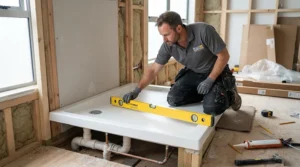
What most buyers overlook about accessible wet rooms is that the floor former, not the tiling, is what actually determines whether a wheelchair or shuffling gait is safe. The Tuff Form’s standout feature is sheer structural confidence at a genuinely thin profile.
At 22mm thick, compatible with standard 18mm timber floorboards plus 4mm ply, it manages to support serious point loads — a maximum weight of up to 60 stone, or over 380kg. That’s not marketing fluff; wheelchair wheels concentrate weight into a tiny contact patch, and a lot of budget trays simply aren’t rated for it. The SMC and GRP composite construction with a ribbed underside also resists the slippage and float that can otherwise wreck an installation on a slightly uneven subfloor.
Here’s what the spec sheet won’t tell you outright: this former is designed to be forgiving during a real building job. It can be trimmed without losing strength, up to 150mm from the waste, and the offset drain position helps installers dodge joists and pipework that would otherwise force a redesign. Reviewers and trade retailers consistently describe it as the go-to accessible-showering product in the UK, reflected in its position as one of the country’s best-selling wet room floor formers.
Pros:
- ✅ Rated for wheelchair and carer combined weight loads
- ✅ Works on both timber and concrete subfloors
- ✅ Can be trimmed on site without losing strength
Cons:
- ❌ Ready-finished trays are quicker if accessibility isn’t a priority
- ❌ Needs a full tanking kit before tiling, adding a step
Expect prices in roughly the £170-£400 range depending on size, before waste and tanking accessories — check current price for your exact dimensions.
3. Kudos KStone Rectangle — best value near-level upgrade
The standout here is straightforward: a genuinely low 45mm profile at a price that doesn’t sting, from a brand that’s been quietly reliable in UK bathrooms for years.
Made in the UK, KStone trays feature a glossy, stain-resistant finish alongside a resin-bonded stone filler that adds real stability underfoot. In practical terms, that stone-resin core means the tray won’t flex or creak like a cheap acrylic shell might when you step in and out repeatedly over a decade of family use. Sizes run right up to 1700mm x 900mm for larger rectangular enclosures, so it scales from an ensuite to a family bathroom without switching product ranges.
What most buyers overlook is that KStone isn’t trying to be a true wet room former — at 45mm it sits proud of the floor rather than flush with it — but for anyone who wants “near-level” styling without recessing the subfloor, that’s precisely the appeal. Reviewers on major UK retailer sites consistently praise the gloss finish holding up well against limescale, though as with most acrylic-capped surfaces, aggressive abrasive cleaners are flagged as the one thing to avoid.
Pros:
- ✅ Genuinely low 45mm profile for an easy-access feel
- ✅ Stone-resin core resists flex and cracking
- ✅ Five-year manufacturer guarantee as standard
Cons:
- ❌ Not a true flush, zero-threshold installation
- ❌ Waste sold separately on most sizes
Typical pricing sits in the £150-£350 range depending on size, often discounted meaningfully from RRP at UK retailers — check current price before buying.
4. Mira Flight Level — the slimmest ready-made wet room look
Mira built its reputation on showers, not trays, but the Flight Level range shows that expertise translates. The standout is the profile: at just 25mm, it’s the thinnest ready-finished tray in this line-up by a clear margin.
With a minimal 25mm tray height, the Mira Flight Level tray is designed specifically to create a wetroom look, and it’s fitted with BioCote technology that reduces bacteria and mould growth by up to 99.9%. What that means day to day: fewer black mould spots creeping in around the waste after a few damp winters, which is the single most common complaint about budget shower trays generally. The waste performance runs at 30 litres per minute at a 10mm head, rising to 40 litres per minute at 15mm, which comfortably handles a standard mixer shower, though it trails the Impey linear drain for sheer volume.
Reviewers on major retailer sites rate the range around 3.9 out of 5 based on 59 ratings, with the honest analytical read being that most criticism centres on delivery logistics for the larger sizes rather than the tray itself. On the spec comparison, this is the pick for buyers who want a wet room silhouette without the floor-recessing work a true former demands.
Pros:
- ✅ 25mm profile is the slimmest ready-made option here
- ✅ Antimicrobial coating genuinely reduces mould buildup
- ✅ Fits flush, surface-mounted, or on riser legs
Cons:
- ❌ Lower flow rate than a dedicated linear drain
- ❌ Larger sizes carry a noticeably higher price jump
Prices range roughly from the low-£200s for compact sizes up to around £800 for the largest 1800mm options — check current price for your specific size.
5. Merlyn MStone — most rigid build quality for daily family use
The standout feature is construction, not looks: Merlyn engineered this tray to survive being battled over by teenagers twice a day for a decade, and it shows.
Unlike most trays on the market, MStone trays are “double-skinned”, with an additional layer of acrylic-capped ABS on the underside to fully encapsulate the stone-resin core and add superior strength. Here’s what the spec sheet won’t spell out: that bottom layer is what stops a tray creaking or flexing on a slightly imperfect subfloor over time, a failure mode that’s a common cause of grout cracking at the tray edge in cheaper single-skin trays. At just 50mm high with a 90mm fast-flow waste included, it’s a touch taller than the Mira or Kudos options, but the trade-off is rigidity.
Based on the spec comparison, this is the pick for anyone who has been burned before by a tray that flexed underfoot within a year or two. Merlyn backs the double-skin construction with a lifetime guarantee, which is a meaningful signal given how the range is positioned as the brand’s flagship standard tray rather than an entry-level product.
Pros:
- ✅ Double-skinned build resists flex over years of use
- ✅ Lifetime manufacturer guarantee included
- ✅ Chrome-domed waste included in the price
Cons:
- ❌ 50mm profile is the tallest ready-finished tray here
- ❌ Riser kit adds significant extra height if needed
Expect the £165-£350 range depending on shape and size, with offset quadrant models typically pricier than square — check current price and availability.

6. Aquadart Slate Effect — best style-led budget upgrade
The standout is texture and finish: a genuine slate-effect surface that makes a budget tray look considerably more expensive than it is.
Manufactured in Britain, this shower tray is constructed from stone resin, ensuring high strength, durability, and stability, and it comes in at a slimline 45mm height with a black textured slate finish that’s non-porous and scratch-resistant. In practical terms, that textured surface isn’t purely cosmetic — it adds genuine underfoot grip, which matters more than most buyers realise once a shower floor is consistently wet. The 90mm waste hole is standard across the range, so it plays nicely with common riser kits and standard plumbing.
What most buyers overlook is that a slate-effect finish this convincing usually costs considerably more from premium brands; Aquadart has essentially borrowed the look and kept the price down. The honest trade-off is that as with any textured stone-resin surface, grout lines and detailing around the drain need a slightly more careful sealing job during installation to avoid future staining.
Pros:
- ✅ Convincing slate texture at a budget-friendly price
- ✅ Anti-slip surface genuinely improves grip when wet
- ✅ Lifetime guarantee backs the stone-resin build
Cons:
- ❌ Textured finish needs careful sealing around the waste
- ❌ Brushed brass waste upgrade adds noticeably to the cost
Typical pricing runs from around £150 for compact quadrant sizes up to the £350-£450 range for larger rectangular formats — check current price, as offers move regularly.
7. Ajax Low Profile Quadrant — cheapest genuine stone-resin option
The standout is simple honesty about price: this is the most affordable tray in the line-up that still uses a real stone-resin core rather than plain acrylic.
Made from lightweight stone resin that’s 30% lighter than standard stone resin trays, with a high-gloss acrylic surface and anti-bacterial hygienic properties, it sits at a 45mm low-profile height with a side-positioned waste. What that means practically: you’re not sacrificing much structurally to hit a lower price point — this isn’t a flimsy shell tray, it’s a genuine stone-resin product manufactured down to a tighter cost rather than down to a lower spec. Tested flow rate runs over 32 litres per minute, which is entirely adequate for a standard household mixer shower.
Reviewers consistently note it as a solid choice for rental properties, guest bathrooms, and budget-conscious full refurbishments where every line item matters. The spec comparison shows it holding its own against trays costing considerably more, though the trade-off is a narrower size range than the bigger brands offer, and the riser kit compatibility is more limited on certain dimensions.
Pros:
- ✅ Genuine stone-resin core at an entry-level price
- ✅ 30% lighter than standard stone resin for easier handling
- ✅ Ten-year manufacturer’s warranty included
Cons:
- ❌ Smaller size range than premium competitors
- ❌ Not all sizes support the optional riser leg kit
Pricing typically sits under £220 for most sizes, making it one of the most accessible genuine stone-resin trays on the UK market — check current price for the latest figures.
Wet Room Tray Drainage: Point Waste vs Linear Drain Explained
What’s the difference between point waste and linear drain in a wet room? A point waste is a single circular drain, usually corner-positioned, draining a tray via one or more gradients; a linear drain is a slot-style channel running along one edge, offering a wider, faster-draining catchment area that suits larger or high-flow showers…
Point wastes, like those on the Kudos KStone, Mira Flight Level, Merlyn MStone, Aquadart Slate Effect, and Ajax Low Profile Quadrant, are simpler to install and plumb, and they’re perfectly adequate for a standard mixer shower in a typical UK household. Reviewers consistently note them as trouble-free once correctly fitted, provided the gradient towards the waste is accurate — even a couple of millimetres out can leave a puddle in the corner.
Linear drains, as fitted to the Impey Aqua-Dec Linear 3, take up more of the tray’s edge but drain a far larger surface area simultaneously, which is exactly why the flow-rate figures are so much higher. They also suit the increasingly popular “no visible tray” wet room aesthetic, since the drain can be positioned discreetly against a wall rather than dictating the layout from a corner. The trade-off, as covered in the product section above, is floor depth: linear systems generally need more clearance beneath the former than a simple point waste, so it’s worth measuring your joist depth before falling in love with the look.
Tileable Shower Tray Options vs Ready-Finished Trays
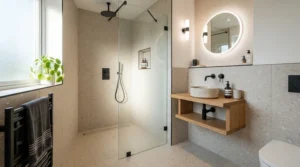
Here’s a distinction that trips up a lot of first-time wet room buyers: a “tileable shower tray option” isn’t the same product category as a ready-finished tray, even though they solve the same basic problem. The Impey Aqua-Dec Linear 3 and AKW Tuff Form are floor formers — structural bases designed to sit beneath your own tiling, vinyl, or safety flooring, so the finished surface reads as one continuous floor with no visible tray edge at all.
Ready-finished trays like the Kudos KStone, Mira Flight Level, Merlyn MStone, Aquadart Slate Effect, and Ajax Low Profile Quadrant arrive with their surface already complete — acrylic-capped stone resin, ready to drop in and plumb. What the spec sheet won’t tell you outright is that this isn’t a lesser option; for a huge proportion of UK bathrooms, a 25-45mm ready-finished tray delivers 90% of the visual “wet room” effect at a fraction of the installation complexity, since there’s no need to recess the subfloor or run a full tanking membrane across the entire floor.
The honest analytical take: choose a tileable former if your goal is a genuinely flush, screed-level wet room floor with zero visible break between shower and room — or if building regulations or accessibility needs demand it. Choose a ready-finished tray if you want a strong wet-room aesthetic without a structural floor alteration, particularly on upper floors where joist depth is a real constraint.
Level-Access Shower Trays: What “Zero Threshold” Really Means
What is a level-access shower tray? It’s a shower base — either a former or a specially designed low tray — installed so its surface finishes flush, or near-flush, with the surrounding floor, removing any lip or step that could catch a foot, wheelchair caster, or walking frame…
A level-access shower tray is a specially designed shower base, recessed into the subfloor so that its surface sits flush with the surrounding bathroom floor, creating a seamless, step-free entry point while still providing a defined gradient directing water towards a drain. Approved Document M, the section of the building regulations covering access to and use of buildings, treats level-access showers as a baseline provision in accessible dwelling design — which is a useful reminder that this isn’t just a lifestyle preference, it’s recognised in national guidance for a reason.
Genuinely level-access products in this line-up are the AKW Tuff Form, engineered specifically around wheelchair and carer weight loads, and the Impey Aqua-Dec Linear 3, which achieves a comparably flush finish via its 22mm recessed profile. The remaining five trays are better described as “low-access” — they minimise the step to a few centimetres rather than eliminating it entirely, which is a meaningful distinction if the tray is being specified for a genuinely mobility-critical bathroom rather than a stylistic wet room look.
Level-Access Bathrooms: Designing for Accessibility and Ageing in Place
A level-access bathroom is about more than the tray alone — it’s a whole-room decision, and the tray is simply the foundation everything else gets built on. The tray determines how safely you can enter and exit the shower, controls where water goes, and dictates what screens, seats, and grab rails can be fitted around it.
For UK homes being adapted for ageing in place or reduced mobility, the honest analytical take is that a full wet room floor — waterproofing and grading the entire room to a single drain, with no separate tray at all — usually gives the most robust long-term accessibility, but it’s also the most invasive and expensive route. A recessed level-access tray like the AKW Tuff Form, paired with a proper tanking kit, is frequently the more achievable middle ground: it delivers the step-free entry that matters most for safety, without requiring the entire bathroom floor to be dug out and re-graded.
Practical detailing matters enormously here: fold-down seating, contrasting grab rails, and slip-resistant surfacing all compound the safety benefit of a level-access tray, and it’s worth planning these alongside the tray rather than retrofitting them afterwards. Anyone specifying for a wheelchair user specifically should also confirm the tray’s rated point-load capacity, since standard trays aren’t designed for the concentrated weight of wheelchair wheels the way reinforced level-access products are.
Comparing the Top 7: Specs at a Glance
| Product | Waste Type | Flow Rate | Guarantee | Best For |
|---|---|---|---|---|
| Impey Aqua-Dec Linear 3 | Linear drain | Up to 42 l/min | Lifetime | Showpiece wet rooms |
| AKW Tuff Form | Gravity/pumped | Standard | Lifetime | Accessible/wheelchair use |
| Kudos KStone | 90mm point waste | Standard | 5 years | Budget near-level look |
| Mira Flight Level | Side point waste | 30-40 l/min | 5-10 years | Slimmest ready tray |
| Merlyn MStone | 90mm point waste | Standard | Lifetime | Long-term durability |
| Aquadart Slate Effect | 90mm point waste | Standard | Lifetime | Style on a budget |
| Ajax Low Profile | 90mm point waste | Over 32 l/min | 10 years | Tightest budgets |
Lined up side by side, the pattern is clear: guarantee length correlates fairly closely with build sophistication, with the double-skinned Merlyn MStone and the recessed formers from Impey and AKW all backed by lifetime cover. If your household showers hard and often, prioritise the flow-rate figures — the Impey Aqua-Dec Linear 3 is in a different league here, while the remaining trays cluster in a broadly similar, perfectly adequate band for everyday mixer showers.
Wet Room Tanking System: Practical Installation & Waterproofing Guide
None of the seven trays above will do their job properly without correct waterproofing underneath and around them — and this is the step that gets rushed more than any other on a DIY wet room. Tanking is the process which ensures wetroom installations remain leak-free for the duration of their lifespan, and it’s arguably the most vital step in the whole job.
Step 1 — Prep the substrate properly. The floor and work area must be clean and completely dry before anything else happens, with any sharp lumps or bumps removed so they can’t puncture the tanking membrane. Rushing this stage is the single biggest cause of early tanking failure.
Step 2 — Apply primer to the tray and subfloor. This ensures the tanking membrane actually bonds, rather than sitting loosely on top and peeling later under thermal movement.
Step 3 — Seal every joint and penetration. Waste pipe collars, corner joints between floor and wall, and any pipework penetrations need dedicated tape or preformed corners — these are consistently the weak points reviewers and trade fitters flag when tanking fails.
Step 4 — Apply the waterproof membrane. This can be a liquid membrane applied in two coats, or a sheet/fleece-backed membrane, and for tileable formers like the Impey Aqua-Dec Linear 3 or AKW Tuff Form, this stage effectively creates the entire watertight shell beneath your finished floor.
Step 5 — Allow a full cure before tiling. Typically 12-24 hours depending on product and ambient temperature; tiling too early is a common and entirely avoidable mistake.
A common first-30-days error worth flagging: grouting straight after tiling without checking the tray’s gradient with a spirit level and a bucket of water first. It costs nothing to test, and it’s far cheaper than lifting tiles later to fix a puddle that shouldn’t be there.

Real-World Scenarios: Which Tray Suits Your Household?
The downsizing couple planning ahead. If you’re renovating a forever-home bathroom in your fifties or sixties with an eye on future mobility, the AKW Tuff Form paired with a full tanking kit is the sensible long-game choice — it’s accessible now and remains fully compliant with wheelchair use later, without a second renovation.
The young family on a tight budget. For a busy family bathroom used twice daily by children and adults alike, the Ajax Low Profile Quadrant or Kudos KStone deliver genuine stone-resin durability without blowing the budget, and their point wastes are simple enough for a competent plumber to install in an afternoon.
The design-led renovator with a statement ensuite. If the wet room is the centrepiece of a high-spec renovation and a powerful shower is non-negotiable, the Impey Aqua-Dec Linear 3 is worth the extra installation complexity — nothing else here matches its drainage capacity or its architectural, edge-to-edge finish.
Common Mistakes When Buying a Shower Tray for Wet Room Installation
Getting the tray wrong is rarely about the tray itself — it’s almost always about the decisions made around it. Reviewers consistently note the same handful of pitfalls across UK forums and trade sites.
Ignoring joist depth before choosing a linear drain. As covered above, the Impey Aqua-Dec Linear 3 needs meaningful clearance beneath it; measuring after purchase, rather than before, is a genuinely common and expensive mistake.
Skipping the tanking kit to save money. A wet room tanking system isn’t an optional extra on a tray-based installation — without it, even the best tray on this list will eventually let water into the subfloor.
Assuming all “low profile” trays are wheelchair-rated. A 45mm ready-finished tray and a genuinely reinforced level-access former are not interchangeable if the bathroom needs to serve someone with a mobility aid; check the load rating specifically, not just the height.
Underestimating waste clearance. Every product in this guide has a minimum below-floor clearance requirement, and on suspended timber floors this can conflict with joist depth in older UK properties — always check before ordering.
Long-Term Cost & Maintenance of Wet Room Shower Trays
The purchase price is only the opening chapter. Stone-resin trays like the Merlyn MStone and Kudos KStone are essentially maintenance-free day to day — a wipe with a non-abrasive cleaner keeps the acrylic cap looking new for years, and the resin core simply doesn’t degrade the way cheap acrylic shells can. Tileable formers such as the AKW Tuff Form and Impey Aqua-Dec Linear 3 shift more of the long-term cost into the surrounding tiling and grout, which will need periodic re-sealing every few years regardless of which tray sits beneath it.
Where costs genuinely diverge is in guarantee-backed peace of mind. A lifetime-guaranteed tray from Merlyn, Impey, or AKW, correctly installed, effectively removes the tray itself as a future expense line — any failure within the manufacturer’s terms is covered. Budget trays with 5-10 year guarantees, like the Kudos KStone or Mira Flight Level, remain excellent value provided you factor a realistic replacement horizon into your overall renovation planning rather than assuming a 25-year lifespan by default.
How to Choose a Shower Tray for Wet Room Installation
How do I choose the right shower tray for a wet room? Match the tray type to your floor structure and accessibility needs first, then narrow by drainage capacity and budget — in that order, not the reverse…
- Confirm your subfloor type and depth first. Timber joist floors and solid concrete slabs have very different clearance requirements, and this single factor rules out or confirms certain products before you even look at price.
- Decide between a tileable former and a ready-finished tray. As covered above, this is the biggest structural decision in the whole project, driven by how flush you need the finish to be.
- Check accessibility requirements honestly. If the bathroom needs to serve a wheelchair user now or in the foreseeable future, specify a genuinely reinforced level-access product like the AKW Tuff Form, not simply the lowest-profile tray available.
- Match drainage to your shower’s actual flow rate. A powerful multi-jet system genuinely needs the capacity a linear drain like the Impey Aqua-Dec Linear 3 provides; a standard mixer shower is well served by any of the point-waste trays here.
- Budget for tanking as a non-negotiable line item. Whatever tray you choose, the wet room tanking system around it is not optional — build its cost and time into the plan from day one.
- Weigh guarantee length against expected household life in the property. A lifetime guarantee matters more in a forever-home than a rental refurbishment.
- Order wastes and riser kits at the same time as the tray. Several products here sell these separately, and mismatched components are a common cause of installation delays.

Frequently Asked Questions
❓ What is the minimum size for a level-access shower?
❓ Can any shower tray be tiled over?
❓ Do I need a tanking kit with a ready-finished shower tray?
❓ How much does it cost to fit a wet room shower tray in the UK?
❓ What's the difference between a wet room and a level-access shower?
Conclusion
If there’s one honest takeaway from all this, it’s that there’s no single “best” shower tray for wet room installation — there’s only the right match for your subfloor, your household, and your budget. The Impey Aqua-Dec Linear 3 earns its premium price through genuinely superior drainage and a flush, architectural finish. The AKW Tuff Form remains the standout for real accessibility needs, backed by serious load ratings most competitors simply don’t offer. For everyday ready-finished trays, the Merlyn MStone‘s double-skinned build quality, the Mira Flight Level‘s slim antimicrobial profile, and the budget-friendly strength of the Kudos KStone, Aquadart Slate Effect, and Ajax Low Profile Quadrant all earn their place depending on what you’re prioritising.
Whichever direction you go, don’t let the tray be the rushed decision at the end of the project — it’s the foundation everything else in your wet room sits on, quite literally. Get the drainage right, get the tanking right, and the tiles and fittings on top will look after themselves for years to come.
Recommended for You
- Shower Tray Under £150: 7 Brilliant UK Picks (2026)
- Offset Quadrant Shower Tray: 7 Best Picks For Small UK Bathrooms (2026)
- Offset Quadrant Shower Tray vs Quadrant Tray: 7 Smart Picks (2026)
Disclaimer: This article contains affiliate links. As an Amazon Associate, I earn from qualifying purchases. If you purchase products through these links, we may earn a small commission at no additional cost to you.
✨ Found this helpful? Share it with your friends! 💬🤗
