In This Article
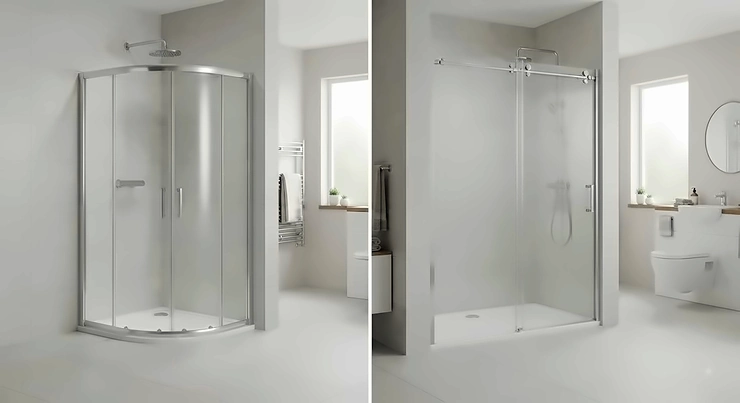
Stand in a poky en-suite with a tape measure in one hand and a shower brochure in the other, and the quadrant vs sliding shower enclosure question stops being theoretical fast. A quadrant shower enclosure uses a curved front and two flat sides to tuck into a corner, with doors that slide along a track rather than swing outward, while a “sliding” enclosure in the wider sense usually means a straight, recessed door fitted between two walls or an alcove. Both are genuinely among the better space-saving shower enclosure types for anyone working with a boxy bathroom rather than a spa-sized wet room. The trouble is that the difference between them isn’t just cosmetic — it changes your footprint, your cleaning routine, and how much elbow room you need to swing a towel afterwards.
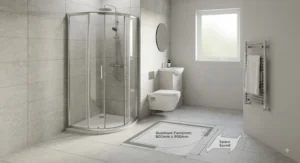
This guide walks through both formats honestly, using real, currently available products rather than invented specs, so you can see how the numbers actually stack up. We’ll cover door swing clearance, the practical footprint each shape leaves behind, and how each option behaves in an enclosure for narrow bathroom layouts specifically — the kind of terraced-house en-suite or box-room shower where every centimetre matters. Along the way we’ll look at seven real enclosures spanning budget, mid-range and premium, compare them head-to-head, and flag the trade-offs nobody puts on the box. Because here’s the thing manufacturers rarely admit outright: the “best” shape isn’t universal — it’s the one that matches your walls, your door swing, and how you actually use your bathroom in the morning rush.
Quick Comparison Table
| Enclosure | Type | Size | Best For |
|---|---|---|---|
| ELEGANT 900 x 900mm Quadrant (6mm) | Quadrant, sliding doors | 900 x 900mm | Budget corner fit, narrow bathrooms |
| Aqualux AQUA 6 900mm Quadrant | Quadrant, sliding doors | 900 x 900mm | Reliability from an established UK brand |
| ELEGANT 1200mm NANO Sliding Shower Door | Straight sliding, recess | 1200mm door | Wide alcoves, family bathrooms |
| Aqualux Florenta Steam Cabin | Quadrant, all-in-one cabin | 900 x 900mm | Premium, self-contained steam showering |
Even from this snapshot, the pattern is clear: quadrant designs dominate the budget-to-mid tier because their curved front genuinely reclaims corner space that a straight door can’t touch, while straight sliding doors earn their keep in wider alcoves where a curve would just waste glass. Price ranges here sit anywhere from around £120 up to four figures for a self-contained steam cabin, so the decision is as much about your ceiling budget as your floor plan. Below, we’ll unpack why that split happens and where each shape starts to lose its advantage.
💬 Found a comparison that matches your bathroom? Save this guide and share it with anyone else mid-renovation!😊
Top 7 Quadrant and Sliding Shower Enclosures: Expert Analysis
1. ELEGANT 900 x 900mm Quadrant (6mm) — best budget corner fit for narrow bathrooms
The standout here is straightforward: a proper quadrant footprint for well under the price of most premium alternatives, without cutting corners on the glass itself. The ELEGANT 900 x 900mm Quadrant (6mm) ships with 6mm tempered safety glass certified to BS EN 12151, a twin sliding door running on sixteen metal rollers, and 20mm of wall adjustment on each side to absorb the slightly-out-of-true walls that plague older UK terraces. In practice, that adjustment range matters more than it sounds — it’s the difference between a clean install and a fitter shimming packers behind the frame for an afternoon.
Based on the spec sheet, this is squarely a starter-home or rental-refresh product: the frame is aluminium rather than the thicker extrusions you’ll find further up the range, and it’s designed to be functional rather than a design statement. Reviewers consistently note that assembly is genuinely straightforward for a competent DIYer, with one recurring five-star theme being how little fuss the installation involved. That said, aggregated feedback also flags an occasional complaint about water finding its way between the glass panel and the frame on some units, which points to sealant application — either at the factory or at fitting — being worth double-checking rather than assumed.
Pros:
- ✅ Genuine quadrant footprint at an entry-level price point
- ✅ 20mm wall adjustment forgives slightly uneven walls
- ✅ Straightforward DIY assembly reported by most buyers
Cons:
- ❌ Some units report leaking at the glass-to-frame seal
- ❌ Aluminium frame feels lighter-duty than premium ranges
Expect this one to sit in the lower price bracket, often under £150, which makes it one of the more accessible entries in this whole roundup — just budget an extra tube of silicone sealant as cheap insurance.
2. Aqualux AQUA 6 900mm Quadrant — best for buyers who want an established UK brand behind the glass
What most buyers overlook about this one is the manufacturer behind it, not just the enclosure itself. Aqualux holds a significant share of the UK shower enclosure market, and the Aqualux AQUA 6 900mm Quadrant reflects that scale — it’s built to BS EN 14428:2004+A1:2008, the specific European standard covering water retention, durability, stability and cleanability for shower enclosures, with toughened glass separately certified to BS EN12150-1:2000.
On paper this means you’re getting a more rigorously tested product than many own-brand alternatives, and the “Quick Fit Dovetail Technology” fitting system is a genuinely useful practical touch — it lets the frame components click together rather than relying purely on fiddly screw alignment, which speeds up installation meaningfully. The Aquagleam glass coating resists limescale and soap scum between cleans, a detail that matters more in hard-water regions than manufacturers usually let on. Gel magnet seals keep the sliding doors watertight, and a lifetime guarantee backs the whole unit — a strong signal of manufacturer confidence that budget alternatives rarely match.
Pros:
- ✅ Backed by a lifetime guarantee from a market-leading UK brand
- ✅ Aquagleam coating meaningfully reduces limescale build-up
- ✅ Dovetail fitting system speeds up DIY installation
Cons:
- ❌ Sits at a noticeably higher price than own-brand quadrants
- ❌ 900mm-only size limits flexibility for awkward layouts
Priced in the low-to-mid £200s typically, the Aqualux AQUA 6 900mm Quadrant is the safer long-term bet if you’d rather pay once and forget about it than save now and gamble on longevity.
3. ELEGANT 900 x 800mm Offset Quadrant — best for genuinely narrow bathroom footprints
Here’s where the enclosure for narrow bathroom conversation gets interesting. An offset quadrant isn’t a standard quadrant squashed smaller — it’s a different curve radius entirely, stretched along one axis so it fits a rectangular alcove rather than a perfect square corner. The ELEGANT 900 x 800mm Offset Quadrant does exactly that, arriving with a stone-resin tray and waste trap included, which matters because offset trays aren’t always interchangeable with standard quadrant ones.
The real-world benefit is subtle but significant: in a bathroom where one wall run is shorter than the other — extremely common in Victorian and 1930s conversions where the bathroom was carved out of a bedroom corner — a standard 900 x 900mm quadrant simply won’t fit without eating into your walkway. Reviewers who’ve fitted offset units in these exact scenarios report that the extra planning pays off, though a recurring theme in feedback across ELEGANT’s offset range is that the handedness (left or right offset) needs confirming carefully before ordering, since reversing it later isn’t straightforward.
Pros:
- ✅ Fits rectangular alcoves standard quadrants can’t use
- ✅ Stone-resin tray and waste trap included in the kit
- ✅ Genuinely reclaims floor space in awkward corner conversions
Cons:
- ❌ Left/right handedness must be confirmed before ordering
- ❌ Fewer size variants than the standard quadrant range
Typically priced in the £180-£250 range with the tray bundled in, this is arguably the single most useful pick in this whole list if your bathroom is more rectangle than square.
4. Sky Bathroom 900x900x1850mm Quadrant — best lesser-known alternative for double-door access
Not every good product wears a household name, and the Sky Bathroom 900x900x1850mm Quadrant is a solid case in point. It uses a twin sliding-door configuration with a 540-radian curve, which sounds like a technical footnote until you realise it dictates exactly which shower tray will pair with it correctly — a genuinely useful detail some competitor listings bury or omit entirely.
Here’s what the spec sheet won’t tell you outright: a twin-door quadrant like this opens from the centre rather than from one side, which in day-to-day use means a wider effective entry gap for the same overall footprint compared with a single sliding panel. For households where more than one person uses the same shower — think teenagers running late for school — that centre-opening design shaves real seconds off the morning routine. Magnetic seal strips on both doors help keep the unit watertight, and stainless steel screws throughout are a small but sensible nod to longevity in a consistently damp environment.
Pros:
- ✅ Centre-opening twin doors give a wider practical entry gap
- ✅ 540-radian curve is clearly specified for tray compatibility
- ✅ Stainless steel fixings resist rust in constant humidity
Cons:
- ❌ Less brand recognition means a smaller pool of long-term reviews
- ❌ Black-framed finish limited compared to chrome-heavy competitors
Positioned in a similar budget bracket to the ELEGANT quadrants, typically under £200, it’s worth cross-shopping against the bigger names before you commit.
5. ELEGANT 1000mm Sliding Shower Door — best entry point into straight sliding for narrow alcoves
This is where the quadrant vs sliding shower enclosure comparison shifts gears entirely. Rather than curving into a corner, the ELEGANT 1000mm Sliding Shower Door is a straight, reversible panel designed to sit within a recess — between two existing walls — with no curve and, crucially, no door swing to plan around at all.
Reviewers and product data both point to the same practical upside: because the door slides flat against a fixed panel rather than opening outward, it needs zero clearance in front of the enclosure, which is precisely what enclosure opening styles compared side-by-side reveal as the sliding format’s biggest structural advantage over hinged or pivot doors. The reversible design means the same unit fits either a left-hand or right-hand recess, which simplifies ordering if you’re not entirely sure of your final layout yet. Based on the spec comparison against the quadrant options above, this format suits a narrow-but-long bathroom shape far better than a corner curve would — think a galley-style layout where the shower sits along one wall rather than in a corner.
Pros:
- ✅ Zero door-swing clearance needed in front of the enclosure
- ✅ Reversible fitting works for left or right-hand recesses
- ✅ Straight profile suits galley-shaped narrow bathrooms
Cons:
- ❌ Requires two solid walls to recess into, unlike a corner quadrant
- ❌ 6mm glass is standard rather than the thicker premium option
Generally priced towards the lower end, often under £150 for the door alone, it’s a genuinely practical starting point for anyone retrofitting a straight alcove rather than a corner.
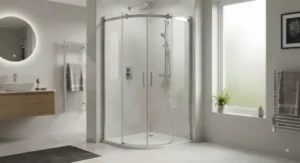
6. ELEGANT 1200mm NANO Sliding Shower Door — best premium sliding door for wider family bathrooms
Stepping up a tier, the ELEGANT 1200mm NANO Sliding Shower Door swaps 6mm for 8mm tempered glass and adds NANO self-cleaning coating technology, which chemically resists limescale and soap-scum adhesion rather than just making the glass easier to wipe. Full-length magnetic seals run the entire height of the door rather than in short segments, addressing one of the more common failure points on cheaper sliding doors — water creeping in at the seams where seal strips don’t quite meet.
What most buyers overlook about wider sliding doors is that extra width doesn’t just mean a roomier shower — it also means a heavier door riding the same track, so the quality of the roller mechanism matters proportionally more as the door gets bigger. At 1200mm, this unit is aimed squarely at family bathrooms rather than compact en-suites, where the wider opening genuinely earns its keep for anyone showering with a young child in tow or simply wanting more room to towel off without knocking elbows on glass. The reversible design again allows left or right-hand fitting, and it can be installed with or without a matching shower tray depending on what you’re pairing it with.
Pros:
- ✅ 8mm glass with NANO coating resists limescale build-up
- ✅ Full-length magnetic seals reduce the risk of leaks at the seams
- ✅ 1200mm width suits family bathrooms needing more room
Cons:
- ❌ Overkill in width for a genuinely narrow bathroom
- ❌ Higher price bracket than the 1000mm equivalent
Expect a price somewhere in the £180-£250 range depending on whether a tray is bundled, positioning it as the sensible upgrade pick for anyone with the wall space to use it.
7. Aqualux Florenta Quadrant Steam Cabin — best all-in-one premium option for a spa-style upgrade
At the top of this roundup sits something categorically different: the Aqualux Florenta Quadrant Steam Cabin isn’t just an enclosure, it’s a fully self-contained 900 x 900mm quadrant steam shower cabin with its own controls, seating and steam generator built in. This is the product that answers “what if I don’t just want a shower, I want an experience” — and the price tag, typically running into four figures, reflects that shift from fitting to appliance.
Here’s the honest analysis worth having before you buy: an all-in-one steam cabin trades the simplicity of a standard enclosure for genuinely useful extra functionality, but it also introduces more moving parts that can fail — a steam generator, electronic controls, additional seals — none of which exist on a basic sliding quadrant. Aggregated review sentiment reflects exactly that trade-off: alongside praise for the spa-like experience, a recurring complaint centres on the steam outlet component needing replacement more than once within the first year on some units, which is worth factoring into any long-term cost thinking. If you want steam functionality specifically, this remains one of the more accessible ways to get it without a full wet-room conversion; if you just want a reliable daily shower, a standard quadrant from earlier in this list will likely serve you better and cost a fraction as much.
Pros:
- ✅ Genuine steam function built into a standard quadrant footprint
- ✅ Self-contained design avoids a full wet-room conversion
- ✅ Spa-style upgrade without extending the bathroom itself
Cons:
- ❌ Steam generator component reported as a recurring failure point
- ❌ Significantly higher price and complexity than a standard enclosure
If steam is a genuine priority, budget for it as a premium appliance purchase rather than a like-for-like enclosure swap — the price gap versus product #2 above is substantial.
Top 7 Products Comparison Table
| Product | Glass | Adjustment | Price Range | Best For |
|---|---|---|---|---|
| ELEGANT 900 x 900mm Quadrant (6mm) | 6mm, BS EN 12151 | 20mm each side | Under £150 | Budget narrow-bathroom fit |
| Aqualux AQUA 6 900mm Quadrant | 6mm, BS EN 14428 | 25mm | Low-mid £200s | Long-term reliability |
| ELEGANT 900 x 800mm Offset Quadrant | 6mm, tray included | Standard | £180-£250 | Rectangular narrow alcoves |
| Sky Bathroom 900x900x1850mm Quadrant | 6mm, twin door | Standard | Under £200 | Wider centre-opening access |
| ELEGANT 1000mm Sliding Shower Door | 6mm, reversible | Standard | Under £150 | Straight, galley-shaped bathrooms |
| ELEGANT 1200mm NANO Sliding Shower Door | 8mm, NANO coating | Standard | £180-£250 | Family bathrooms, wider entries |
| Aqualux Florenta Steam Cabin | 6mm, cabin build | N/A | Four figures | Spa-style premium upgrade |
Look closely and the split by shape tells its own story: five of these seven are quadrants because the curved format simply wins more often in the compact UK bathrooms this guide is built around, while the two straight sliding doors earn their place specifically where a corner curve doesn’t apply. The Aqualux Florenta Steam Cabin is the clear outlier on price, and rightly so — it’s not competing with the others on value-per-square-metre, it’s competing on functionality you can’t retrofit onto a basic enclosure. If your budget tops out around £250, the realistic shortlist narrows to five of these seven, and the choice between them comes down almost entirely to your wall layout rather than brand preference.
Real-World Scenarios: Matching the Enclosure to Your Bathroom
Picture a first-time buyer in a converted Victorian terrace, en-suite squeezed into what used to be a walk-in wardrobe. That’s the ELEGANT 900 x 900mm Quadrant (6mm) or the Sky Bathroom 900x900x1850mm Quadrant territory — tight budget, tight corner, and the curved front reclaiming just enough floor space to actually close the door behind you without your elbow hitting glass.
Now picture a young family in a 1930s semi with a long, narrow bathroom rather than a boxy one — bath at one end, basin and loo along the facing wall, and a shower needed somewhere in between without eating the walkway. That’s exactly the scenario the ELEGANT 1000mm Sliding Shower Door or its wider sibling, the ELEGANT 1200mm NANO Sliding Shower Door, was built for: no curve needed, no swing space required, just a straight recessed panel doing its job quietly.
And then there’s the couple mid-way through a proper renovation, budget stretched a little further, who want the bathroom to feel like a genuine upgrade rather than a like-for-like swap. For them, either the Aqualux AQUA 6 900mm Quadrant for dependable everyday quality, or the Aqualux Florenta Steam Cabin if steam functionality is genuinely on the wish list, both make sense — the difference is purely how much of the budget they’re willing to commit to the shower alone versus spreading it across tiling, flooring and fittings.
Practical Usage Guide: Getting the Fit Right First Time
Measure twice, order once — it sounds obvious, but the single most common installation headache with any quadrant or sliding enclosure is discovering the walls aren’t quite square after the glass has already arrived. Before ordering anything from this list, measure the alcove at three heights (floor, mid-height, and top), not just once, since older UK properties routinely have walls that lean by a centimetre or more over their height.
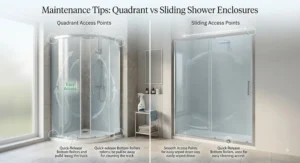
Once the unit is in, the first thirty days matter more than people expect. New silicone sealant needs roughly 24 hours to cure fully before the enclosure sees its first proper shower, and running the extractor fan or opening a window straight after each use in that window helps the seal set without trapped moisture undermining it. Wipe the tracks of any sliding door — quadrant or straight — dry after use during the first few weeks; grit or hair in a fresh roller mechanism is the leading cause of that annoying grinding noise appearing within the first month.
Longer term, a monthly check of the magnetic seal strips pays for itself. They’re the component most likely to degrade first, and replacing a worn seal strip costs a fraction of what a full reseal or, worse, water damage to a chipboard floor beneath would cost. A soft squeegee after each shower, rather than a cloth, keeps the glass coating — NANO or otherwise — working as intended for years rather than months.
Buyer’s Decision Framework: A Simple Priority Checklist
If your bathroom has a genuine 90-degree corner and floor space is the priority, choose a quadrant enclosure because the curved front reclaims corner space no straight door can match. If your bathroom is narrow but long, with two parallel walls rather than a corner, choose a straight sliding door because it needs zero clearance and doesn’t require a curved tray. If more than one person regularly uses the same shower, prioritise a twin-door or wider sliding format because the effective entry gap matters more than the total footprint. If your walls are visibly out of true, prioritise a product with generous wall adjustment — 20mm or more each side — over one optimised purely for price. And if long-term reliability outweighs upfront cost, lean toward an established brand with a meaningful guarantee rather than the cheapest listing on the page.
Enclosure Opening Styles Compared: Quadrant, Sliding, Hinged and Bi-Fold
The quadrant vs sliding shower enclosure debate is really a subset of a bigger question: how does the door open, and what does that cost you in floor space? A hinged or pivot door swings outward into the bathroom, which needs genuine clearance in front of the enclosure — typically 700-900mm of clear floor — making it a poor fit for anything genuinely tight. A bi-fold door concertinas inward on itself, needing far less swing space than a hinged door but still marginally more than a true sliding panel, and it introduces extra hinge points that can wear over time.
Sliding doors, whether on a straight recess enclosure or a curved quadrant, move flat along a track and require no swing clearance at all — the door never leaves the footprint of the enclosure itself. That’s the core reason both formats dominate this list: in a bathroom where every centimetre in front of the shower is also the walkway to the basin or door, a swinging door simply isn’t compatible with daily life. The trade-off is track maintenance — sliding mechanisms need occasional cleaning to stay smooth — against the swing-door’s simpler, maintenance-light hinge, but for genuinely narrow bathrooms, that trade-off is almost always worth making.
How to Choose a Shower Enclosure for a Narrow Bathroom
- Measure the alcove or corner precisely, at floor, mid, and top height, since older properties rarely have perfectly true walls.
- Decide corner or straight first, because that single choice narrows quadrant versus sliding-door options before you even look at brands.
- Check the door swing requirement, ruling out hinged or pivot doors immediately if floor space in front of the shower is under roughly 700mm.
- Match tray radius to enclosure curve, since quadrant units specify an exact radian that only fits certain trays — mixing brands can leave a gap.
- Confirm handedness for offset or reversible units, particularly with offset quadrants, where left and right versions aren’t interchangeable after fitting.
- Prioritise wall adjustment tolerance if your walls are visibly uneven, since 20mm or more per side saves a much harder retrofit later.
- Weigh glass thickness against budget, since 8mm feels sturdier and often includes better coatings, but 6mm remains perfectly safe and BS EN certified at a lower cost.
Common Mistakes When Buying a Quadrant or Sliding Shower Enclosure
The single most frequent mistake is ordering by footprint alone and forgetting the door swing entirely — a hinged door that looks compact on a spec sheet can still demand more clearance than the entire bathroom offers once open. A close second is assuming all quadrant trays are interchangeable; the curve radius genuinely varies between manufacturers, and a mismatched tray-to-door radian leaves a gap that no amount of sealant fixes properly.
Buyers also regularly underestimate how much uneven walls affect fitting. A unit with only 10mm of adjustment can turn into an afternoon of packers and shims on a wall that’s leaned by 15mm over its height — checking the adjustment tolerance before ordering, not after the glass arrives, avoids that entirely. Finally, there’s a tendency to chase the cheapest listing without checking the certification marks; BS EN 12150 for toughened glass and BS EN 14428 for the enclosure as a whole aren’t marketing fluff, they’re the actual safety standards, and their absence from a listing is worth noticing.
Door Swing Clearance and Shower Enclosure Footprint Explained
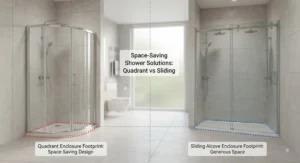
Footprint and door swing clearance are two different measurements that get conflated constantly, and getting them confused is exactly how people end up with a shower door they can’t fully open. The footprint is simply the floor area the enclosure itself occupies once installed — for a 900 x 900mm quadrant, that’s fixed and doesn’t change regardless of door type. Door swing clearance, by contrast, is the additional floor space the door needs to physically move through when opening, and it only applies to hinged, pivot or bi-fold doors.
This is precisely why sliding and quadrant-with-sliding-doors formats punch above their weight in narrow bathrooms: their effective total space requirement is just the footprint, full stop, because the door travels within that same footprint rather than beyond it. A 900mm hinged door, by comparison, can need close to a metre of additional clear floor in front of it to open fully — space that, in a genuinely narrow bathroom, simply doesn’t exist. When you’re comparing listings, always check whether the quoted dimensions include swing clearance or just the enclosure footprint, since sellers don’t always make that distinction obvious.
Long-Term Cost & Maintenance: What the Sticker Price Doesn’t Show
The upfront price on any of these seven products is only part of the real cost. Sliding mechanisms — whether on a quadrant or a straight door — have rollers that can wear or gather grit over years of use, and replacement roller kits typically run to a modest sum rather than requiring a whole new door, provided the frame itself is sound. Magnetic seal strips are the other recurring cost; they degrade faster in hard-water areas and are worth budgeting to replace every few years rather than waiting for a leak to appear.
Glass coatings genuinely change this equation. A NANO or Aquagleam-style coating, as featured on a couple of the products above, measurably reduces limescale build-up, which in hard-water regions of the UK can otherwise mean a fairly aggressive descaling routine every few weeks. Factor that ongoing time cost against the modest price premium those coated products command, and the long-term value case often tips in their favour, particularly for anyone in a hard-water postcode who’s tired of scrubbing.
Safety, Regulations and Compliance for UK Bathrooms
Every product featured in this guide uses toughened safety glass certified to British and European safety standards, which shatters into small, rounded fragments rather than sharp shards if it ever breaks — a meaningful safety distinction from ordinary annealed glass. For anyone planning an accessible or level-access bathroom, it’s also worth checking Approved Document M, the UK government’s building regulation guidance covering minimum shower zone dimensions and clearances for wheelchair and ambulant users, since standard enclosure sizes don’t automatically meet those thresholds.
If your renovation involves moving walls, altering drainage, or converting a room into a wet room, it’s also worth a quick check against the wider Building Regulations guidance on access and use of buildings before committing to a layout, particularly in a rental or shared-ownership property where compliance can affect resale.
✨ Don’t Miss These Exclusive Deals!
🔍 Take your bathroom renovation to the next level with these carefully selected enclosures. Click on any highlighted product to check current pricing and availability. These picks will help you create a genuinely space-saving shower your whole household will actually enjoy!
Shower Enclosures vs Traditional Shower Curtains: Benefits Comparison
| Factor | Shower Enclosure (Quadrant/Sliding) | Shower Curtain |
|---|---|---|
| Space efficiency | Fixed, predictable footprint | Billows outward, unpredictable |
| Water containment | Sealed glass, minimal leakage | Prone to gaps and mould |
| Maintenance | Occasional seal/roller upkeep | Frequent washing or replacement |
| Best For | Narrow, defined bathroom layouts | Renters wanting a low-cost, temporary fix |
The analysis here is fairly one-sided for anyone in a permanent home: a glass enclosure, whether the ELEGANT 900 x 900mm Quadrant (6mm) or the ELEGANT 1000mm Sliding Shower Door, contains water far more reliably than a curtain that clings, billows, and needs replacing every year or two once mildew sets in. Curtains still hold a genuine place for renters who can’t alter fixtures, but for anyone with the freedom to install a proper enclosure, the long-term hygiene and space-efficiency case is difficult to argue against.
Price Range & Value Analysis
| Tier | Example Product | Typical Range | Value Verdict |
|---|---|---|---|
| Budget | ELEGANT 900 x 900mm Quadrant (6mm) | Under £150 | Strong value if walls are true |
| Mid-range | ELEGANT 1200mm NANO Sliding Shower Door | £180-£250 | Coating justifies the premium |
| Premium | Aqualux AQUA 6 900mm Quadrant | Low-mid £200s | Lifetime guarantee offsets cost |
| Luxury | Aqualux Florenta Steam Cabin | Four figures | Only for genuine steam-shower buyers |
Read across this table and the value story isn’t simply “spend more, get more” — it’s about matching spend to what actually matters for your bathroom. Paying extra for the Aqualux AQUA 6 900mm Quadrant‘s lifetime guarantee makes sense if you’re fitting once and don’t want to revisit the job in five years, whereas stretching to the Aqualux Florenta Steam Cabin only pays off if steam functionality itself is the goal, not just a nicer shower. For most narrow-bathroom renovations, the mid-range tier delivers the best balance of coating technology, glass thickness and price without tipping into luxury-appliance territory.
Frequently Asked Questions
❓ What is the difference between a quadrant and a sliding shower enclosure?
❓ Do sliding shower doors need less space than hinged doors?
❓ What size quadrant shower enclosure fits a small bathroom?
❓ Is an offset quadrant better than a standard quadrant for narrow bathrooms?
❓ How much wall adjustment do I need for an uneven bathroom wall?
Conclusion
There isn’t a single winner in the quadrant vs sliding shower enclosure debate, and honestly, that’s the point — the right answer depends entirely on whether your bathroom gives you a true corner or a straight run of wall to work with. Quadrant designs, from the budget-friendly ELEGANT 900 x 900mm Quadrant (6mm) through to the guarantee-backed Aqualux AQUA 6 900mm Quadrant, earn their popularity by reclaiming corner space no straight door can match. Straight sliding doors like the ELEGANT 1000mm Sliding Shower Door and its wider NANO-coated sibling solve a different problem entirely — narrow, galley-shaped layouts where a curve would simply be wasted glass.
What ties every product in this guide together is the sliding mechanism itself: whichever shape you choose, avoiding a swinging door is what actually makes an enclosure work in a genuinely narrow UK bathroom. Measure your walls properly, match the tray to the curve radius if you’re going quadrant, and weigh the long-term maintenance case — sealed strips, roller wear, glass coatings — against the upfront price before you commit. Get that right, and whichever shape you land on should serve your household comfortably for a decade or more.
Recommended for You
- Quadrant Shower Enclosure: 7 Best Buys for UK Bathrooms 2026
- Vitamin C Shower Filter UK: 7 Best Picks Tested for 2026
- Shower Head Filter Replacement Cartridge: 7 Best Picks (2026)
Disclaimer: This article contains affiliate links. As an Amazon Associate, I earn from qualifying purchases. If you purchase products through these links, we may earn a small commission at no additional cost to you.
✨ Found this helpful? Share it with your friends! 💬🤗
