In This Article
Here’s the thing nobody tells you about that “clean” feeling after a shower: for a lot of us, it isn’t clean at all — it’s chemically stripped. A shower filter for sensitive skin is a small inline or showerhead-mounted device that reduces chlorine, chloramine, heavy metals and sediment from your water before it ever touches your skin, using layered media like activated carbon, KDF-55 and calcium sulfite. If you’ve ever stepped out of the shower feeling tight, itchy or blotchy within minutes — not hours, minutes — the water itself might be doing more damage than your soap ever could.

This isn’t a niche concern either. Britain’s water is treated with chlorine at every treatment works in the country, and while it’s kept well within safety limits, “safe to drink” and “kind to a compromised skin barrier” are two very different standards. The NHS overview of atopic eczema notes that flare-ups are commonly triggered by contact with irritants such as soap and detergents — and for many people, chlorinated shower water quietly belongs on that same list. For anyone managing eczema, dermatitis, psoriasis or just skin that seems to flare for no obvious reason, the shower is often the missing variable. Below, we’ve dug into seven real, currently available filters — budget, mid-range and genuinely premium — and pulled apart what the specs actually mean once the water’s running.
Quick Comparison Table
| Filter | Best For | Price Range | Key Feature |
|---|---|---|---|
| AquaBliss High Output Revitalizing Shower Filter (SF100) | All-round sensitive skin upgrade | £25-£35 range | Multi-stage KDF-55 + vitamin C |
| Cobbe 34-Stage Vitamin C Shower Filter | Budget eczema-prone skin | Under £25 | 34-stage layered cartridge |
| Jolie Filtered Showerhead | Premium, dermatologist-favoured | £120-£160 range | Clinically tested KDF-55 blend |
| VOXON 36-Stage Shower Filter | Tight-budget vitamin C boost | Under £20 | High stage count, universal fit |
| EMBATHER 20-Stage Shower Head Filter | Hard water areas | Under £18 | Chlorine, fluoride & metal reduction |
| VeoryFly 36-Stage Upgraded Shower Filter | Families, high water usage | £18-£25 range | Two included cartridges |
| Culligan Wall-Mounted Filtered Shower Head | Fragrance-free, psoriasis-prone skin | £35-£50 range | Established brand, no added scent |
Look at that spread for a second, because it tells its own story: price doesn’t map neatly onto suitability here. The mid-£20s AquaBliss High Output Revitalizing Shower Filter (SF100) and the far pricier Jolie Filtered Showerhead both lean on near-identical chemistry — KDF-55 and calcium sulfite — which means you’re often paying for design, warranty and convenience rather than a fundamentally different filtering result. Meanwhile, if fragrance sensitivity or reactive skin is your main battle, the unscented Culligan Wall-Mounted Filtered Shower Head earns its higher price by leaving out the vitamin C and fragrance additives that some of the budget options lean on.
💬 Found a filter that fits your skin type? Bookmark this comparison so you can check current pricing before you buy.
Top 7 Shower Filters for Sensitive Skin: Expert Analysis
1. AquaBliss High Output Revitalizing Shower Filter (SF100) — most trusted all-rounder for sensitive skin
The AquaBliss High Output Revitalizing Shower Filter (SF100) is the filter most people land on first, and there’s a reason it’s become something of a default recommendation. It’s an inline unit that fits between your existing showerhead and the arm, so you keep whatever showerhead you already like.
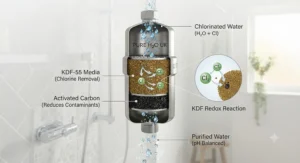
Inside, water passes through a stack of media — KDF-55, calcium sulfite, activated carbon and ceramic beads — designed to knock down chlorine, some trace metals and general odour before infusing the water with vitamin C. In practice, that layered approach matters more than any single ingredient: KDF-55 handles chlorine through a redox reaction, while the carbon mops up what’s left, and neither stage alone would do the whole job.
Who should care? Anyone with eczema-prone or generally reactive skin who wants a “set and forget” upgrade without replacing their whole showerhead. Reviewers consistently report softer-feeling skin and less post-shower tightness within the first couple of weeks, though a smaller cluster of reviews mention a noticeable drop in water pressure — a trade-off worth knowing about before you buy, not after.
Pros:
- ✅ Works with any existing showerhead you already own
- ✅ Layered KDF-55 and carbon filtration targets multiple irritants
- ✅ Filter cartridge is rated to last around six months
Cons:
- ❌ Some users report reduced water pressure after fitting
- ❌ Vitamin C infusion may not suit fragrance-sensitive skin
Expect to pay in the £25-£35 range at the time of research, and given the six-month cartridge life, it’s one of the better value-per-month options on this list — check current price before ordering, as availability and bundle deals shift often.

2. Cobbe 34-Stage Vitamin C Shower Filter — best budget pick for eczema-prone skin
The Cobbe 34-Stage Vitamin C Shower Filter is the classic “throw a lot of stages at the problem” budget filter, and honestly, that’s not necessarily a criticism — it just needs translating. Thirty-four stages sounds dramatic, but it typically means one cartridge with many layered mineral and carbon beads rather than 34 genuinely distinct chemical processes; what matters more is which media are actually present, and here that’s a carbon-and-mineral blend aimed at chlorine and sediment.
For UK households on mains water — which is already treated to Drinking Water Inspectorate standards — this kind of filter functions less as a necessity and more as an extra layer of reassurance for reactive skin. One thing worth flagging honestly: aggregated Amazon reviews for this style of filter are mixed, with some buyers noting it makes the most obvious difference when travelling to areas with heavily treated or poor-quality water, and a more modest, subtler effect on typical UK domestic supply.
It’s best suited to budget-conscious buyers who want to test whether a filter helps their skin at all before committing to a pricier option.
Pros:
- ✅ Genuinely low upfront cost for a multi-stage filter
- ✅ Includes a spare cartridge in most current listings
- ✅ Simple screw-fit installation with no tools required
Cons:
- ❌ Real-world effect on already-compliant UK mains water is modest
- ❌ Some reviewers found the “stage count” marketing overstated
At under £25 at the time of research, this is a sensible low-risk way to test the theory before spending more.
3. Jolie Filtered Showerhead — best premium pick for dermatologist-backed filtration
If budget isn’t the constraint and you want the most independently scrutinised option on this list, the Jolie Filtered Showerhead is it. Unlike the inline attachments above, this replaces your entire showerhead, and its filtration — a proprietary blend of KDF-55 and calcium sulfite — has actually been picked apart by outlets like Forbes Vetted and NBC Select rather than only the brand’s own marketing.
What sets it apart on paper is that testers specifically highlighted something budget filters often sacrifice: water pressure. A common complaint with cheap filtered showerheads is a sad, weak drizzle once the media is packed in; independent testers noted the Jolie Filtered Showerhead kept a strong, even spray, which is exactly the kind of detail a spec sheet alone won’t tell you.
This is the pick for buyers who’ve already tried a budget filter, felt a difference, and want the more polished version — or for anyone gifting a skin-conscious friend or family member something that doesn’t look like a plumbing accessory. One practical catch for a UK audience: it’s built around a US ½-inch NPT thread, so UK buyers should confirm compatibility or budget for a simple BSP adapter before fitting it.
Pros:
- ✅ Independently tested to maintain strong water pressure
- ✅ Filter swap takes minutes with no tools beyond the kit provided
- ✅ Widely regarded as the most rigorously tested option here
Cons:
- ❌ Significantly pricier than every other filter on this list
- ❌ US threading may need an adapter for UK shower fittings
Priced roughly in the £120-£160 range once converted and imported, it’s a genuine investment rather than an impulse buy — worth it if independent testing matters to you, less so if you’re just curious whether filtration helps at all.
4. VOXON 36-Stage Shower Filter — best budget vitamin C boost
The VOXON 36-Stage Shower Filter sits in the same budget bracket as the Cobbe option but leans harder into the vitamin C angle, marketing itself specifically around softening the drying effect of chlorinated water. The mechanism is familiar — a universal ½-inch fitting, layered filtration media, and an ascorbic acid stage designed to neutralise residual chlorine and chloramine.
Vitamin C (ascorbic acid) genuinely does react with chlorine, which is one of the few claims in this category with real chemistry behind it rather than pure marketing spin. What’s less clear from the listing alone is exactly how much ascorbic acid is packed in and how quickly it depletes — something none of the budget brands publish transparently, so treat “removes chlorine” claims from any sub-£20 filter as directionally true rather than lab-verified.
This one suits buyers who specifically associate their irritation with a “swimming pool” smell or taste from their tap water, since that’s the exact scenario ascorbic acid filtration is built to address.
Pros:
- ✅ Ascorbic acid stage has genuine chemistry behind chlorine reduction
- ✅ Fits standard, handheld and rain showerheads without tools
- ✅ Comes with a spare cartridge in most listings
Cons:
- ❌ No independent third-party testing data published
- ❌ Ascorbic acid depletion rate isn’t clearly stated by the brand
At under £20 at the time of research, it’s an easy low-commitment trial for anyone chasing that specific chlorine-smell complaint.
5. EMBATHER 20-Stage Shower Head Filter — best for hard water areas
If your postcode sits in one of the UK’s notoriously hard-water regions — much of the South East, East Anglia and parts of the Midlands — the EMBATHER 20-Stage Shower Head Filter is worth a specific look, because its listing focuses as much on fluoride and mineral sediment as it does on chlorine.
That distinction matters more than it sounds. A softener and a chlorine filter solve different problems: hard water leaves mineral residue and a soap film that can trap bacteria against the skin, while chlorine is a separate chemical irritant altogether, and a filter like this one is aimed at catching the sediment side of that equation rather than fully replacing a proper water softener.
Best suited to households who’ve already noticed limescale on taps and shower glass and suspect that same mineral load is contributing to skin tightness, rather than those whose main complaint is a chemical chlorine smell.
Pros:
- ✅ Specifically targets sediment and mineral residue, not just chlorine
- ✅ High output design avoids the weak-pressure complaint of cheaper units
- ✅ Comes with two cartridges for a longer initial run
Cons:
- ❌ Won’t fully replace a dedicated water softener in very hard water areas
- ❌ Polished finish shows limescale marks faster than matte alternatives
Typically listed under £18, making it one of the cheapest entries here for anyone wanting to address sediment specifically.
6. VeoryFly 36-Stage Upgraded Shower Filter — best high-output flow for families
Families showering back-to-back through a single peak-hour window tend to have one specific complaint about filtered showerheads: pressure drops off a cliff by the third or fourth shower. The VeoryFly 36-Stage Upgraded Shower Filter is pitched directly at that problem, with a “high output” design and two replaceable cartridges included in the box, rather than the single cartridge most budget filters ship with.
The practical upshot of shipping two cartridges upfront is a lower effective cost-per-month across the filter’s first year, since you’re not buying a replacement pack within weeks of installing it — useful in a household running four or five showers a day rather than one.
It’s a solid fit for larger households where at least one person has flagged sensitive or eczema-prone skin, but where the whole family will realistically be using the same shower filter, vitamin C infusion and all.
Pros:
- ✅ Ships with two cartridges, extending time before a repurchase
- ✅ High output design holds up better under frequent daily use
- ✅ Universal fitting works across fixed, rain and handheld heads
Cons:
- ❌ Vitamin C additive may be unnecessary for non-sensitive family members
- ❌ Bulkier housing than some slimmer inline competitors
At £18-£25 for two cartridges’ worth of filtration, it’s arguably the best pound-per-shower value on this list for busy households.
7. Culligan Wall-Mounted Filtered Shower Head — best fragrance-free option for psoriasis-prone skin
Culligan has been in water treatment for the best part of a century, and it shows in how the Culligan Wall-Mounted Filtered Shower Head is built — this is deliberately the plainest filter on this list, with no vitamin C infusion, no fragrance and no coloured beads, just KDF media aimed squarely at chlorine and scale reduction.
That restraint is precisely the point for reactive or psoriasis-prone skin. Dermatology guidance on managing sensitive skin conditions consistently flags added fragrance and unnecessary actives as potential secondary irritants, so a filter that does one job — chlorine and scale reduction — without extras is often the safer starting point rather than the more exciting one.
Best suited to anyone who’s tried a vitamin C-infused filter and found it made no difference, or whose dermatologist has specifically advised avoiding added fragrance in every product that touches inflamed skin.
Pros:
- ✅ No added fragrance or vitamin beads to act as a secondary irritant
- ✅ Backed by an established, long-standing water-treatment brand
- ✅ Wall-mounted design keeps the filter housing out of the direct spray
Cons:
- ❌ Higher price than most budget inline alternatives
- ❌ Plainer feature set may feel underwhelming next to flashier listings
Expect a price in the £35-£50 range, which reflects brand reputation and build quality more than any dramatic difference in filtration chemistry.
How to Set Up and Maintain Your Shower Filter
Installing most of these filters takes less time than the shower itself. Unscrew your existing showerhead (or, for inline units like the AquaBliss High Output Revitalizing Shower Filter (SF100), leave it attached), wrap the threaded connector in plumber’s tape if it isn’t pre-fitted, then hand-tighten the filter into place. Never use tools to over-tighten — cracked plastic housings are one of the most common (and entirely avoidable) reasons a brand-new filter fails within its first month.
Run the shower on cold for thirty seconds before your first proper wash. This flushes out loose carbon dust that’s completely normal in a fresh cartridge but can otherwise leave a gritty residue on skin. From there, most cartridges are rated for two to six months depending on your household’s usage and local water hardness — harder water and heavier daily use both shorten that window, so treat the manufacturer’s estimate as a ceiling, not a guarantee.
Set a phone reminder for the shorter end of whatever range your filter specifies. A cartridge that’s quietly stopped working is worse than no filter at all, because it gives a false sense of protection while doing nothing.
Who Actually Needs a Shower Filter? Real-World Scenarios
The new parent with a baby’s first eczema patches. If a health visitor or GP has flagged early eczema and advised avoiding harsh water exposure, an unscented option like the Culligan Wall-Mounted Filtered Shower Head or the fragrance-conscious AquaBliss High Output Revitalizing Shower Filter (SF100) removes one variable from an already stressful early-days routine, without adding new scented actives to test.
The renter in a hard water postcode. Someone who can’t install a whole-house softener but has noticed limescale and post-shower tightness is a natural fit for the EMBATHER 20-Stage Shower Head Filter, which is inexpensive, fully removable at the end of a tenancy, and specifically aimed at sediment rather than requiring plumbing changes.
The skincare-conscious professional who’s already tried everything else. For someone who’s cycled through cleansers, moisturisers and prescription creams with limited relief and wants the most independently tested option on the market, the Jolie Filtered Showerhead is the logical next step — not a magic fix, but a genuinely scrutinised product rather than an untested budget gamble.
Common Shower-Water Skin Problems (And How to Fix Them)
Problem: Skin feels tight and dry within minutes of stepping out. This is the classic chlorine signature — it strips the skin’s natural lipid barrier. Solution: a chlorine-focused filter such as the VOXON 36-Stage Shower Filter, combined with lukewarm (not hot) water and moisturiser applied within three minutes of towelling off, while skin is still slightly damp.
Problem: Visible limescale, plus skin that feels coated rather than clean. That’s a hard water and mineral sediment issue rather than a chlorine one. Solution: the EMBATHER 20-Stage Shower Head Filter targets sediment specifically, and rinsing thoroughly for an extra ten seconds helps clear residual soap film that hard water leaves behind.
Problem: Flare-ups that seem to track hot showers specifically. Heat opens pores and accelerates moisture loss regardless of filtration. Solution: cap shower temperature and length even alongside a filter — filtration reduces chemical irritants, but it doesn’t cancel out the drying effect of a fifteen-minute hot shower.
Problem: A filter installed but no noticeable change after a month. Check the cartridge age first; a spent cartridge behaves like no filter at all. If it’s fresh and there’s still no change, the trigger may not be water-related — worth raising with a GP or dermatologist rather than cycling through more filters.

How to Choose a Shower Filter for Sensitive Skin
- Identify your actual trigger first. A chlorine smell points toward carbon or vitamin C filtration; visible limescale points toward sediment reduction — buying the wrong type wastes money and delays relief.
- Check for fragrance and additive content. If your skin reacts to scented products generally, prioritise unscented options like the Culligan Wall-Mounted Filtered Shower Head over vitamin C-infused alternatives.
- Match cartridge life to household size. A single-person household can stretch a six-month cartridge; a family of four showering daily will burn through it far faster.
- Confirm your shower fitting before buying. Most filters use a universal ½-inch BSP thread common in the UK, but imported options like the Jolie Filtered Showerhead may need an adapter.
- Weigh independent testing against marketing claims. “36-stage” numbers are far less meaningful than knowing whether KDF-55, calcium sulfite or activated carbon is actually present.
- Set a realistic budget band. Budget filters (under £25) are reasonable first tests; premium options only make sense once you know filtration genuinely helps your skin.
- Plan for ongoing replacement cost, not just the upfront price. A cheap filter with expensive, hard-to-find replacement cartridges can cost more over a year than a pricier all-in-one system.
Shower Filter for Eczema: What the Science Actually Says
It’s worth being precise here rather than sweeping, because the evidence on eczema and shower water is genuinely mixed depending on which irritant you’re looking at. According to the NHS, atopic eczema is a common skin condition that causes itchy skin and cannot be cured, though treatment can help manage symptoms — a shower filter sits firmly in the “manage” category, not the “cure” one, and no honest source should suggest otherwise.
On the specific question of hard water, a controlled study examining skin washed with surfactant in water of varying hardness found that hard water significantly increased soap residue on skin, which in turn increased water loss through the skin and caused irritation — an effect that was notably more pronounced in participants carrying a specific genetic marker linked to atopic dermatitis. Interestingly, that same research did not find a clear standalone effect from chlorine concentration alone, which is a useful reality check against filter marketing that treats chlorine as the sole villain.
Meanwhile, on the regulatory side, UK water companies typically keep chlorine at 0.5 mg per litre or less in tap water, which is well within safety limits set to protect public health. That’s reassuring from a safety standpoint, but it doesn’t rule out chlorine as a contributing skin irritant at those still-present low levels for people whose skin barrier is already compromised — safety and comfort are separate standards, and a filter addresses the second, not the first.
Best Shower Head for Psoriasis: What to Look For
Psoriasis behaves differently to eczema, and it’s worth not conflating the two even though shower filters get marketed at both conditions almost interchangeably. Psoriasis involves faster skin cell turnover and thicker plaques rather than the barrier-function issue central to eczema, so the priority for a psoriasis-prone shower routine leans more toward avoiding additional irritants than aggressively filtering every trace mineral.
That’s exactly why an unscented, additive-free option like the Culligan Wall-Mounted Filtered Shower Head tends to suit psoriasis-prone skin better than the vitamin C-boosted budget filters on this list — fewer added ingredients means fewer chances of a secondary reaction on already-inflamed plaques. It’s also worth noting that some topical psoriasis treatments, such as coal tar or dithranol preparations, can stain a shower or bath, so anyone using those alongside a new filter should clean the unit promptly rather than letting residue sit against the filter housing.
None of this replaces proper dermatological care. If you’re managing psoriasis, treat a shower filter as a supporting habit around your existing treatment plan rather than a substitute for it.
Shower Filter vs Traditional Shower Head: Chlorine & Skin Irritation Compared
| Standard Shower Head | Filtered Shower Head | |
|---|---|---|
| Chlorine exposure | Full mains-level exposure | Reduced via carbon/KDF media |
| Sediment/mineral residue | Passes through untouched | Partially reduced by sediment-focused models |
| Fragrance/additives | None (unless separately added) | Varies — some infuse vitamin C, others stay plain |
| Upfront cost | Baseline showerhead price | Adds £15-£160 depending on model |
| Ongoing cost | None | Cartridge replacement every 2-6 months |
The core trade-off here isn’t complicated: a filtered option adds cost and a small maintenance habit in exchange for meaningfully reduced chlorine exposure at the point it touches your skin. Where it gets more nuanced is additives — a plain filter like the Culligan Wall-Mounted Filtered Shower Head changes almost nothing except chlorine and scale levels, while vitamin C-infused budget options like the VOXON 36-Stage Shower Filter are doing an extra chemical job that suits some skin types and irritates others.
Common Mistakes When Buying a Shower Filter for Sensitive Skin
The single most common mistake is buying based on “stage count” alone. A 36-stage filter isn’t automatically better than a 12-stage one — what matters is which specific media are present, not how many marketing-friendly layers a brand can list. Ask what’s actually inside before comparing numbers across listings.
The second mistake is ignoring cartridge replacement cost until after purchase. A cheap filter with expensive or hard-to-source refills can quietly cost more over a year than a pricier all-in-one option — always check that replacement cartridges are readily available before committing to a brand.
The third, and possibly the most damaging, mistake is expecting a filter to replace medical treatment. A shower filter can reduce one environmental irritant among many; it is not a treatment for a diagnosed skin condition, and anyone with persistent or worsening symptoms should still be working with a GP or dermatologist rather than relying on filtration alone.
Long-Term Cost & Maintenance: Is a Shower Filter Worth It?
Running the numbers honestly: a budget filter like the Cobbe 34-Stage Vitamin C Shower Filter at under £25, replaced roughly every three months, works out to under £2 a month across a year including the initial unit. A premium option like the Jolie Filtered Showerhead at £120-£160 upfront, with quarterly replacement cartridges, lands closer to £10-£15 a month once you factor in refills — a genuinely different cost tier, not just a pricier one-off purchase.
Where the maths tips in favour of spending more is durability and pressure retention over time; several budget units develop reduced flow as sediment builds in cheaper housings, which can mean an earlier-than-expected full replacement rather than just a cartridge swap. Reviewers of higher-end filters consistently report that pressure and build quality hold up better across repeated cartridge changes, which is where some of that extra upfront cost quietly earns itself back.
Features That Actually Matter (And Those That Don’t)
Matters: the specific filtration media listed (KDF-55, calcium sulfite, activated carbon), cartridge replacement frequency and cost, and whether the fitting matches UK shower thread standards. Doesn’t matter nearly as much: eye-catching “stage counts” with no breakdown of what those stages contain, and coloured filter beads that look dramatic but add little beyond aesthetics.
Matters: independent testing or NSF-style certification claims that can be checked against a manufacturer’s own documentation. Doesn’t matter: vague “clinically proven” language with no study referenced, which several budget brands lean on without providing anything a buyer can actually verify.

FAQ
❓ Do shower filters really help with eczema?
❓ How often should I change my shower filter cartridge?
❓ Will a shower filter soften hard water?
❓ Can I use a shower filter with a psoriasis treatment cream?
❓ Do shower filters fit all UK shower heads?
Conclusion
There’s no single “best” shower filter for sensitive skin — there’s a best one for your specific trigger, your water type and your budget. If chlorine smell is the obvious culprit, something like the VOXON 36-Stage Shower Filter or the well-reviewed AquaBliss High Output Revitalizing Shower Filter (SF100) is a sensible, low-risk starting point. If limescale and hard water are the visible issue, the EMBATHER 20-Stage Shower Head Filter is built for exactly that. And if you’ve already tried the basics and want the most independently scrutinised option available, the Jolie Filtered Showerhead earns its higher price tag through genuine third-party testing rather than marketing alone.
What all seven share is a fairly simple promise: less of what irritates reaching your skin, and a bit more control over one variable in a routine that often feels frustratingly out of your hands. None of them replace proper dermatological care for a diagnosed condition — but for the daily, cumulative low-level irritation that chlorinated water can cause, filtration is a genuinely reasonable, evidence-backed place to start.
Recommended for You
- 7 Best Shower Head Filters for Hair Loss in 2026
- Shower Filter For Hard Water: 7 Best UK Picks (2026)
- Filter Shower Head UK: 7 Best Picks Tested for 2026
Disclaimer: This article contains affiliate links. As an Amazon Associate, I earn from qualifying purchases. If you purchase products through these links, we may earn a small commission at no additional cost to you.
✨ Found this helpful? Share it with your friends! 💬🤗
