
In This Article
A 10.5kW electric shower is a mains-fed unit that heats cold water on demand using a 10.5-kilowatt element, drawing roughly 44 amps at 240V. It sits at the powerful end of the UK range. It delivers more hot water per minute than 8.5kW or 9.5kW models, but it needs a dedicated, correctly rated circuit.
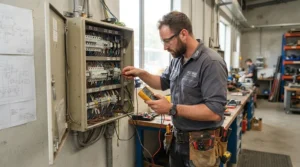
Here’s what the shop shelf won’t tell you: kilowatts don’t make water hotter. They decide how much cold water the element can drag up to temperature every minute. In a British January, with mains water arriving at around 5°C, that gap separates a proper soak from a lukewarm drizzle. A 10.5kW electric shower gives you that headroom.
The headroom isn’t free, though. At the Ofgem price cap rate of 26.32p per kWh for 1 October to 31 December 2026, a unit running flat out costs roughly 4.6p a minute. The good news is that heating a litre of water costs the same whatever the shower’s rating. A bigger element only costs more if you use more water.
This guide compares seven real 10.5kW electric shower models and works out what the 9.5kW vs 10.5kW electric shower decision means in litres and pounds. It also covers the wiring your electrician will ask about. One honest note: this is desk research built on published specs and aggregated buyer commentary, not hands-on testing.
10.5kW Electric Shower Quick Comparison
| Product | Standout Feature | Price Range (at time of research) | Best For |
|---|---|---|---|
| Gainsborough Slim Duo | Three power settings | £120-£140 | Gainsborough Slim Duo suits tight budgets and guest ensuites |
| Triton T80 Easi-Fit+ | Swing-fit and swivel-fit connections | Varies by retailer | Triton T80 Easi-Fit+ suits like-for-like swaps |
| Aqualisa Quartz | Single-dial control | Around £200 | Aqualisa Quartz suits simplicity-first households |
| Bristan Bliss 3 | Touch controls, digital display | From around £140 | Bristan Bliss 3 suits tech-curious buyers |
| Triton T100xr | Cold/Economy/High buttons | Check current price | Triton T100xr suits owners of older Triton XR units |
| Aqualisa eMOTION | Stainless hose, eight multi-fit options | £310-£330 | Aqualisa eMOTION suits design-led upgrades |
| Triton T80 Easi-Fit+ UNIQ | Thermostatic, 200mm rainfall head | Premium bracket | Triton T80 Easi-Fit+ UNIQ suits stable winter temperatures |
Looking at the table, the Gainsborough Slim Duo is the clear entry point for a 10.5kW electric shower, while the Aqualisa eMOTION costs more than twice as much for a design-led finish. If temperature stability is your priority, the Triton T80 Easi-Fit+ UNIQ is the only thermostatic option here. Prices shift constantly, so treat these as ballparks and check current price before buying.
💬 Just one click — help others make better buying decisions too!😊
Top 7 10.5kW Electric Shower Picks: Expert Analysis
1. Gainsborough Slim Duo — three power settings on a budget
The headline is flexibility. The Gainsborough Slim Duo pairs a full 10.5kW element with three power settings, so you aren’t stuck running at full tilt all year.
The listing shows push-button start with flow control, a rotary temperature dial, a stainless steel hose and eight multi-fit options. The quoted flow range runs from about 1.7 litres a minute at 0.9 bar to roughly 11 litres at the top end. In plain English, it will work in marginal-pressure homes, but you’ll only see the headline flow when your supply is healthy.
On paper this is the sensible ticket into 10.5kW territory. Winter households get the element they need, and in summer you can drop a power setting rather than cranking the dial towards cold. The listing doesn’t claim thermostatic control, so don’t expect perfect temperature when the kitchen tap runs.
I couldn’t verify a meaningful pool of genuine owner reviews for this exact 10.5kW variant, so I won’t characterise buyer sentiment. Check recent feedback before committing.
Pros:
- ✅ Three power settings add seasonal flexibility
- ✅ Eight multi-fit options ease replacement
- ✅ Stainless steel hose resists kinking
Cons:
- ❌ Only a three-spray handset, fewer than rivals
- ❌ Hard to verify owner-review evidence
Listings sat in the £120-£140 range at the time of research. As a way into 10.5kW, it is the best value of these seven.
2. Triton T80 Easi-Fit+ — easiest like-for-like swap
Swap day is where the Triton T80 Easi-Fit+ earns its name. Its swing-fit cable and swivel-fit water connections let you connect from either side.
Triton’s data gives a flow window of about 4.1 to 6.8 litres a minute. That matches the physics of heating 5°C water versus 20°C water to 42°C. The unit is also regulated to a maximum of 8 litres a minute at 3 bar or above, a built-in brake that stops strong pressure overwhelming the element. The kit includes an adjustable top bracket, a 1.25m anti-twist chrome hose and a 110mm five-spray head.
For anyone replacing an older Triton or a generic white box, the generous footprint matters more than any spray pattern. It helps cover old fixing holes, which can save a tiling headache. The flow cap means you won’t chase headline numbers, but it also means you can’t outrun the heater by accident. Think workhorse, not showpiece.
Verifiable owner-review data was thin for this exact variant, so check current buyer feedback.
Pros:
- ✅ Left or right cable and water entry
- ✅ Five spray patterns on a 110mm head
- ✅ Flow regulation protects the heating element
Cons:
- ❌ Flow capped at 8 litres a minute above 3 bar
- ❌ Limited verifiable review evidence
Pricing varies by seller, so check current price. For a straightforward replacement, the value is strong.
3. Aqualisa Quartz — one-dial simplicity
The Aqualisa Quartz (model QZE10501) is built for households that argue about which of two dials to touch. One rotary control manages temperature, with push-button start and stop.
Published specs show operation from 0.9 to 10 bar, a maximum water temperature of 50°C, a five-spray head and a two-year guarantee. Over-temperature protection is built in. A delayed shutdown flushes residual hot water out of the unit, which helps limit limescale. Aqualisa’s electrical notes call for a 230-240V supply and a 45A or 50A MCB.
The analysis is straightforward. This is an uncomplicated unit with one power level, so there’s no economy setting to step down to in summer. You manage everything with a single dial. That suits families and landlords, but fiddly tweakers may miss separate power control.
I couldn’t verify a robust pool of owner reviews for the 10.5kW model specifically, so I’m not summarising sentiment here.
Pros:
- ✅ Single dial keeps operation foolproof
- ✅ Phased shutdown flushes out hot water
- ✅ Works from a low 0.9 bar
Cons:
- ❌ One power level, no summer economy setting
- ❌ Manual control, not thermostatic
Around £200 at the time of research. That is fair value for a simple, recognisable brand.
4. Bristan Bliss 3 — touch controls with a digital display
The Bristan Bliss 3 (BL3105 W) swaps knobs for a touch panel and a digital temperature readout. It also adds a warm-up mode, so you can see what you’re getting before stepping in.
It offers three power settings, works from 0.7 to 10 bar, and carries an A energy rating. The published flow at 10.5kW is 5.6 litres a minute under European Water Label conditions (15°C in, 42°C out). That sits comfortably above the 5.1 litres quoted for 9.5kW on the same basis. Safety extras include a thermal cut-out and on-screen low-pressure warnings.
Digital feedback is more useful than it sounds, because you can repeat a temperature you liked rather than guessing at dial positions. The trade-off is that you’re adding electronics to a wet room, so it’s worth buying from a seller with a clear guarantee.
Reviewers on the listings I found, a small sample, mention straightforward fitting, strong pressure and a gentle soft start and shutdown. One noted that fixing holes didn’t line up with an old Aqualisa, so budget for drilling.
Pros:
- ✅ Digital temperature display aids repeatability
- ✅ Five directional inlet options
- ✅ Low-pressure warnings on screen
Cons:
- ❌ Fixing holes may not match older units
- ❌ Only a three-mode handset
From around £140 depending on finish and retailer, check current price. Good value for a feature-rich option.
5. Triton T100xr — three power buttons, slimline looks
The Triton T100xr offers Cold, Economy and High power buttons, which makes it a good fit for seasonal living. Its slimline body has a brushed chrome fascia.
Specs include a stop button with phased shutdown, a low-pressure indicator, double temperature protection and a five-spray rub-clean head. Triton quotes a minimum of 1 bar for 8 litres a minute and 1.5 bar for 11 litres a minute on the 10.5kW model. Reading that closely, full performance needs a healthy supply, so measure before you buy.
It is billed as the successor to the T70xr and T80xr and shares their backplate, so it suits anyone swapping out an older Triton. Availability is patchy, though. One major retailer lists the 10.5kW as discontinued, while others still stock it.
Buyer feedback is a small sample, but telling. One reviewer replaced a decade-old unit like-for-like. Another noted that in summer, high power on the 10.5kW model let them shower comfortably on the fully cold setting. That is a useful reminder that the Economy button earns its keep outside winter.
Pros:
- ✅ Three power buttons for seasonal control
- ✅ Same backplate as T70xr and T80xr
- ✅ Double temperature protection
Cons:
- ❌ Patchy stock across retailers
- ❌ Needs 1.5 bar for full flow
Check current price and availability. It is a strong value pick if you can find stock.

6. Aqualisa eMOTION — design-led retrofit
The Aqualisa eMOTION is the style pick, with a contoured polished chrome trim and three finishes: Arctic White, Arctic Grey and Midnight Black.
Its retrofit credentials are solid: eight multi-fit connection options and cable entry on either side, top, bottom or rear. A stainless steel hose and a push-button height slider add durability, and the maximum operating pressure is 10 bar. Wickes notes that the 10.5kW unit needs a dedicated electrical connection, which echoes everything in the wiring section below.
The analytical take is simple. This is a premium finish on a familiar-feeling electric shower. If bathroom aesthetics matter and your old unit’s fixing holes are a nuisance, the multi-fit design reduces tiling drama. If you only want hot water, cheaper models here deliver the same kilowatts.
I couldn’t verify enough owner reviews to characterise sentiment, and the listing I saw didn’t publish detailed flow figures.
Pros:
- ✅ Eight multi-fit options ease retrofits
- ✅ Three colour finishes to match decor
- ✅ Stainless steel hose resists wear
Cons:
- ❌ Costs more than rivals with equal power
- ❌ No flow figures on the listing seen
In the £310-£330 range at the time of research. You are paying for looks, so the value verdict is fair rather than outstanding.
7. Triton T80 Easi-Fit+ UNIQ — thermostatic rainfall for winter
The Triton T80 Easi-Fit+ UNIQ is the only thermostatic 10.5kW electric shower in this lineup. It pairs precise temperature control with a 200mm rainfall head.
It offers eight water and six cable entry points, plus Swing-Fit connections for left or right cable entry. Installation works on a flat wall or in a corner, and the finish is white with polished chrome. Thermostatic control matters because it is designed to hold temperature steady when someone runs a tap elsewhere in the house.
Here’s what to weigh: a rainfall head spreads the same litres across a wider area, so it feels softer than a focused handset. That suits a long winter soak, but it won’t feel like a power jet. The thermostat does its best work when the incoming supply is stable, so check your pressure first.
I couldn’t find enough genuine owner reviews to summarise, so verify recent feedback.
Pros:
- ✅ Thermostatic control stabilises temperature
- ✅ Large 200mm rainfall head
- ✅ Corner or flat-wall installation
Cons:
- ❌ Typically costs more than standard T80 units
- ❌ Rainfall spray feels gentler
Premium bracket, so check current price. The value is good if temperature stability is worth paying for.
Setup, First-Use Tips and a 30-Day Maintenance Plan
A 10.5kW electric shower punishes sloppy installation, so a little discipline pays off. Start by having your electrician fit the circuit, isolator and MCB. Then flush the cold supply pipework before connecting, because debris in a new run clogs the inlet filter fast.
On first use, run the shower on its lowest power and flow for a minute to purge air. Then step up gradually. It’s tempting to blast High immediately, but in cool-water months you’ll quickly learn the sweet spot between flow and temperature.
Here’s a simple schedule:
- Weekly: wipe the handset and rub the nozzles clean.
- Monthly: check hose connections and the wall fixings for weeping.
- Every three to six months: clean the inlet filter, especially in hard water areas.
The most common mistakes in the first 30 days are leaving the hose draped in the bath, running full power in summer and ignoring small drips under the unit. City Plumbing’s guide suggests a quality electric shower lasts roughly seven to ten years, and limescale in hard water areas can shorten that, so these habits genuinely pay back.
Real-World Scenarios: Which 10.5kW Electric Shower Fits Your Home?
The family of four, upstairs bathroom. Four daily showers, cold winters and an electrician already booked. Budget is flexible. Here, the Triton T80 Easi-Fit+ UNIQ or the Bristan Bliss 3 makes sense: thermostatic stability or repeatable digital settings help when queues form.
The like-for-like swapper. A homeowner replacing an old Triton or generic unit, daily use, modest budget. The Triton T80 Easi-Fit+ and Triton T100xr are built for this, because their entry points and backplates ease the swap. Just confirm your existing cable is up to the job.
The guest ensuite. Occasional use, small room, price-sensitive. The Gainsborough Slim Duo gives you 10.5kW capability with a power-setting escape hatch for summer, without a premium finish.
The design-first bathroom refit. Fresh tiles, matched finishes, flexible budget. The Aqualisa eMOTION earns its premium here, while the Aqualisa Quartz is the quieter choice if all you want is one dial and a trusted name.
9.5kW vs 10.5kW Electric Shower: What the Extra Kilowatt Really Buys You
Strip away the marketing and the 9.5kW vs 10.5kW electric shower question is arithmetic. One extra kilowatt means roughly 11% more hot water per minute at the same temperature. The table below uses the standard heating formula and matches published manufacturer figures.
| 8.5kW | 9.5kW | 10.5kW | |
|---|---|---|---|
| Current at 240V | ~35A | ~40A | ~44A |
| Flow to 42°C from 5°C (litres/min) | ~3.3 | ~3.7 | ~4.1 |
| Flow to 42°C from 15°C (litres/min) | ~4.5 | ~5.1 | ~5.6 |
| Cost per minute at full power* | ~3.7p | ~4.2p | ~4.6p |
| Best for | Guest rooms, summer use | Most households | Winter power, big families |
*At 26.32p per kWh.
Moving from 9.5kW to 10.5kW adds about 0.4 litres a minute in winter. That’s noticeable, but not transformative. DIY forum threads show owners who rarely turn the dial past six or seven and question whether they needed the heavier wiring. City Plumbing describes 9.5kW as the most popular UK standard and 10.5kW as the choice for a true power-shower feel.
So who should upgrade? If your cable and MCB are already 10mm² and 45A, the extra cost is small. If you’d need rewiring, 9.5kW often wins on total cost.
High Flow Rate: What the Numbers Mean in Your Bathroom
A high flow rate sounds like pure upside, but it is capped by physics and by your plumbing. Flow is measured in litres per minute. Your shower can only deliver as much as your supply provides, and as much as the element can heat.
Triton’s 10.5kW data shows about 4.1 litres a minute with 5°C incoming water and about 6.8 litres at 20°C. Bristan quotes 5.6 litres at 15°C. Triton also regulates its T80 Easi-Fit+ to a maximum of 8 litres a minute at 3 bar or above. Crucially, the Triton T100xr needs 1.5 bar to hit its quoted 11 litres.
Before buying, try a quick bucket test. Run your cold kitchen tap into a 10-litre bucket. If it fills in under about 75 seconds, you have roughly 8 litres a minute or better, which matches the minimum most of these units quote. Slower than that and you may see the low-pressure cut-out. A tap can restrict flow, so treat it as a rough proxy rather than gospel.
The Which? independent testing of electric showers includes water flow rate as a scored measure, and it notes that higher wattage generally means more hot water. The models in the pages I viewed leaned towards 8.5kW, 9.5kW and 10.8kW, so a verdict on these exact 10.5kW units may not exist.
Winter Water Temperature: Why 10.5kW Earns Its Keep in January
Winter water temperature is the 10.5kW electric shower’s best argument. The element must heat water from around 5°C up to about 42°C, a rise of 37°C. In summer the same rise might be only 22°C.
| Incoming water | 8.5kW | 9.5kW | 10.5kW |
|---|---|---|---|
| 5°C (deep winter) | ~3.3 l/min | ~3.7 l/min | ~4.1 l/min |
| 20°C (summer) | ~5.5 l/min | ~6.2 l/min | ~6.8 l/min |
| Best for | Mild, short showers | Everyday balance | Cold-supply homes |
Look at the gap. A 10.5kW unit in winter delivers about what an 8.5kW unit manages in a warm spell. That means your winter shower holds its pressure feel instead of dribbling. The flip side is summer: with a 10.5kW element you’ll often drop to Economy or turn the flow up to avoid overheating, which is why units with power settings, like the Gainsborough Slim Duo, are handy.
Some makers build in seasonal compensation. Mira’s Opti-flo adjusts flow through the year, though that’s on its 10.8kW Sport Max rather than on the 10.5kW units here. With a Triton T80 Easi-Fit+ UNIQ, the thermostat helps hold the temperature you set even as the mains temperature drifts. Remember too that standing under a trickle isn’t a failure of the shower. It is physics doing its job on very cold water.
Electrical Circuit Requirements for a 10.5kW Electric Shower
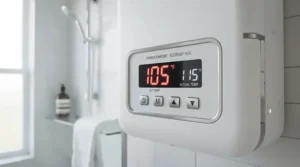
Electrical circuit requirements are where a 10.5kW electric shower stops being a simple swap. At 240V the unit draws roughly 44 amps, which is more than most ring-main sockets handle by a wide margin. It needs its own dedicated circuit, run in unbroken cable from the consumer unit.
Typical practice looks like this, though your electrician will confirm for your house:
- Cable: City Plumbing notes that 8.5kW units usually run on 6mm² cable, while 10.5kW models often require 10mm². Long runs, or cable buried in insulation, may call for more.
- Protection: Aqualisa’s own spec for its 10.5kW Quartz calls for a 45A or 50A MCB, and Mira lists a 45A supply for its 10.8kW Sport Max.
- RCD and isolator: the circuit should have RCD protection and a suitable isolation switch, as electricians’ forums consistently advise.
- Consumer unit capacity: a 10.5kW load is big, so your installer should check your overall maximum demand.
Regulation matters too. In England, Approved Document P covers electrical safety in dwellings and explains when work must be notified to building control. City Plumbing notes that most bathroom electrical work is notifiable. Scotland, Wales and Northern Ireland have their own rules, so check locally. Ultimately, use a suitably competent, registered electrician and ask them for the certificate.

Electric Shower for Power Boost: Features That Add Real Punch
If you’re shopping for an electric shower for power boost, separate the marketing from the mechanics. Real power comes from three places: element size, flow and head design.
Element size. More kilowatts is the only way to genuinely raise hot-water output. That’s the case for a 10.5kW electric shower.
Air infusion. Mira’s Sport Max with Airboost is the best-known example. It is a 10.8kW model, so slightly above this guide’s brief. Mira states its Airboost increases flow by up to 30% without using more water by infusing air. It changes how the shower feels, not the heating limit, and its supply rating is 45A.
Multi-head setups. The Triton T80 Easi-Fit+ DuElec adds a diverter between a handset and fixed head, which spreads the same power across more surface.
Power selectors. The Triton T100xr and Gainsborough Slim Duo let you choose a lower setting, which is the flip side of boost: control.
The takeaway is to prioritise kilowatts and healthy flow first, then treat spray tricks as seasoning.
How to Choose a 10.5kW Electric Shower
- Check your electrics first. Confirm cable size, MCB rating and consumer unit capacity before falling for a finish. A rewire can cost more than the shower.
- Test your water supply. Do a bucket test and check your minimum pressure against the shower’s published figure, such as 0.7 bar for the Bristan Bliss 3 or 0.9 bar for the Aqualisa Quartz.
- Decide between manual and thermostatic. Thermostatic units like the Triton T80 Easi-Fit+ UNIQ hold temperature better when other taps run, but they cost more.
- Match the footprint. If you’re replacing a unit, multi-fit and generous backplates, as on the Aqualisa eMOTION or Triton T80 Easi-Fit+, save tiling headaches.
- Look for power settings. Economy or Cold modes help in summer, as on the Triton T100xr.
- Budget for the whole job. Add electrician fees, isolator and any cable upgrade to the sticker price.
Common Mistakes When Buying a 10.5kW Electric Shower
The first mistake is assuming 10.5kW means hotter water. It doesn’t. It means more water heated per minute, so only a healthy supply lets you feel the difference.
Second, many buyers ignore the cable. Dropping a 10.5kW unit onto an old 6mm² run is a safety risk, not a shortcut. Third, buyers overlook minimum pressure. If your supply is marginal, a low-pressure indicator or cut-out will make the shower feel faulty.
Fourth, shoppers forget fixing holes. As one Bristan reviewer found, a new unit may not line up with the old, so choose a multi-fit model or budget for tile repairs. Fifth, people expect a thermostatic shower to cure weak pressure. It stabilises temperature, but it can’t create flow.
Finally, hard water gets forgotten. Limescale shortens life, so choose rub-clean nozzles, phased shutdown and a descaling routine.
Long-Term Cost and Maintenance of a 10.5kW Electric Shower
The running cost of a 10.5kW electric shower is more modest than its wiring suggests. At the October to December 2026 cap of 26.32p per kWh, full-power running costs break down as follows.
| Shower length | 9.5kW | 10.5kW | Best for |
|---|---|---|---|
| 5 minutes | ~21p | ~23p | Quick rinses |
| 10 minutes | ~42p | ~46p | Typical daily shower |
| 15 minutes | ~62p | ~69p | Long winter soaks |
A daily 10-minute shower at full power adds up to roughly £14 a month for 10.5kW versus £12.50 for 9.5kW. Those are worst-case figures, because the unit doesn’t always draw maximum power.
The key insight is that energy per litre is fixed. A 10.5kW shower costs more only if you use more water or run hotter. Add maintenance, such as filter cleaning, descaling and eventual replacement after the seven to ten years City Plumbing suggests, and the true cost is mostly electricity plus an installation you only pay once.

FAQ
❓ Can I use a 10.5kW electric shower with a combi boiler?
❓ How long does a 10.5kW electric shower last?
❓ Is a 10.5kW electric shower better than a power shower?
❓ Will a 10.5kW electric shower work in a flat with low water pressure?
❓ Why does my 10.5kW electric shower go cold?
Conclusion
Choosing a 10.5kW electric shower is really a decision about your house, not just the product. If your cable, MCB and water supply are ready, you gain meaningful winter performance: about 11% more hot water than a 9.5kW unit and roughly 24% more than an 8.5kW one at the same temperature. If they aren’t, 9.5kW may deliver better value overall.
For most buyers, the Gainsborough Slim Duo is the budget route in, the Triton T80 Easi-Fit+ is the easiest swap, and the Aqualisa Quartz is the simple one-dial option. The Bristan Bliss 3 adds digital control. The Triton T100xr suits owners of older XR units, if you can find stock. The Aqualisa eMOTION brings the design polish. And the Triton T80 Easi-Fit+ UNIQ is the thermostatic pick for winter water temperature.
Whichever you choose, book a competent electrician, confirm your electrical circuit requirements and measure your flow before you buy. Do that, and January showers get a lot more civilised.
✨ Ready to Upgrade Your Winter Showers?
🚿 Compare the picks above, check current pricing and availability, and choose the 10.5kW electric shower that fits your home, your wiring and your budget. Your warmest January shower is one click away!
Recommended for You
- 9.5kW Electric Shower: 7 Powerful Picks For UK Homes (2026)
- 8.5kW Electric Shower: 7 Best Picks For UK Homes (2026)
- Thermostatic vs Manual Shower Valve: 7 Best Picks For UK Homes (2026)
Disclaimer: This article contains affiliate links. As an Amazon Associate, I earn from qualifying purchases. If you purchase products through these links, we may earn a small commission at no additional cost to you.
✨ Found this helpful? Share it with your friends! 💬🤗
