In This Article
An electric shower for combi boiler homes is a self-heating unit that takes cold water straight from the mains and warms it with its own element, so it runs independently of your boiler. It needs its own electrical circuit and decent mains pressure, but it never touches your gas-fired hot water. Choose the right electric shower for combi boiler setups and you get an instant, dependable shower that doesn’t care what the boiler is doing.
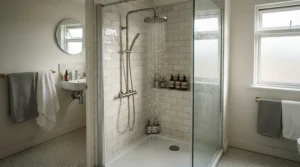
Here’s the quirk that catches people out. A combi has no hot water cylinder, so the usual shortcuts vanish. Pumped power showers are off the table. Mixer showers lean on how much hot water the boiler can deliver at once. And the moment someone opens the kitchen tap, your temperature wobbles. An electric unit sidesteps the lot. Which? points out that electric showers run on cold mains water, so your hot water system doesn’t affect them. That independence is the whole appeal.
It isn’t a free lunch. Electric showers deliver a gentler flow than a well-fed mixer, they put a serious load on your consumer unit, and cheaper models can struggle in winter when the incoming water is icy. That’s why this guide relies on spec analysis rather than hype. I haven’t showered in any of these units, so you won’t find invented anecdotes. You’ll find real specifications, published test findings and plain reasoning.
Inside: seven carefully chosen models, a straight-talking guide to combi boiler compatibility and mains pressure, advice on choosing an electric shower for low pressure, a sober look at the digital electric shower trend, and the case for backup hot water as a reason to buy. All prices are ranges only, so check the current price before you commit.
Quick Comparison: Electric Shower for Combi Boiler at a Glance
Here’s the shortlist at a glance. Minimum pressure figures come from manufacturer and retailer specifications, so confirm them on the product page before buying.
| Product | Power | Min. pressure | Best For |
|---|---|---|---|
| Triton T80Z Fast-Fit | 7.5kW–10.5kW options | 1 bar (about 8 L/min flow) | Budget replacements |
| Redring Glow | 9.5kW (10.5kW also sold) | 1 bar | Long warranty on a budget |
| Mira Sport Max Airboost | 9kW or 10.8kW | 0.7 bar (9kW) | Modest mains pressure |
| Aqualisa Quartz | 8.5kW, 9.5kW or 10.5kW | 0.9 bar | Steady temperature |
| Aqualisa eSense | 9.5kW | 0.85 bar | Digital display with pressure warning |
| Triton Amore | 9.5kW | 1 bar | Touch-control style |
| Mira Azora | 9.8kW | 0.7 bar | Premium design |
Looking at the comparison above, the Mira Sport Max Airboost and Mira Azora ask the least of your supply at 0.7 bar, so they suit homes where mains pressure is the weak link. The Aqualisa eSense and Triton Amore both build a low-pressure indicator into their displays, which helps you work out whether a weak spray is the shower’s fault or the supply’s. The Triton T80Z Fast-Fit wins on simplicity and price, while the Aqualisa Quartz earns its slot on temperature control.
💬 Just one click — help others make better buying decisions too!😊
Top 7 Electric Shower for Combi Boiler Picks: Expert Analysis
Each pick below mixes spec interpretation with published review findings. Where I couldn’t verify a meaningful pool of owner reviews, I say so rather than guess.
1. Triton T80Z Fast-Fit — budget workhorse built for easy swaps
The Triton T80Z Fast-Fit is the hatchback of electric showers: unglamorous, easy to live with and cheap to keep running. It comes in 7.5kW, 8.5kW, 9.5kW and 10.5kW versions, and Expert Reviews lists its minimum requirement as roughly 8 litres a minute at 1 bar (11 litres for the 10.5kW). In practice, a healthy combi-home supply will feed it comfortably, but a feeble one won’t. The 10.5kW version gives extra heating headroom in winter, though it demands heavier cabling, so budget for an electrician.
This is a sensible choice for landlords, tenants’ replacements and anyone swapping a tired unit without redecorating. The five-setting head ranges from a light mist to a jet, and the fitting is designed with replacement jobs in mind. Expert Reviews says users are generally impressed with its performance and flexible fixings. I couldn’t verify a large pool of recent owner reviews, so check current Amazon UK feedback. A Pro-Fit variant adds Dura-Flow limescale protection, worth considering in hard water areas.
Pros:
- ✅ Wide power range from 7.5kW to 10.5kW
- ✅ Five spray settings from mist to jet
- ✅ Flexible, replacement-friendly fitting
Cons:
- ❌ No digital display or advanced features
- ❌ Plain looks and basic controls
Price range: around £130–£180 at the time of research. As an electric shower for combi boiler homes on a tight budget, it’s excellent value.
2. Redring Glow — three-year warranty without the premium price
The Redring Glow stands out for its three-year UK warranty, which is generous at this price. The 9.5kW model has phased shutdown anti-scaling technology, push-button start/stop, a 1.5m anti-kink hose and a five-mode rub-clean head. Retailers list an operating range of 1 to 10 bar. That upper limit matters if you live somewhere with punchy mains pressure, because some rivals cap out lower.
Which? describes it as an inexpensive, non-thermostatic model and notes that Redring is less famous than Mira or Triton. “Non-thermostatic” means it relies on pressure balancing rather than active temperature correction, so expect more wobble if mains pressure shifts while someone runs a tap. In a combi house that’s a real consideration. It suits second bathrooms, rentals and spare-room installs where the shower isn’t asked to perform miracles. Which?’s detailed test scores sit behind a membership wall, and I couldn’t verify enough owner reviews to summarise a trend.
Pros:
- ✅ Three-year UK warranty offers reassurance
- ✅ Phased shutdown helps protect the element
- ✅ Push-button start/stop saves your settings
Cons:
- ❌ Non-thermostatic, so less steady if pressure shifts
- ❌ Smaller brand with a thinner review base
Price range: roughly £120–£200, depending on version. It’s a value pick for a secondary electric shower for combi boiler households.
3. Mira Sport Max Airboost — extra punch when pressure is modest
The Mira Sport Max Airboost is built around one clever trick. Its patented Airboost technology adds air to raise perceived flow by up to 30% without using more water. The 9kW version runs from a minimum maintained pressure of 0.7 bar (the 10.8kW needs 1 bar), with a maximum maintained pressure of 5 bar. It also has separate power and temperature controls, Sensi-flo scald protection, Clearscale limescale reduction and phased shutdown, plus a two-year guarantee.
Here’s what the spec sheet won’t say loudly. Airboost doesn’t create water; it adds speed and force, so the spray feels livelier even when supply is limited. That matters because electric showers deliver modest litres per minute. Expert Reviews calls it outstanding but notes it’s loud with Airboost engaged and that some users have reported reliability problems. That is useful honesty. It’s a strong candidate for an electric shower for low pressure homes, but pay attention to the 5 bar ceiling if your supply is lively.
Pros:
- ✅ Airboost makes the spray feel stronger
- ✅ Runs from just 0.7 bar on the 9kW model
- ✅ Separate power and temperature controls
Cons:
- ❌ Louder than rivals with Airboost engaged
- ❌ Some reviewers report reliability problems
Price range: around £220–£300, depending on retailer. For modest mains pressure it’s a smart electric shower for combi boiler homes.
4. Aqualisa Quartz — calm temperature control and minimalist looks
The Aqualisa Quartz takes the opposite approach to gadget-heavy rivals: strip things back and get the basics right. It comes in 8.5kW, 9.5kW and 10.5kW, with a five-pattern head, a minimum pressure of 0.9 bar, a rotary temperature dial and an illuminated on/off button. There are no power settings, which means fewer decisions and a built-in temperature limit that stops you scalding yourself by accident. After you finish, it flushes cold water through to reduce limescale.
Expert Reviews praises its consistently good flow and excellent temperature management, even on the 8.5kW model, and says it’s popular with users and plumbers. In a combi home, where mains pressure can dip when other taps run, steady temperature control is gold. This is the quietly sensible pick for households that want a shower to behave. I couldn’t verify a robust set of independent owner reviews beyond that editorial summary.
Pros:
- ✅ Reviewers praise stable temperature control
- ✅ Cold-water flush helps fight limescale
- ✅ Compact design in three finishes
Cons:
- ❌ No separate power settings for fine-tuning
- ❌ Costs more than basic budget units
Price range: around £250–£330. It’s a sensible mid-range electric shower for combi boiler households.
5. Aqualisa eSense — digital display with a low-pressure warning
The Aqualisa eSense is a digital electric shower aimed squarely at retrofit buyers. The 9.5kW model has a digital display, a low water pressure indicator, an adjustable height slider, an illuminated push button and automatic phased shutdown. Its minimum pressure is 0.85 bar, and retailer specifications list a Universal Multifit design intended to cover marks left by a previous unit. It’s covered by a two-year guarantee with registration.
The low-pressure indicator is the clever bit. If your spray feels thin, the display tells you whether the supply is struggling, saving you from blaming (or replacing) the wrong thing. That’s useful diagnostic information for combi homes with uncertain mains pressure. The trade-off is a three-spray head, which offers less variety than five-pattern rivals. I couldn’t verify enough recent owner reviews to describe a trend, so check current customer feedback.
Pros:
- ✅ Low-pressure indicator helps diagnose supply issues
- ✅ Runs from just 0.85 bar
- ✅ Multifit design suits retrofit installs
Cons:
- ❌ Only three spray patterns
- ❌ Pricier than analogue units of similar power
Price range: around £280–£340. As a digital electric shower for combi boiler homes, it earns its premium through feedback rather than flash.

6. Triton Amore — touch controls and an OLED readout
The Triton Amore is the style statement of the group. Its touch-activated controls handle on/off, power and temperature, and an OLED display shows the water temperature, power setting (eco, max or cold) and a low-pressure indicator. It’s a 9.5kW unit with a five-pattern head, a 1 bar minimum, phased shutdown, three finishes and a two-year guarantee.
Read the fine print and you’ll notice retailer listings describe the temperature control as manual. So “digital” here means the display and touch layer, not a digital mixing valve like those on premium mixer showers. That’s no criticism, but it’s worth knowing. The Amore suits buyers who want clear feedback and a tidy, modern look, and who have a reliably healthy mains supply (it needs a full 1 bar). I couldn’t verify a meaningful pool of owner reviews to summarise.
Pros:
- ✅ Clear digital temperature readout
- ✅ Eco, max and cold power modes
- ✅ Three finishes to match fittings
Cons:
- ❌ Needs a full 1 bar to run
- ❌ Touch controls add more electronics than dials
Price range: around £300–£400, depending on finish and retailer. Choose it if style matters as much as substance in your electric shower for combi boiler upgrade.
7. Mira Azora — frosted-glass design with composed temperature
The Mira Azora is where electric showers get dressed up. Its frosted glass fascia is compact and distinctive, with a push-button on/off, three power settings, a smooth temperature dial and four spray patterns. It’s rated at 9.8kW with a 0.7 bar minimum pressure, and it includes Sensi-flo scald protection and Clearscale limescale reduction.
Expert Reviews reports consistent water flow and a temperature that stays within about 1.5°C of the setting, though the glass fascia is prone to limescale marking. In a combi house that temperature stability is the headline feature, since pressure dips are the usual culprit for hot-cold swings. At 9.8kW, check your cable and protective device with an electrician before ordering. The editorial verdict is solid and reliable. I couldn’t verify a large body of owner reviews, so treat that as one expert opinion.
Pros:
- ✅ Temperature holds within about 1.5°C
- ✅ Runs from just 0.7 bar
- ✅ Frosted glass fascia looks premium
Cons:
- ❌ Glass fascia shows limescale marks
- ❌ Most expensive pick in this list
Price range: around £400–£480. It’s a premium electric shower for combi boiler bathrooms where design counts.
Top 7 Compared: Features, Prices and Best Uses
| Product | Key feature | Spray modes | Price range | Best For |
|---|---|---|---|---|
| Triton T80Z Fast-Fit | Easy-swap fitting | 5 | £130–£180 | Budget replacements |
| Redring Glow | Three-year warranty | 5 | £120–£200 | Rentals and spare bathrooms |
| Mira Sport Max Airboost | Airboost flow boost | 4 | £220–£300 | Modest mains pressure |
| Aqualisa Quartz | Stable temperature | 5 | £250–£330 | Families wanting consistency |
| Aqualisa eSense | Low-pressure indicator | 3 | £280–£340 | Retrofit with diagnostics |
| Triton Amore | OLED display, touch controls | 5 | £300–£400 | Style-led bathrooms |
| Mira Azora | Glass fascia, tight temperature | 4 | £400–£480 | Premium refits |
Prices are indicative ranges at the time of research and will vary, so check current price. The table shows a clear split. Spend under £200 and you get reliable basics, around £250–£340 buys stability or smart feedback, and above £400 you’re paying largely for design. For most combi homes, the Aqualisa Quartz or Mira Sport Max Airboost offer the best balance of price and capability.
✨ Ready to Upgrade Your Morning Shower?
🔍 Take your electric shower for combi boiler upgrade to the next level with these carefully selected options. Click on any highlighted product name to check current pricing and availability. A little research now means a steadier, hotter shower every morning!
Practical Guide: Installing, Using and Maintaining Your Electric Shower
A good unit installed badly is a bad shower. These steps cover what Amazon listings rarely mention.
Before you buy: Locate your stopcock and measure your flow. Time how long a mains-fed tap takes to fill a 2-litre bottle. You’ll use the result in the next section.
Installation order:
- Isolate both water and power.
- Flush the supply pipe into a bucket before connecting, so debris doesn’t clog the inlet filter.
- Fit the unit and connect water first.
- Run water through the unit to check for leaks and purge air before switching power on.
Most manufacturers expect an isolating valve on the inlet, so check your manual.
First-use tip: In winter, set the power to maximum and reduce flow slightly rather than cranking flow up. A fixed-power element can only heat so much water. Retailer notes for 9.5kW Triton models quote a minimum of about 3.7 litres a minute at 5°C incoming water and about 6.2 litres at 20°C, for a 42°C shower. That’s physics, not a fault.
Maintenance schedule:
- Monthly: wipe rub-clean nozzles.
- Every two to three months in hard water: soak the head in descaler.
- Every six to twelve months: clean the inlet filter, following your manual.
- Yearly: check hose and seals.
Don’t kill power at the isolator mid-cycle, because phased shutdown needs a few seconds to flush hot water from the tank.
Common first-30-day mistakes: judging the shower only in summer, maxing the temperature dial and expecting more heat rather than less flow, and ignoring mild limescale until the flow suffers.
Real-World Scenarios: Which Electric Shower Fits Your Home?
These are illustrative profiles, not real customers, built to show how the analysis plays out.
Scenario 1: the rental flat. A two-bed flat with an ageing electric shower, two daily users and a budget under £200. The Triton T80Z Fast-Fit keeps costs down with replacement-friendly fitting. If the landlord values paperwork and longevity, the Redring Glow and its three-year warranty look smarter. Either way, confirm the existing circuit rating first.
Scenario 2: the busy family semi. Four people, a new combi, modest mains pressure and a budget of £250–£350. Back-to-back morning showers mean flow and consistency matter most. The Mira Sport Max Airboost helps the spray feel stronger on limited supply, while the Aqualisa eSense tells you if pressure is the problem. Only consider the 10.8kW version once an electrician has checked the circuit.
Scenario 3: the design-led refit. A newly tiled bathroom, good mains pressure and a £400-plus budget. The Mira Azora gives premium looks and steady temperature, and the Triton Amore adds a display and touch interface. If you’d rather spend on reliability than glass, the Aqualisa Quartz is the grounded alternative.
Across all three, the same rule applies. Match the unit to your pressure and circuit first, then choose on style.
How to Choose an Electric Shower for Combi Boiler Homes
Choose by testing your mains pressure and flow first, then matching kilowatt rating to your electrical circuit, and finally weighing temperature stability, controls and finish. Here’s the order that avoids expensive mistakes:
- Measure mains pressure and flow. Time a 2-litre fill from a mains-fed tap. Your supply decides which models are viable.
- Match kW to your circuit. Higher ratings need heavier cable and different protective devices, so a 7.5kW unit can’t simply be swapped for a 9.5kW one without an electrician.
- Plan for winter. Incoming water is coldest in January, so a higher rating gives more headroom.
- Prioritise temperature stability. On a combi supply, pressure dips are common, so thermostatic or pressure-stabilised designs earn their keep.
- Choose analogue or digital deliberately. Display and touch controls add feedback and style, not extra water.
- Check fit and finish. Look at cable and water entry points, rail mounting holes and limescale protection such as phased shutdown.
- Verify approvals and warranty. Look for recognised approval marks and compare guarantee lengths.
Expert Reviews’ electric shower buying advice makes a similar point: check minimum pressure and flow, and note that higher wattage gives more headroom to deliver heat and pressure.
Combi Boiler Compatibility and Mains Pressure: What Actually Matters
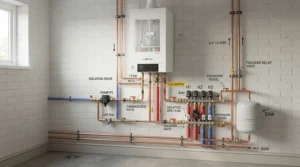
Combi boiler compatibility is simple for electric showers: it’s effectively automatic. The unit heats its own cold mains feed, so your boiler type is irrelevant to whether it works. The boiler’s hot water capacity is also left free for the kitchen tap, which means a simultaneous demand won’t leave you shivering.
The catch is everything else. A combi has no cylinder, so, as Viessmann’s UK guidance explains, you can’t fit a shower pump to boost pressure. The same advice suggests a good combi-fed shower wants a boiler flow of roughly 12–15 litres a minute. That’s a high bar, and it’s one reason an electric shower for combi boiler homes can be the pragmatic choice.
Mains pressure: how to check yours
Mains pressure is the real gatekeeper. Fill a container from a mains-fed tap and time it, as in the buying steps above. Several of the showers here quote minimums of 0.7 to 1 bar, but flow rate matters too. Retailer specifications for some models show minimum flow figures of only a few litres per minute, which is enough to function but not to impress. Test at busy times as well, because shared supplies can dip. If your reading is borderline, choose a model with a low minimum and a pressure indicator.
Electric Shower for Low Pressure: What Works and What Doesn’t
If your mains is weak, an electric shower for low pressure can still deliver. The trick is to shop for low minimum operating pressure and sensible expectations. The Mira Sport Max Airboost (0.7 bar on the 9kW), Mira Azora (0.7 bar), Aqualisa eSense (0.85 bar) and Aqualisa Quartz (0.9 bar) all sit at or below 1 bar. Expert Reviews notes that a higher-wattage unit can add overhead for heat and pressure, and that opinions differ on how effective air-boost tricks really are.
Be realistic about what “works” means. A shower running at 0.7 bar will operate, but flow will be modest. A 9.5kW unit can only heat a fixed volume of water per minute, so in winter you’ll often be limited to a few litres. Airboost-style designs change how the spray feels, not how much water you get.
A warning for tank-fed homes: pumped electric showers like the Mira Elite SE are built for gravity-fed systems only, and Expert Reviews cautions that running one from the mains is more likely to damage it than help. With a combi, you don’t have a tank, so stick with mains-rated units.
Digital Electric Shower: Worth the Premium?
A digital electric shower usually means a display, touch or push-button controls and sometimes pressure feedback, layered over a normal heating element. It is not the same as a digital mixer shower, which blends hot and cold supplies through a digital thermostat. The distinction matters, because mixers draw from your boiler while electric units don’t.
The Triton Amore and Aqualisa eSense show what you actually get: a temperature readout, power modes, and a low-pressure indicator on both. The Mira Azora isn’t marketed as digital, but its tight temperature stability delivers some of the same benefit without a screen. The honest verdict is that digital features improve feedback and styling more than performance. They’re worth paying for if the low-pressure warning solves a real diagnostic problem or the look suits your bathroom. If you only want hot water on demand, analogue dials are cheaper, simpler and have less to go wrong.
Backup Hot Water: The Underrated Case for an Electric Shower
Backup hot water is the quiet superpower here. Combi boilers fail like any appliance, and when yours does you lose heating and hot water together. An electric shower runs on cold mains and its own element, so you can still wash while you wait for the engineer. Hometree makes this point, noting the unit is separate from your hot water system and keeps working if the boiler breaks down.
Homeowner discussions on UK forums repeat the idea. Many suggest keeping an electric unit as insurance even when a combi-fed mixer is the main shower, and the logic holds up. For a one-bathroom home, an electric shower for combi boiler setups is the cheapest resilience upgrade you can buy.
There’s a limit worth stating. If the power or mains water supply fails, an electric shower stops too. It’s backup against boiler faults, not against every outage. For a rented or busy family home, though, the peace of mind is hard to beat.
Electric Shower vs Combi-Fed Mixer Shower: Cost, Comfort and Control
| Shower type | Works with a combi? | Flow feel | Backup if boiler fails? | Best For |
|---|---|---|---|---|
| Electric shower | Yes, uses cold mains | Gentle to moderate, roughly 4–6 L/min at a comfortable temperature (9.5kW) | Yes | Second bathrooms, resilience |
| Combi-fed thermostatic mixer | Yes, if pressure and boiler output suffice | Stronger if the boiler can deliver 12–15 L/min | No | Strong-supply homes |
| Power shower with pump | No | Not applicable to combi | No | Tank-fed systems only |
| Digital mixer (high-pressure/combi) | Yes, special versions exist | Strong | No | Big budgets, often £1,000 or more before fitting |
The table shows the trade-off clearly. Mixers give a more generous spray when your supply and boiler can handle it, but they share the boiler’s fate. Electric units give you independence at the cost of flow. If one bathroom has to cover everything, the electric shower for combi boiler households is the safer bet; if you have two, pairing a mixer with an electric unit is the sweet spot.
On cost, gas is cheaper than electricity per unit, but electric showers use less water, which helps if you’re on a meter. Aqualisa’s own figures suggest roughly 20p–50p per shower, and its analysis says electric is often cheaper for short solo showers while mixers win in larger households. Treat that as a manufacturer’s view, and check Which?’s published running-cost estimates for each model.
Safety, Regulations and Compliance Guide
Electric showers are high-load appliances, so the rules matter. In England and Wales, electrical work in homes must meet Part P of the Building Regulations. Local authority guidance explains that adding a new circuit is notifiable and must be done or certified by a competent person. Bathrooms count as special locations. Industry guidance indicates that replacing an existing shower like-for-like on its existing circuit is generally not notifiable, but confirm with your local authority or electrician. Scotland and Northern Ireland have their own arrangements.
Power rating drives cable and protection. A 9.5kW unit draws roughly 41 amps at 230V, which is why higher-rated models need heavier cable and different fusing. Expert Reviews makes the same point, adding that you shouldn’t swap ratings without an electrician.
Check the maximum operating pressure too. The Mira Sport Max Airboost lists a 5 bar maximum maintained pressure, while the Triton Amore lists 10 bar, which matters on strong supplies. Finally, look for recognised approval marks, such as BEAB and CE on some listings, and register your warranty if required.
Common Mistakes When Buying an Electric Shower for Combi Boiler Homes
Most regrets come from a handful of predictable errors:
- Buying on kilowatts alone. More power means more heating headroom, not more water. Flow still depends on your supply.
- Skipping the pressure test. Ten minutes with a 2-litre bottle prevents weeks of disappointment.
- Ignoring the circuit. Going from 7.5kW to 10.5kW without checking cable and protection is a safety risk.
- Assuming Airboost adds water. It changes how the spray feels, as the Mira Sport Max Airboost shows.
- Paying for digital by default. The Triton Amore and Aqualisa eSense add feedback, not flow.
- Forgetting limescale. Hard water shortens life, so phased shutdown, cold flushes and regular descaling all help.
- Expecting combi-fed performance. Even the best electric shower for combi boiler setups delivers a gentler spray than a well-supplied mixer.
FAQ
❓ What kW electric shower is best for a combi boiler home?
❓ Can I replace my electric shower myself?
❓ How much does a digital electric shower cost?
❓ Will an electric shower still work if my combi breaks?
❓ Does an electric shower for low pressure need a pump?
Conclusion
The best electric shower for combi boiler homes is the one that suits your supply, your circuit and your tolerance for faff. For tight budgets, the Triton T80Z Fast-Fit and Redring Glow deliver sound basics, with the Redring’s three-year warranty adding reassurance. For modest mains pressure, the Mira Sport Max Airboost helps the spray feel stronger, while the Aqualisa eSense tells you when the supply is the problem. If steady temperature matters most, the Aqualisa Quartz and Mira Azora are the calm choices, and the Triton Amore brings the most striking looks and display.
Whatever you choose, test your mains pressure and flow first, check the circuit and set realistic expectations. An electric unit won’t match a strongly fed mixer for flow, but it gives you independence from your boiler, instant heat and the quiet confidence of having backup hot water when the boiler lets you down.
🚿 Ready to stop gambling on lukewarm mornings?
Click any highlighted product name above to check current pricing and availability, and choose the electric shower for combi boiler setups that fits your home. 💧
Recommended for You
- 10.5kW Electric Shower: 7 Best Picks For Winter Power (2026)
- 9.5kW Electric Shower: 7 Powerful Picks For UK Homes (2026)
- 8.5kW Electric Shower: 7 Best Picks For UK Homes (2026)
Disclaimer: This article contains affiliate links. As an Amazon Associate, I earn from qualifying purchases. If you purchase products through these links, we may earn a small commission at no additional cost to you.
✨ Found this helpful? Share it with your friends! 💬🤗
